
India’s nuclear expansion will depend not only on reactor technology and project approvals but also on the industrial capacity to deliver critical equipment on time. As the country moves towards its target of 100 GW of nuclear power capacity by 2047, the nuclear supply chain will face a major test. Manufacturers must meet rising demand while maintaining nuclear-grade quality, traceability and reliability. However, the challenge is not simply to manufacture more equipment. Qualified suppliers, specialised materials, testing facilities and skilled workers must also be available when projects need them.
- 1. Long-Lead Components: Critical Path to Construction
- 2. Specialised Materials and Technologies: Where Dependencies Matter
- 3. Nuclear Supply Chain: Supplier Concentration and Delivery Risks
- 4. Capacity Planning for Fleet-Mode Construction
- 5. Building Robus Capacity and Nuclear Supply Chain Resilience
- Capacity Must Grow with Nuclear Ambition
India already has a strong industrial base in heavy engineering and precision manufacturing. Moreover, capabilities developed for infrastructure, power and other industrial sectors can support nuclear manufacturing, provided companies meet the necessary nuclear quality and technical requirements. The key question, therefore, is how to convert this industrial potential into reliable, scalable nuclear supply capacity.
1. Long-Lead Components: Critical Path to Construction
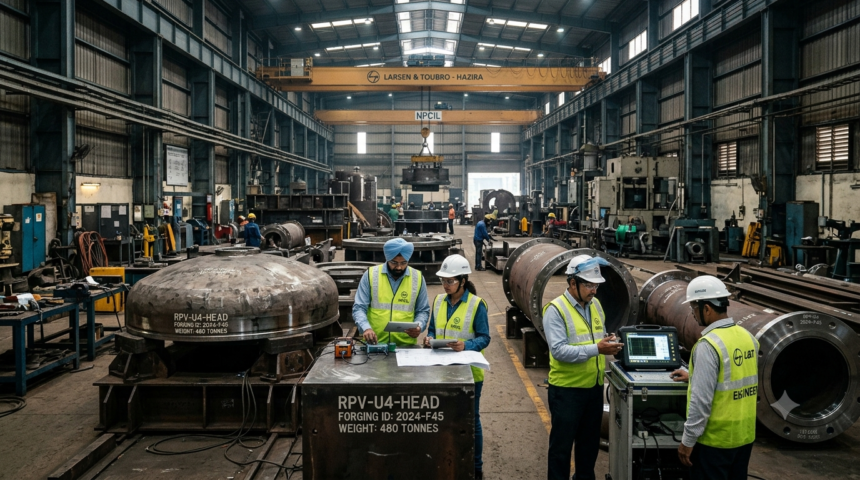
Nuclear power plants require equipment that can take months or years to engineer, manufacture, inspect and qualify. These include reactor pressure-boundary components, steam generators, primary coolant pumps, large forgings, specialised valves and control systems. Such equipment cannot always be sourced from the open market. Manufacturers must meet detailed technical specifications and nuclear quality requirements. Some components also require specialised production facilities, dedicated tooling and extensive testing.
Consequently, a delay in one critical component can affect several project activities. Civil construction may progress, but installation and commissioning can remain dependent on equipment that has not arrived. The risk increases when multiple reactor units enter construction simultaneously. Even if the total manufacturing capacity appears adequate, suppliers may struggle to meet overlapping delivery schedules.
India has already taken steps to address this challenge. In February 2026, the government reported that standardisation of indigenous 700 MWe pressurised heavy water reactors (PHWRs) had enabled bulk procurement of long-manufacturing-cycle equipment, with staggered deliveries helping reduce time and cost. This approach offers an important lesson: long-lead procurement must begin early and be aligned with the project schedule. Reactor design, supplier selection, manufacturing capacity and delivery planning need to progress together.
2. Specialised Materials and Technologies: Where Dependencies Matter
Nuclear manufacturing depends on materials with specific mechanical, chemical and performance properties. These include nuclear-grade steels, nickel-based alloys, specialised forgings, tubes, welding consumables and other qualified materials. Their availability is only one part of the challenge. Manufacturers must also demonstrate that the materials meet the required specifications and can be traced through production and inspection.
The same applies to specialised technologies. Certain instrumentation and control systems, electronic components, advanced manufacturing processes and testing capabilities may involve a limited number of qualified suppliers. Dependence on a single source can create a bottleneck if that supplier faces production problems, export restrictions, logistics disruptions or competing orders from other nuclear projects.
Localisation can reduce these risks, but it requires more than replacing an imported component with a locally manufactured one. Indian companies need access to technical knowledge, suitable production facilities, testing infrastructure and the expertise to meet nuclear requirements. The objective should be to develop domestic capability across the full manufacturing process, including material production, fabrication, inspection and qualification. At the same time, imports may remain necessary for selected technologies and materials. A resilient nuclear supply chain should therefore combine domestic production with carefully managed international sourcing.
3. Nuclear Supply Chain: Supplier Concentration and Delivery Risks
A supply chain can appear strong while remaining vulnerable to the failure of a few critical suppliers. For example, several component manufacturers may depend on the same source for specialised forgings, raw materials or electronic systems. A disruption at that source could affect multiple projects at once.
Transport and logistics create additional risks. Large and heavy nuclear components require suitable handling facilities, route planning and specialised transport arrangements. Delays in approvals, port operations or inland movement can affect delivery schedules even when manufacturing is complete.
Supplier concentration also limits the flexibility of project owners. If only one qualified manufacturer can supply a component, a production delay may leave few immediate alternatives. India needs to widen its qualified supplier base wherever technically and economically feasible. This includes developing second-source manufacturers for critical components and identifying common dependencies across different projects.
The government has outlined several measures to strengthen the domestic supply chain for the ten approved 700 MWe PHWR units. These include bulk orders, vendor-base expansion, indigenous equipment development, support for MSMEs and opportunities for qualified local suppliers. However, adding vendors must not become a numbers-driven exercise. New suppliers need appropriate technical capabilities, quality systems and manufacturing controls. Supplier diversification must strengthen reliability without weakening nuclear-grade standards.
4. Capacity Planning for Fleet-Mode Construction
India’s potential capacity is far more than acknowledged. Heavy engineering capacity that has come up to serve infrastructure projects as well as precision manufacturing eco system can be effectively leveraged through well planned orientation towards nuclear requirements and making it attractive for that supply chain to shift towards investing on Nuclear capability. Some of the initiatives that could make it happen are:
Standardised reactor designs improve manufacturing engineering and planning thus more predictable output and efficiency. Repeat reactor design across several sites means plan production runs that pay for invested tools and dedicated facilities that improve delivery predictability.
Fleet-mode construction can give manufacturers greater visibility of future orders. Greater visibility provides investment theses. Investment in machinery, skilled personnel, testing facilities and production capacity will create highly scalable capacity.
Coopting the Suppliers: India’s nuclear expansion plans include ten indigenous 700 MWe PHWRs approved under the fleet-mode programme. The government has also highlighted the role of domestic manufacturing in supporting the wider 100 GW target. Yet, repeat orders alone will not guarantee timely delivery. Project owners must provide suppliers with realistic schedules and vision of future demand. If several projects require the same equipment at the same time, manufacturers need to understand the combined requirement rather than plan for each contract in isolation.
A coordinated capacity plan should map critical components against project milestones. It should identify manufacturing bottlenecks, supplier utilisation, material availability and testing capacity.
Such plans bring out best practices from several industries such as concurrent engineering, simultaneous engineering, Agile methodologies etc of managing project and programs by identifying commonalities and constraints to produce, and create specilaised lines where applicable.
Nothing improves efficiency like levelling; nothing helps levelling like uniform demand. However, in life uniform demand is a pipedream. Least that can be done is to ensure predictable demand for suppliers. Uncertain order pipelines discourages investment, while sudden increases in demand can stretch existing facilities beyond their practical limits. The solution is to connect reactor construction plans with long-term industrial planning.
5. Building Robus Capacity and Nuclear Supply Chain Resilience
Strengthening India’s nuclear supply chain requires action across several areas. Robust capacity need not create everything within the country as long as it can ensure continuity and best things are produced in best places at best cost. However, it is critical to retain technology within the country to address any geopolitical issue – what is true for technology need not be true for every system where there are multiple independent sources outside of the country.
- Expand critical manufacturing capacity. Investments should focus on components with long production cycles, limited supplier availability or of high strategic importance. This includes suitable forging capacity, specialised fabrication, precision machining and advanced testing facilities.
- Develop more qualified suppliers. Large manufacturers, reactor operators and engineering organisations can work with MSMEs to improve technical capability, documentation, welding, inspection and quality assurance. Supplier development should begin well before a project reaches its procurement peak. Ideally involve supplier from initial design stage and not after tender.
- Secure material availability. Early identification of material requirements and strategic sourcing can reduce the risk of shortages. Where feasible, domestic producers should be supported in developing nuclear-grade materials and consistent production processes. Supplier shouldn’t develop only based on patriotism – for supplier to be patriotic, owner has to be more patriotic in supporting them.
- Improve supply chain visibility. Digital systems can track orders, production milestones, inspection status and dispatch schedules. Early warnings can help project teams respond before a delay affects installation or commissioning.
- Strengthen workforce and testing infrastructure. Expanding manufacturing output requires skilled engineers, welders, inspectors, quality professionals and technicians. Testing and qualification facilities must also keep pace with industrial demand.
- Ensure suppliers are able to self-inspect before supply. Inspection shouldn’t end-up becoming either a bottleneck or an activity that feels like harassment.
Finally, resilience requires contingency planning. Project owners should identify single-source dependencies, assess alternative suppliers and prepare responses to material, manufacturing and these measures should be implemented without compromising nuclear safety, regulatory requirements or product quality.
Capacity Must Grow with Nuclear Ambition
India’s nuclear expansion presents a major opportunity for domestic manufacturers, engineering companies and specialised suppliers. However, the scale of the programme will test the industry’s ability to deliver complex equipment within demanding schedules. The central challenge is to align manufacturing capacity with project demand. Long-lead components must be ordered early. Specialised materials must be secured. Qualified suppliers must have the resources to expand production. And project owners must coordinate procurement across multiple reactor units.
India’s nuclear supply chain will become more resilient when domestic manufacturing, supplier development, standardisation and capacity planning work as parts of a single system. The target is not merely to manufacture more equipment in India. It is to build a supply chain that can deliver nuclear-grade components reliably, repeatedly and at the pace required by the country’s long-term energy ambitions.
- Source
- 1. PIB Strengthening the domestic nuclear supply chain, 19 March 2026
- https://www.pib.gov.in/PressReleasePage.aspx?PRID=2242540®®=48&lang=2
- 2. PIB — Indigenous 700 MW PHWRs and long-lead equipment, 12 February 2026
- https://www.pib.gov.in/PressReleasePage.aspx?PRID=2227081&lang=2®®=48
- 3. PIB — Domestic nuclear power generation and the 100 GW target, 4 February 2026
- https://www.pib.gov.in/PressReleasePage.aspx?PRID=2223250&lang=2®=3
- 4. NPCIL — Fleet Mode Reactors
- https://npcil.nic.in/writereaddata/CMS/202405141100203976607Fleet_Mode_Reactors_english.pdf
- 5. NPCIL — Annual Report 2024–25
- https://www.npcil.nic.in/WriteReadData/userfiles/file/Annual_Report_2024_25_08042026.pdf
- 6. PIB — Nuclear Energy Technology in India, 28 August 2026
- https://www.pib.gov.in/PressReleasePage.aspx?PRID=2304034&lang=1®=3