
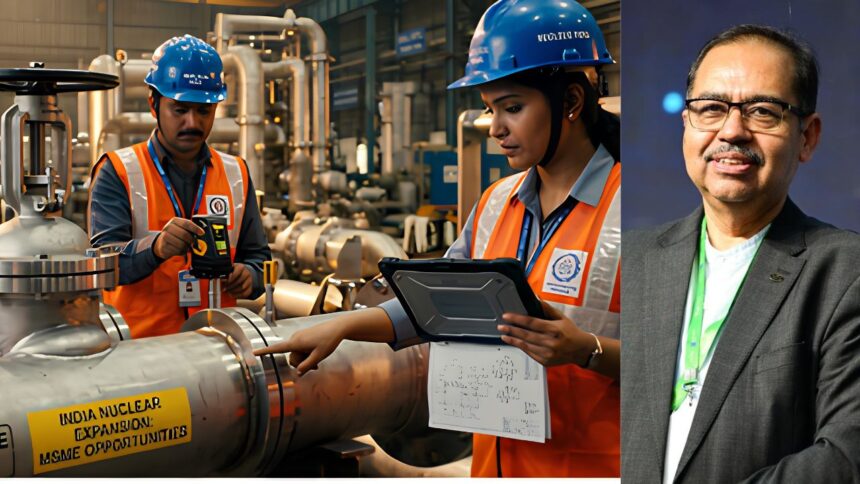
India’s nuclear expansion is opening opportunities for Nuclear Supply Chain especially MSMEs in nuclear-grade piping, valves, heat exchangers, electrical assemblies and engineering services . Mr. Madhukar Sharma, President & Director, ASME India Private Limited, shares his perspective with Nuclear .IN Magazine on localization, supplier qualification and industry collaboration.
- How do you see India’s nuclear supply chain evolving?
- Where are the biggest opportunities for localization and indigenization?
- What are the key challenges facing India’s nuclear suppliers?
- How can large companies and MSMEs/start-ups strengthen the domestic supply chain?
- What is your outlook for Indian industry?
How do you see India’s nuclear supply chain evolving?
India’s nuclear supply chain is entering an important phase. As the act paves the entry of private sector owners / operators the market will expand and so will deeper participation from engineering industries across manufacturing, design, engineering, and systems integration value stream. A key part of this evolution will be creating more pathways for MSMEs to participate in the sector and connect with larger industry opportunities.
Where are the biggest opportunities for localization and indigenization?
There is considerable scope across nuclear-grade piping, valves, Seals & Gaskets , Electrical assemblies , heat exchangers, structural materials, process instrumentation, and modular assemblies. Engineering services, digital technologies, inspection, material traceability, and safety assessment also present opportunities. Many Indian MSMEs (Nuclear Supply Chain) already bring specialized engineering and manufacturing capabilities that can contribute to these areas.
What are the key challenges facing India’s nuclear suppliers?
The foremost challenge at the beginning of the road ahead will be qualified personnel workforce. Nuclear projects have specialized requirements around safety, quality, documentation, certification, and traceability. Access to technical knowledge, training, standards, testing infrastructure, and long-term visibility can make it easier for a wider supplier base to engage with the sector. availability
How can large companies and MSMEs/start-ups strengthen the domestic supply chain?
The way forward is through collaboration. Large companies can provide mentorship, vendor-development opportunities, and greater visibility into future requirements. MSMEs and start-ups bring specialized capabilities, agility, and innovation. Connecting these strengths through shared platforms, technical programmes and industry dialogue can broaden and deepen the domestic supply chain.
What is your outlook for Indian industry?
India has an opportunity to build a more inclusive and globally connected nuclear supply chain that can have ability to fulfill variety of NPP technologies – BSR , AP1000, VVER . For ASME India, workforce development and cultivating & strengthening MSME is an important part of our mission. We are focused on creating connections to technical knowledge, standards, research and skills and wider industry networks so that more Indian enterprises can participate in emerging sectors, including nuclear energy.