
While many international suppliers are still exploring how to enter India’s nuclear market, Everllence is already deeply integrated into its infrastructure. Through a long-standing licensee model and local industrial partnerships, the company has participated in several generations of India’s nuclear programme — from its earliest stations to its most recent projects.
Archita Rajkumari, Nuclear Business Developer at Everllence, confirms that the company’s emergency diesel generator technology is present at Tarapur, Kakrapar Units 3 and 4, Kalpakkam Units 1 and 2, Rawatbhata Units 7 and 8, and Kudankulam Units 1 and 2, with ongoing involvement in Kudankulam Units 5 and 6. That reference list spans multiple reactor generations and represents a level of supply-chain continuity that few international suppliers have achieved in India.
“We have already been working with NPCIL through our licensee. We have a very established ecosystem in India and a working model that has been developed over many years.”
The licensee model is central to Everllence’s approach. Rather than relying on imported equipment, the company combines international technology with local manufacturing, engineering and support capabilities — creating a structure that delivers localisation as an industrial reality rather than a procurement target.
For Everllence, however, localisation does not stop at manufacturing. One of the strongest messages at INEF 2026 was that India’s greatest challenge may not be technology but human capital: building dozens of reactors will require engineers, technicians, operators and maintenance specialists capable of supporting those facilities throughout their operational life.
“We support local people to develop their skills. We have training academies in place and we work with customers and partners to increase technical capabilities.”
Equipment can be purchased. Skills and experience must be developed. For a country seeking to expand its nuclear fleet significantly over the coming decades, investment in qualified personnel may prove just as important as investment in infrastructure. Everllence’s experience demonstrates that successful localisation is not measured by the equipment delivered — but by the capabilities that remain long after it has been installed.
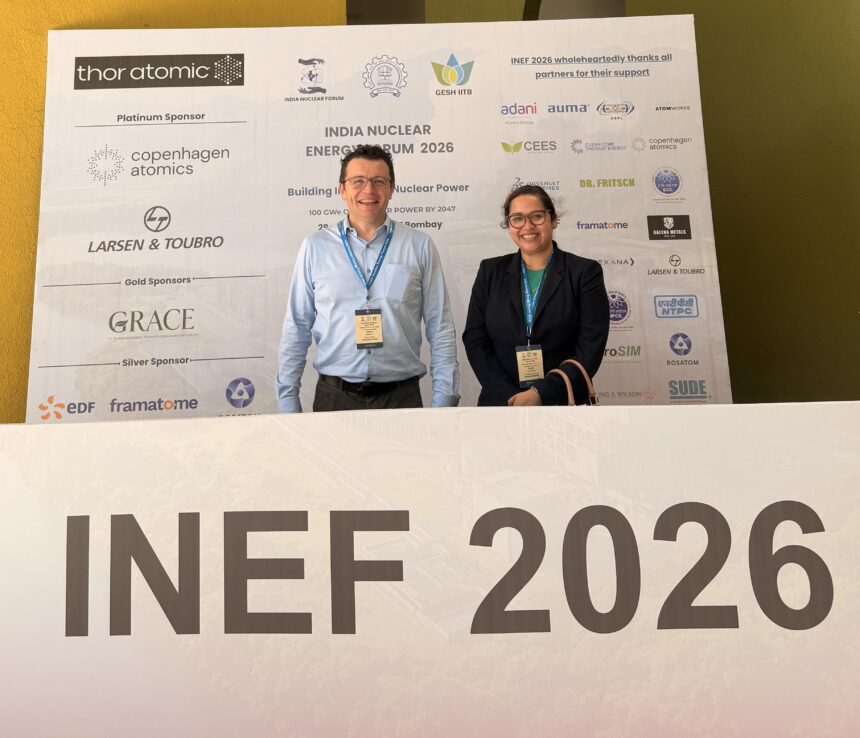
The India Nuclear Energy Forum 2026 took place at IIT Bombay on 29–30 May 2026.