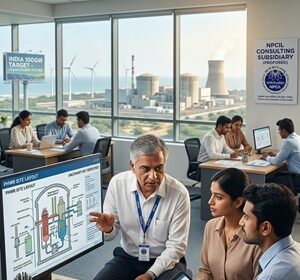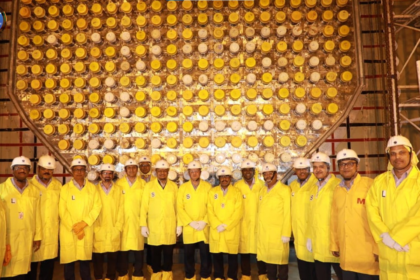

India’s nuclear power programme continues to expand, with 20 Nuclear reactors currently under implementation across the country. According to the Department of Atomic Energy (DAE), 10 Nuclear reactors are under construction while another 10 are in pre-project stages.
The update was provided by Union Minister of State for Atomic Energy, Dr. Jitendra Singh, in a written reply in the Rajya Sabha on July 30.
Projects currently under construction include:
- RAPP-8 at Rawatbhata, Rajasthan (700 MW)
- Kudankulam Units 3 & 4 (2,000 MW)
- Kudankulam Units 5 & 6 (2,000 MW)
- Prototype Fast Breeder Reactor (PFBR) (500 MW)
- Gorakhpur Haryana Anu Vidyut Pariyojana Units 1 & 2 (1,400 MW)
- Kaiga Units 5 & 6 (1,400 MW)
Meanwhile, several new projects are progressing through pre-project activities. These include:
- Gorakhpur Units 3 & 4, Haryana
- Chutka Units 1 & 2, Madhya Pradesh
- Mahi Banswara Units 1 & 2, Rajasthan
- Mahi Banswara Units 3 & 4, Rajasthan
- Fast Breeder Reactors 1 & 2 at Kalpakkam, Tamil Nadu
The DAE also highlighted the economic impact of these projects. During peak construction, each project is expected to employ around 8,000 people. Once operational, a twin-unit station is expected to support about 2,000 direct and indirect jobs.
For the Fast Breeder Reactor programme, around 650 direct jobs and 3,600 indirect jobs are expected to be created.
At the same time, the government reiterated its commitment to nuclear safety. According to the DAE, nuclear power plants undergo multiple levels of safety review and continuous monitoring by the Atomic Energy Regulatory Board (AERB). Nuclear facilities are designed with redundancy, diversity and defence-in-depth safety features to ensure safe operation.
The government also highlighted progress in nuclear medicine. Scientists from the Bhabha Atomic Research Centre (BARC) and Tata Memorial Centre (TMC) have jointly developed 90Y-BhabhaSphere, an indigenous radioisotope-based treatment for liver tumours that cannot be removed through surgery. The product has received regulatory approval and is now being manufactured and supplied in India by the Board of Radiation & Isotope Technology (BRIT).
The latest update reflects the scale of India’s nuclear ambitions. As the country works towards its long-term clean energy and energy security goals, these projects are expected to play a key role in expanding nuclear power generation and supporting the vision of 100 GWe of nuclear power capacity by 2047.