
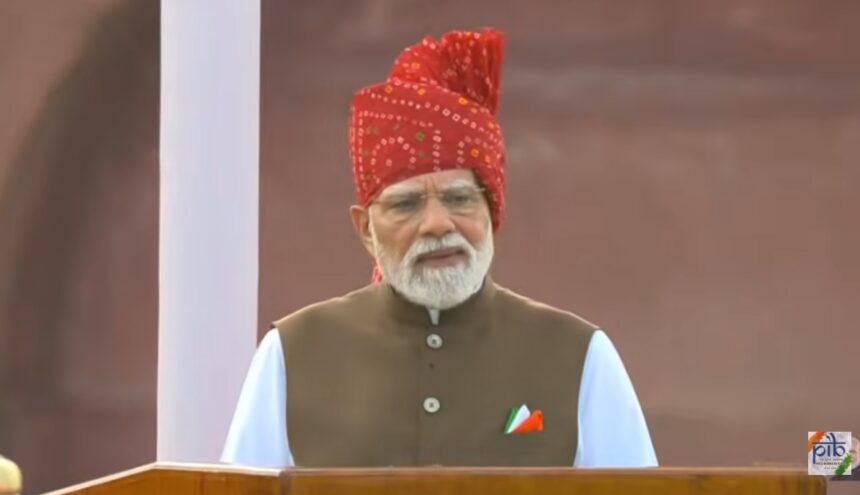
New Delhi, August 15, 2026: Prime Minister Narendra Modi used his Independence Day address from the Red Fort to underline the strategic importance of critical minerals, energy security, and nuclear power (100 GW Nuclear Power Target) in India’s journey towards becoming a developed nation by 2047.
Announcing a major push for resource security, the Prime Minister said India will invest ₹85,000 crore in deep-sea exploration, highlighting the growing importance of seabed resources in meeting future industrial and energy needs. He noted that many countries are increasingly looking to India as a trusted partner in the critical minerals sector.
“We are also engaged in making ourselves self-reliant in critical minerals,” the Prime Minister said, adding that the government has announced a Critical Mineral Corridor to strengthen supply chains and reduce dependence on imports.
The Prime Minister linked the country’s economic ambitions with the need for reliable energy supplies, pointing to the rapid growth of data centres, semiconductor manufacturing, digital infrastructure, and advanced technologies.
“It is impossible to run a modern world without energy,” he said, emphasizing that energy security has become a national priority in an increasingly technology-driven economy.
In a significant reference to the country’s long-term energy strategy, PM Modi reiterated India’s goal of developing 100 GW of nuclear power capacity by 2047. The target forms a key component of the government’s broader vision for achieving energy independence and supporting sustainable economic growth.
The remarks come at a time when India is accelerating investments in nuclear energy, including large-scale reactor projects, indigenous reactor technologies, and Small Modular Reactors (SMRs). The government’s Nuclear Energy Mission and recent policy reforms are aimed at expanding nuclear power’s contribution to the national electricity mix while supporting the country’s net-zero and energy security objectives.
Industry observers note that the Prime Minister’s simultaneous emphasis on critical minerals, deep-sea exploration, and nuclear energy reflects an integrated approach to securing the resources and infrastructure required for India’s next phase of industrial development.
As demand for electricity continues to rise from sectors such as artificial intelligence, data centres, electric mobility, and advanced manufacturing, nuclear energy is expected to play an increasingly important role in providing reliable, low-carbon baseload power for the country’s future.
Key Highlights
- ₹85,000 crore investment announced for deep-sea exploration.
- Focus on self-reliance in critical minerals and strategic supply chains.
- Critical Mineral Corridor to strengthen resource security.
- Energy security identified as a key national priority.
- India reiterates target of 100 GW nuclear power capacity by 2047.
- Nuclear energy positioned as a strategic pillar of India’s long-term growth and energy transition.
For the nuclear industry, the message from the Red Fort was clear: resource security, energy security, and nuclear energy will be central to India’s development roadmap in the decades ahead.