
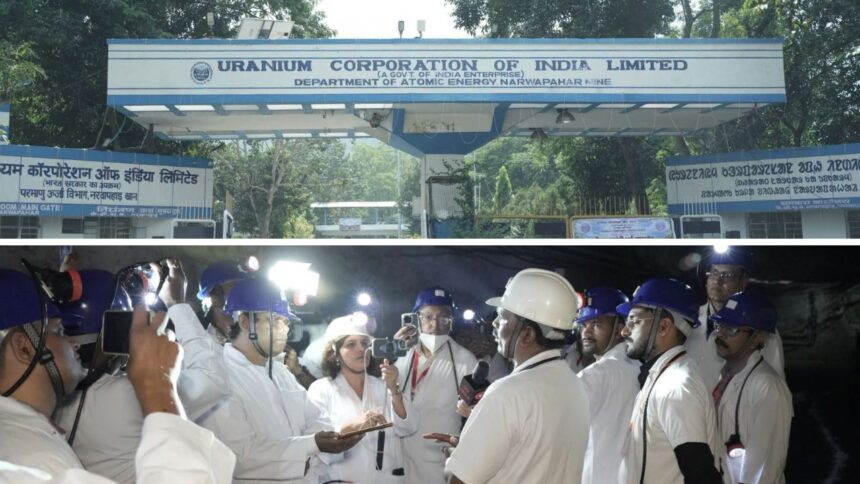
As UCIL marks six decades of uranium mining and processing capability, journalists go beyond the newsroom. And into the operational world of Narwapahar, Jharkhand, getting a first-hand look at the people, technology and processes behind the front end of India’s nuclear fuel cycle.
Nuclear story is often told through reactors, power plants, capacity targets and megawatts. At UCIL’s Narwapahar Mine in Jharkhand, the story begins much deeper underground.
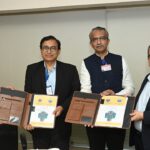
As part of its Diamond Jubilee Year celebrations, the Uranium Corporation of India Limited (UCIL) opened its operations to journalists and media professionals. Taking them beyond the conventional press briefing and into the working environment of uranium mining.
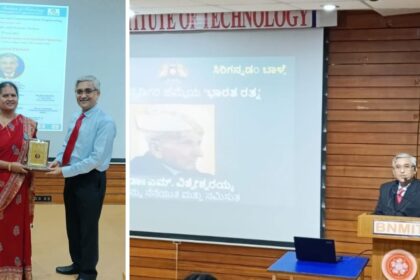
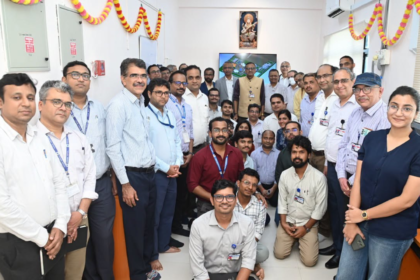
Journalists’ Workshop, organized at the Information Centre, Narwapahar, offered media delegates an opportunity to interact with scientists, engineers and technical experts. And gain a closer understanding of the technologies, systems and people supporting India’s nuclear program.
Beyond the newsroom
For the visiting journalists, the experience was different from reporting nuclear energy through policy announcements, project updates or institutional briefings.
Visit brought them closer to the operational side of the nuclear fuel cycle. Media delegates visited UCIL’s uranium mining and milling facilities, gaining first-hand exposure to mining operations, ore handling and processing systems, along with the technologies and practices used at the operational sites.
Significance of the visit lay not only in going underground, but in seeing the people and systems that make uranium mining possible.
Where the nuclear fuel story begins
Before uranium can become part of the nuclear fuel used in a reactor, it must first be located, mined and processed. That places uranium mining at the front end of the nuclear fuel cycle. UCIL, a public sector enterprise under the Department of Atomic Energy, has been an integral part of India’s indigenous uranium mining and processing capability since its incorporation in 1967.
Over six decades, its activities have evolved across underground and opencast mining, ore processing, technology development, occupational safety, radiation protection and environmental management. The Narwapahar visit provided journalists with a rare opportunity to see part of this chain at close quarters.
People behind the operation
Mining uranium is not simply a story of geology and machinery. It is also a story of people working in technically demanding environments. Engineers, scientists, mine personnel, operators and other technical professionals collectively support the mining and processing operations.
That human element was central to the journalists’ workshop, which brought media professionals into direct interaction with the personnel responsible for UCIL’s operations.
For an industry often discussed in highly technical terms, such first-hand engagement provides another perspective: the nuclear programme is sustained not only by large projects and sophisticated technologies, but also by generations of skilled personnel working behind the scenes.
Six decades of capability
The Narwapahar visit came as UCIL marked its Diamond Jubilee Year, commemorating six decades since its incorporation on 4 October 1967. At the celebrations in Jaduguda, Seema Jain, Member-Finance, Atomic Energy Commission, described the milestone as a recognition of six decades of scientific capability, institutional experience and dedicated service.
She also highlighted the contribution of generations of UCIL personnel who have worked in challenging conditions to sustain India’s uranium mining and processing capabilities.
Dr Ajit Kumar Mohanty, Secretary, Department of Atomic Energy and Chairman, Atomic Energy Commission, also conveyed his greetings and underlined the importance of continued innovation and capability building as India advances its Nuclear Energy Mission.
From the mine to the wider nuclear programme
Importance of uranium mining becomes clearer when viewed within the larger nuclear ecosystem. Mining and processing represent the early stages of a much longer chain that ultimately connects uranium resources with nuclear fuel and, eventually, electricity generation.
Journey involves multiple specialised capabilities—from resource extraction and processing to fuel fabrication, reactor operations, waste management and other supporting technologies. For India, strengthening this indigenous capability is closely linked to the country’s long-term nuclear ambitions.
Opening the nuclear ecosystem to the media
Journalists’ Workshop also points to a broader issue: how the nuclear sector communicates complex technologies to the wider public. Much of nuclear energy remains invisible to the average reader. Mines, fuel-cycle facilities, laboratories, engineering systems and specialized technical operations rarely receive the same visibility as a reactor or a power plant.
By bringing journalists closer to these facilities, UCIL provided an opportunity to see the less visible infrastructure behind India’s nuclear program. DAE Technology Exhibition organised alongside the workshop extended that engagement to school students, showcasing industrial and societal applications emerging from DAE units and institutions.
Looking beyond six decades
UCIL’s Diamond Jubilee is therefore more than an institutional anniversary. It is a moment to look at how India’s uranium mining and processing capability has developed—and how that capability will need to evolve as the country seeks a larger role for nuclear energy.
For the journalists who travelled underground at Narwapahar, the experience offered a different vantage point from which to view India’s nuclear journey. Story did not begin with a reactor. It began deep beneath the ground—with uranium, technology and the people who work to bring them together. Six decades of experience. A continuing commitment to capability. And a nuclear energy program looking towards the future. Uranium leads the way.