
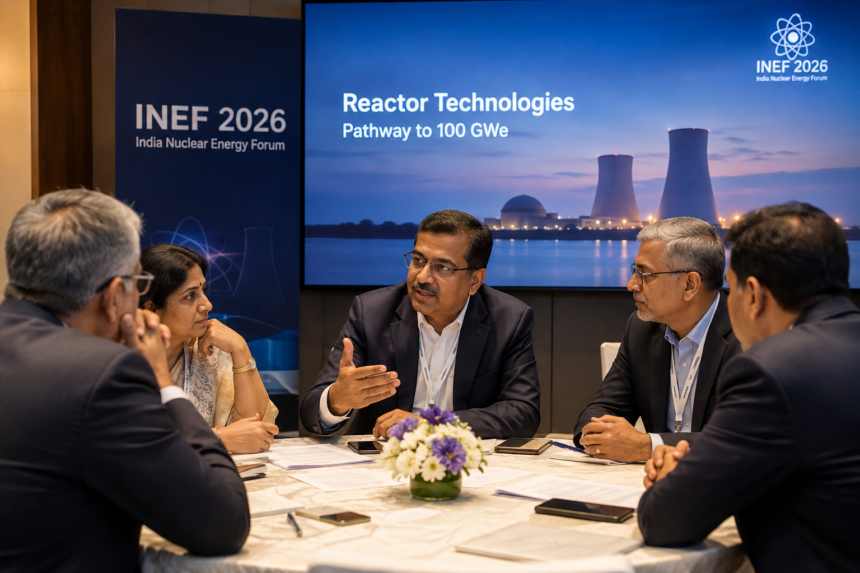
Reactor Technologies will play a key role in India’s plan to reach 100 GWe of nuclear power capacity by 2047. However, industry experts say a clear technology strategy is needed. Without such a strategy, project developers may follow different approaches. As a result, costs can rise and project timelines can increase. Therefore, stakeholders have called for a common framework to support large-scale deployment.
These recommendations emerged during discussions at the India Nuclear Energy Forum (INEF) 2026. During the discussions, participants highlighted the need for clear policies for both existing and emerging reactor technologies. Common Reactor Designs Can Bring Faster Results. At present, many developers are engaging reactor suppliers independently. As a result, technology choices may vary from one project to another. This can increase costs and slow deployment. Therefore, industry stakeholders suggested that the Government identify a limited number of reactor designs for large-scale deployment.
The proposed technology mix could include:
- Indigenous PHWRs
- Large Light Water Reactors (LWRs)
- Small Modular Reactors (SMRs)
- Micro Modular Reactors (MMRs)
A fleet-mode approach can offer several advantages. For example, it can reduce project costs by up to 30 percent. It can also shorten construction schedules by up to 40 percent. In addition, it can improve manufacturing efficiency and strengthen supply chains. As a result, developers can deliver projects faster and at lower cost.
Stakeholders also recommended wider access to India’s proven PHWR technology. Under this approach, qualified public and private sector companies would be able to use approved reactor designs with the required technical support.
Such support could include design documents, engineering assistance, safety practices and operating experience. In addition, vendor qualification processes could be shared with industry. This would help more Indian suppliers participate in future projects. Consequently, the domestic nuclear supply chain would become stronger.
Another important recommendation relates to standard PHWR designs. Currently, each project must complete extensive design reviews. However, many of these designs are already operating successfully. Therefore, industry experts recommended a design approval system for standardised PHWR units.
Under this system, a reactor design would be approved once. Thereafter, future projects would only need reviews related to site-specific conditions. As a result, project approvals could be completed more quickly while maintaining safety standards.At present, many developers are talking to reactor suppliers separately. As a result, technology choices may differ from project to project. This can increase costs and slow down deployment. Therefore, industry stakeholders suggested that the Government identify a small number of reactor designs for large-scale deployment.
- Indigenous PHWRs
- Large Light Water Reactors (LWRs)
- Small Modular Reactors (SMRs)
- Micro Modular Reactors (MMRs)
A fleet-mode approach can deliver major benefits. It can lower project costs by up to 30 percent. It can also reduce construction time by up to 40 percent. In addition, it can help manufacturers, suppliers and project developers work more efficiently.
Experts also recommended easier access to India’s proven PHWR technology. Qualified public and private companies should be able to use approved reactor designs with proper technical support. This support could include design documents, engineering guidance, safety practices and operating experience. At the same time, more Indian suppliers should be trained and qualified to support future projects.
Another important recommendation is a design approval system for standard PHWR units. Once a reactor design is approved, future projects should only need reviews related to the site. This can reduce duplication and speed up project approvals.Industry participants also highlighted the need for a clear framework for advanced reactors. In particular, they focused on Small Modular Reactors (SMRs) and Micro Modular Reactors (MMRs).
At present, there is limited clarity on approvals, licensing, technology transfer and imports. Because of this uncertainty, developers find it difficult to plan investments and partnerships. Therefore, stakeholders called for a dedicated policy framework for these technologies.
The framework should clearly explain how companies can develop, acquire or import SMR and MMR technologies. At the same time, it should define approval and licensing pathways. This would provide greater certainty to investors and project developers.
Experts also recommended detailed studies of reactor technologies available around the world. Such studies would help Indian companies compare different designs. In turn, they could make better technology choices based on safety, cost and suitability.
For imported reactors, industry stakeholders suggested a national Expression of Interest (EoI) process. Through this process, the Government could identify technologies that are safe, commercially viable and suitable for Indian conditions.Industry participants also called for a clear framework for advanced reactors. This includes Small Modular Reactors and Micro Modular Reactors. Today, there is uncertainty about approvals, technology transfer and imports. As a result, developers find it difficult to plan investments and partnerships.
Therefore, stakeholders recommended a dedicated policy for SMRs and MMRs. The framework should explain how companies can develop, acquire or import these technologies. Experts also suggested detailed studies of reactor technologies available around the world. Such studies can help Indian companies compare designs and choose the most suitable options.
For imported reactors, industry recommended a national Expression of Interest (EoI) process. This would help identify technologies that are safe, commercially viable and suitable for Indian conditions. The selection process should also encourage technology transfer and local manufacturing. Consequently, India can build domestic capabilities while expanding nuclear power capacity.
Reactor Technologies
| Area | Concern | Recommendation |
|---|---|---|
| Shortlisting Reactor Designs for Fleet Deployment | New public and private sector operators are engaging reactor suppliers independently. This can lead to fragmented negotiations and different technology choices. | The Government should identify a limited number of reactor technologies through an Expression of Interest (EoI) process. The portfolio may include Indigenous PHWRs, 1,000–1,650 MW LWRs, SMRs and MMRs. A defined share can be assigned to each technology category. This will help developers negotiate with reactor vendors within a national framework. Fleet-mode deployment can reduce project costs by 15–30% and shorten timelines by 30–40%. |
| PHWR Technologies | Private developers have limited access to reactor design information, engineering support and operational experience. Indigenous vendors also need greater support to deliver projects on time. | Create a framework that allows qualified developers to adopt the 220 MW Bharat Small Reactor (BSR) and 700 MW PHWR designs. Provide access to design documents, engineering support, safety practices and operating procedures. Establish engineering support organisations to maintain design integrity throughout plant life. Share vendor qualification processes and approved supplier lists. |
| Design Certification for Standardised PHWR Units | Every project must repeat extensive safety reviews even when the reactor design is already operating commercially. This increases time and cost. | Introduce a Design Certification or Type Approval process for standardised PHWR designs. Once a design is certified, future projects should only undergo site-specific reviews covering factors such as seismic, meteorological, hydrological and demographic conditions. This can significantly accelerate multi-unit deployment. |
| Standardised IPHWR Technology Licensing Framework | Developers need predictable licensing terms to assess project costs and secure financing. The absence of a clear framework creates uncertainty. | Establish a standard licensing framework for IPHWR-700 and IPHWR-220 technologies. Provide non-exclusive access to reactor designs, engineering support and design updates. Introduce a transparent royalty structure, including an upfront technology fee and a capped generation-based royalty. Include strong intellectual property protection and confidentiality provisions. |
| SMR and MMR Technologies | Industry needs clarity on approvals, licensing and import rules for SMRs and MMRs. There is also limited capability to compare global technologies. | Define approval and licensing pathways for SMRs and MMRs. Clarify technology transfer and import regulations. Support development of Indian SMRs and MMRs through dedicated schemes. Conduct comparative studies of global technologies and share findings with industry. For imported technologies, adopt a national EoI process that considers safety, commercial viability, technology transfer and domestic manufacturing potential. |
In addition, the selection process should encourage technology transfer and domestic manufacturing. As a result, Indian companies would gain valuable expertise. Furthermore, local manufacturing capacity could expand. Ultimately, this would support India’s long-term nuclear power programme.
Industry leaders believe that a clear reactor technology strategy will be essential for achieving Mission 100 GWe. With common reactor designs, faster approvals and support for advanced reactors, India can accelerate nuclear power growth. At the same time, it can strengthen domestic industry and improve long-term energy security.
These recommendations emerged from INEF 2026 discussions and represent the collective voice of stakeholders working to advance India’s nuclear energy ambitions.