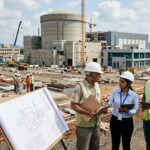


Behind India’s ambitious nuclear energy expansion lies a quietly assembled army of specialists. While national energy policies typically capture headlines with megawatt projections and plant commissioning dates, the actual momentum of the grid relies on roughly 50,000 highly trained scientists, engineers, metallurgists, and heavy-manufacturing personnel (Nuclear Workforce). This human architecture spans both state-run institutions under the Department of Atomic Energy and an expanding ring of private industrial partners.
The largest concentration of this specialized talent still sits at the research and development core. At the Bhabha Atomic Research Centre in Trombay and its satellite facilities, nearly 14,000 professionals drive advanced reactor design, fuel chemistry, and radioisotope production. Down the eastern coast at Kalpakkam, another 2,800 experts at the Indira Gandhi Centre for Atomic Research focus on fast reactor physics and liquid sodium hydraulics. Together, these two institutions account for more than a third of the entire sector’s workforce. They serve as the incubator for every major technical advance in the country’s atomic footprint.
Translating those laboratory breakthroughs into grid capacity is the responsibility of the power generation sector. The Nuclear Power Corporation of India Limited commands a Nuclear workforce of around 11,000 operational engineers, civil construction leads, and safety officers. These teams are spread across active stations from Kudankulam to Rawatbhata. Operating alongside them is Bharatiya Nabhikiya Vidyut Nigam Limited, a lean team of about 1,000 specialists tasked specifically with bringing the Prototype Fast Breeder Reactor into commercial service. Combined, these operational entities make up nearly a quarter of the total workforce. They work at the direct intersection of heavy technology and public power demand.
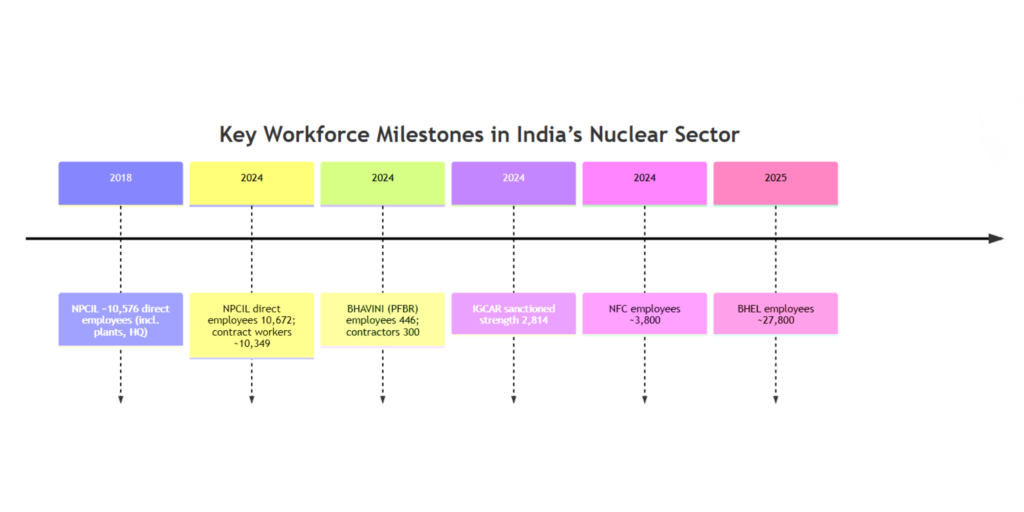
A nuclear sector cannot function without a resilient supply chain behind it, and that back-end infrastructure employs its own massive Nuclear workforce. Upstream, the Uranium Corporation of India Limited deploys over 4,000 personnel across mining and milling sites in Jharkhand and Andhra Pradesh to secure raw fuel. Downstream, the Nuclear Fuel Complex in Hyderabad and Kota uses roughly 4,500 engineers and metallurgists to fabricate delicate zirconium cladding and precision fuel assemblies. Overseeing every single step across both research labs and active power sites is the Atomic Energy Regulatory Board. Here, a compact body of 500 safety reviewers and inspectors holds independent authority over licensing and radiation protection standards.
The remaining quarter of India’s atomic workforce operates outside traditional government gates, embedded within Tier-1 industrial partners that build the heavy hardware. At Larsen & Toubro’s massive engineering facilities in Hazira and Powai, approximately 6,000 personnel are dedicated solely to forging massive reactor pressure vessels and containment structures. Bharat Heavy Electricals Limited maintains another 5,000 power equipment specialists building steam turbines and generators. Meanwhile, Godrej & Boyce employs 1,500 precision engineering experts crafting critical fuel handling equipment. As India shifts from design-heavy prototyping to rapid commercial deployment, the center of gravity within this 50,000-strong ecosystem is steadily migrating toward these industrial shop floors.
Umesh Kumar Shimladka, Managing Editor, Nuclear. IN Magazine
Source – Official DAE/NPCIL publications, parliamentary replies and annual reports were used. Key sources include the Rajya Sabha reply on “Employees in Nuclear Power Plants” (Dec 2024) and organizational reports. Where hard data is unavailable, estimates or acknowledgements of missing data are noted. Additional data drawn from BARC/IGCAR disclosures and published annual reports (e.g. BHEL’s 2024–25 AR).