
BARC Technology Transfer is gaining momentum, with 22 technology-transfer agreements, two incubation agreements and three product launches highlighting India’s growing push to move advanced public R&D towards startups, industry and commercial applications.
The journey from a laboratory breakthrough to a commercially viable product is often as challenging as the research itself. A recent technology-transfer and incubation event involving the Bhabha Atomic Research Center (BARC) points to an expanding effort within India’s Department of Atomic Energy (DAE) ecosystem to bridge that gap.
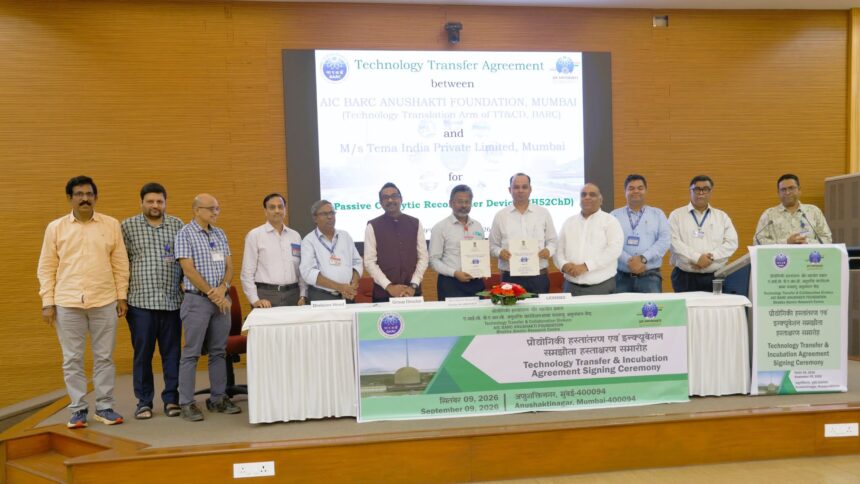
At an event held in Mumbai on September 9, 2026, BARC, in association with AIC ANUSHAKTI, marked the signing of 22 technology-transfer agreements, two incubation agreements and three product launches. Technologies covered areas including healthcare, environment, advanced materials, food and other applications, bringing together established industry players as well as deep-tech startups.
For the industry, the significance goes beyond the agreements signed on the day. It highlights a potentially important business pipeline: government-funded R&D moving through technology transfer and incubation towards industrial adoption and commercialisation.
From research to commercialisation
BARC’s Technology Transfer and Collaboration Division (TT&CD), under its Knowledge Management Group, has a mandate that extends beyond scientific research. BARC identifies technology transfer and incubation as mechanisms for sharing its developed technologies and enabling their wider deployment.
DAE’s technology-transfer programme already has a substantial base. According to DAE, more than 800 licences have been issued to around 600 transferees across the industrial and rural sectors, with many products commercialised. The department has also established Atal Incubation Centres at several DAE units, including BARC, to help translate technologies, expertise and know-how into market-driven products and processes, with a particular focus on startups.
The BARC-AIC model therefore represents more than a conventional licensing arrangement. It creates a route through which a technology developed inside a national research institution can find an entrepreneurial or industrial partner capable of taking it towards deployment.
A wider technology opportunity
One of the notable features of BARC’s technology-transfer portfolio is its breadth. AIC ANUSHAKTI currently facilitates technology transfer of innovations developed by BARC and associated DAE institutions to industry, startups and MSMEs. Its technology portfolio spans areas such as agriculture and bioscience, radiation technology, advanced instrumentation, medical equipment, engineering, environment, chemical technologies and water technology.
This means the commercialisation opportunity emerging from the DAE research ecosystem is not restricted to conventional nuclear applications.
For example, technologies available through the AIC ANUSHAKTI platform include radiation-processing systems, radiation-monitoring equipment, advanced instrumentation, hydrogen-related technologies, medical technologies and food-processing applications.
For Indian companies, this creates a potential source of technologies that may already have significant R&D and validation behind them, reducing the need to develop every underlying technology from scratch.
The startup bridge
The incubation component is particularly relevant to India’s deep-tech ambitions. AIC ANUSHAKTI describes its role as enabling startups and MSMEs to adopt proven technologies and translate them into commercially viable products and services. Its model includes technology identification, expression of interest, technical evaluation, technology-transfer agreements and defined commercial terms.
The importance of this bridge is straightforward: many research technologies fail to reach the market not because the underlying science is inadequate, but because they need product development, engineering, manufacturing capability, investment and market access.
Incubation can help address part of this gap by connecting scientific expertise with entrepreneurial and industrial capabilities. BARC’s recent activities also show that this is becoming an ongoing ecosystem rather than a one-off initiative. The BARC newsletter has highlighted technology incubation, deep-tech startups and technology spin-offs, while AIC ANUSHAKTI has been developing a dedicated technology-commercialisation platform.
What it means for industry
For industry stakeholders, the opportunity is potentially significant. Technology-transfer programmes can open routes for companies to access indigenous technologies in areas such as advanced materials, instrumentation, radiation technology, healthcare, food processing, environmental solutions and other specialised fields.
For startups, the attraction is different. Access to technologies developed within a major national research institution can provide a foundation on which entrepreneurs can build products, business models and new applications.
For established manufacturers and technology companies, the opportunity may lie in scaling, integrating or commercialising technologies that require industrial production capabilities rather than fundamental scientific development.
Challenge, however, is moving from agreement to actual market adoption. Technology transfer is only one step. Product engineering, certification, manufacturing scale-up, financing, customer acceptance and market development will determine whether laboratory innovations ultimately become sustainable businesses.
Building a repeatable lab-to-market pipeline
September 9 event therefore offers a broader lesson for India’s deep-tech ecosystem. Real measure of technology translation will not simply be the number of agreements signed, but how many technologies eventually become products, services, companies and industrial capabilities.
For BARC and the wider DAE ecosystem, the emerging model is increasingly clear: Research – Technology Development – Incubation/Transfer – Industry – Commercialisation – Market Impact.
If that pipeline can be scaled, India’s national laboratories could become not only centres of advanced scientific research, but also important sources of new industrial technologies and deep-tech enterprises.
Latest agreements are therefore best viewed not as the end of a technology-transfer process, but as another step in a larger effort to take Indian science from the laboratory to the marketplace and ultimately to the nation’s enterprise.