
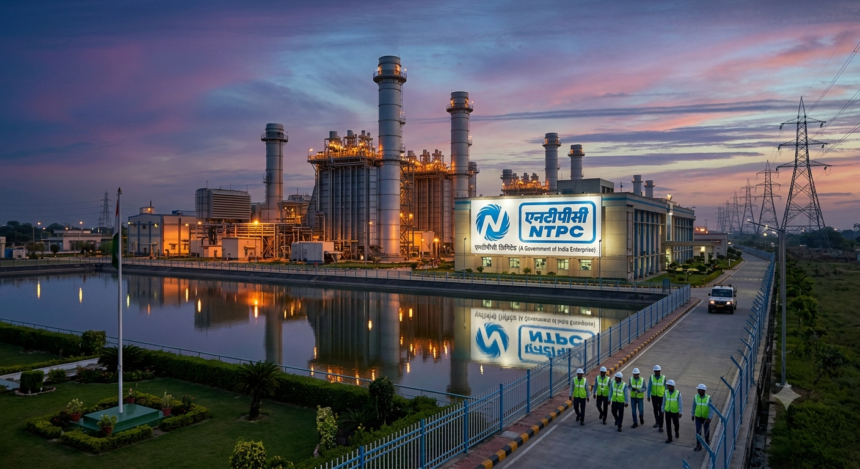
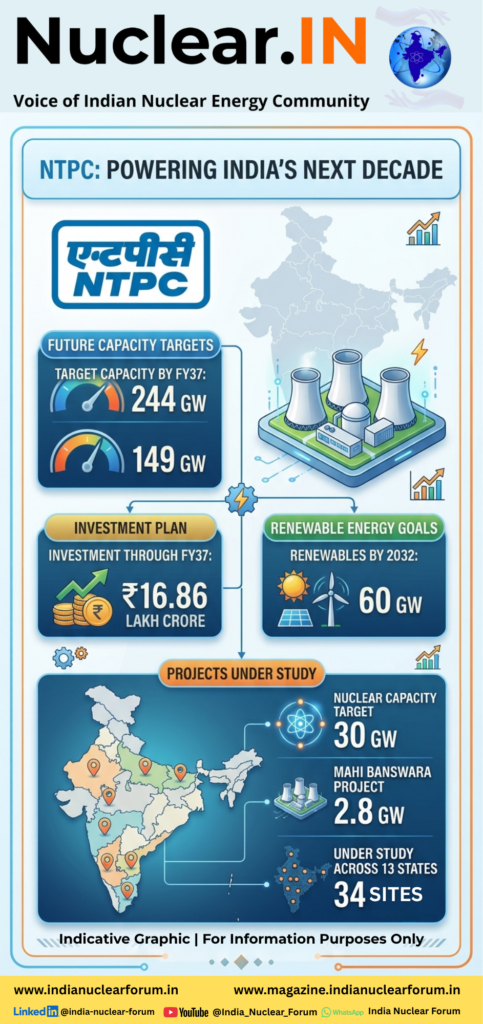
New Delhi, 28 August 2026: NTPC is planning a major expansion of its power generation portfolio, targeting nearly three times its current capacity at 244 GW by FY2037. The expansion includes a significant nuclear power component, with the company aiming to contribute around 30 GW of nuclear capacity (NTPC 30 GW) to India’s long-term nuclear energy programme.
According to The Economic Times report Friday, NTPC Chairman and Managing Director Gurdeep Singh outlined the company’s expansion strategy at its annual general meeting. The company plans to reach 149 GW of generation capacity by 2032, including around 60 GW of renewable energy capacity. Company expects to invest approximately ₹16.86 lakh crore through FY2037 across thermal power, hydro, pumped storage, renewable energy, battery storage, mining and nuclear power.
Nuclear Power Becomes a Strategic Growth Area
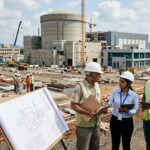
Nuclear energy is emerging as an important part of NTPC’s long-term growth strategy. The company aims to develop around 30 GW of nuclear capacity through its wholly owned subsidiary NTPC Parmanu Urja Nigam and its joint venture Anushakti Vidhyut Nigam with Nuclear Power Corporation of India.
Immediate focus is the 2.8 GW Mahi Banswara nuclear project in Rajasthan. NTPC is also studying and holding discussions for 34 additional sites across 13 states. Sites could potentially support projects based on different nuclear technologies, indicating the scale of NTPC’s emerging nuclear ambitions.
NTPC’s nuclear strategy aligns with India’s broader objective of significantly increasing nuclear generation capacity over the coming decades. The company sees nuclear power as a source of reliable, low-carbon, round-the-clock electricity that can complement the rapid growth of renewable energy.
NTPC 30 GW: Building a Flexible Power System
NTPC’s expansion strategy is not limited to generation capacity. The company is also increasing its focus on energy storage, including battery energy storage systems and pumped storage projects. Growing share of renewable energy will increase the need for flexible power resources. NTPC is therefore exploring long-duration storage technologies, including CO₂ storage and redox-flow batteries, which could reduce dependence on conventional critical minerals.
Company expects its future power system to combine scale, flexibility and reliability. Nuclear power could provide firm generation, while renewable energy and storage would provide flexibility. For India’s nuclear industry, NTPC’s planned 30 GW nuclear portfolio could become a major source of future project opportunities across engineering, manufacturing, construction, technology, supply chains and services.
Proposed expansion also signals a broader shift in India’s power sector, with large utilities preparing to operate across nuclear, renewable, thermal and energy-storage technologies as the country’s electricity demand continues to rise.
Source: Economic Times, August 28, 2026