
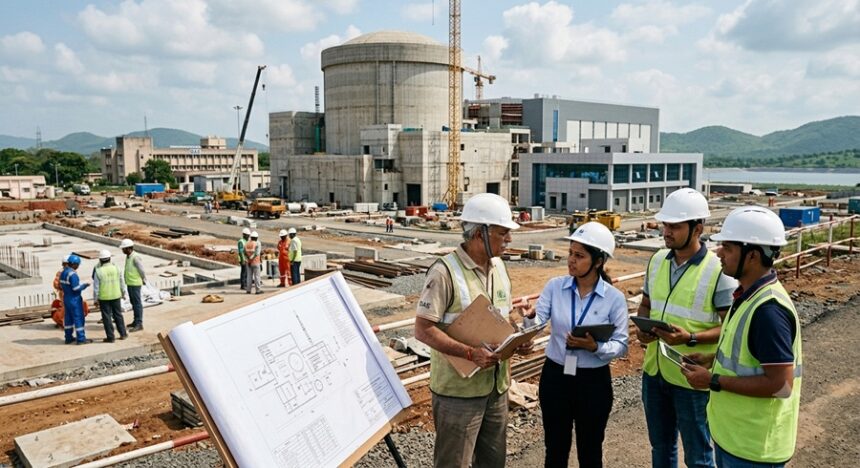
For nearly seven decades, India’s nuclear workforce was built around a very different model. From the establishment of the Department of Atomic Energy (DAE) in 1954 through much of the next 70 years, nuclear development was largely a government-led enterprise. Recruitment, training, research, reactor development, fuel-cycle activities and project execution were concentrated within a relatively small number of public institutions.
That model served India well during the early years of the nuclear programme. It created specialised expertise, protected sensitive technologies and helped the country develop capabilities despite technology restrictions and international isolation. But India of 2025–2047 is a very different country.
Nuclear sector is now being positioned for much larger deployment. New reactor technologies, large-scale manufacturing, nuclear power expansion, clean hydrogen, industrial heat, medical applications and advanced nuclear research are creating demand for skills and organisations beyond the traditional government system.
Result is a significant transition from a public-sector-dominated nuclear ecosystem to a broader multi-player market. This is not simply a change in ownership. It is a change in who recruits, who trains, who supplies, who builds, who operates and who carries nuclear capability into the next generation.
1954–2024: Building the Atomic Institution
India’s nuclear programme was built around a strong central institutional structure. Creation of DAE in 1954 provided the administrative foundation for the country’s atomic energy programme. Over the decades, institutions such as the Bhabha Atomic Research Centre (BARC), Nuclear Power Corporation of India Limited (NPCIL), Indira Gandhi Centre for Atomic Research (IGCAR), Uranium Corporation of India Limited (UCIL), Electronics Corporation of India Limited (ECIL) and others became important pillars of the ecosystem.
Model was relatively straightforward. Government planned. Government institutions researched. Government organisations developed technology. Public-sector companies built and operated facilities. A specialised government-trained workforce carried the programme forward. This created an environment in which nuclear expertise was accumulated over generations. Scientists, engineers, operators, technicians and specialists often entered the system early in their careers and developed highly specialised knowledge through long-term institutional training. That continuity became one of India’s biggest nuclear strengths.
2025–2047: The Multi-Player Market Shift
India’s nuclear expansion plans require something much larger than incremental growth. Country needs more reactors, more manufacturing capacity, more suppliers, more engineering capability and, most importantly, many more skilled people. This is where the new phase of India’s nuclear workforce becomes important. The future workforce cannot come entirely from traditional recruitment pipelines.
A larger nuclear programme will require participation from Government institutions, public-sector companies, joint ventures, private industry, universities, research institutions, technology companies, engineering firms, specialised suppliers. That means the nuclear workforce itself will become more diverse.
A young engineer entering the nuclear sector in the 2030s may no longer have only one obvious career path. He or she could work for a government research institution, a public-sector utility, a nuclear manufacturing company, a private engineering firm, a joint venture, a technology developer, a safety organisation or a specialist supplier. That is the fundamental shift.
JV Factor: A New Route into Nuclear
Joint ventures can become one of the important bridges between India’s traditional nuclear capabilities and the emerging commercial ecosystem. A company such as ASHVINI illustrates the importance of the JV model in India’s changing nuclear landscape. Significance of such structures goes beyond the creation of another corporate entity.
JVs can combine Government or public-sector experience, private-sector capital and management, engineering capabilities, manufacturing capacity, project execution skills, international technology partnerships, new approaches to talent recruitment.
For the workforce, this can create a new employment model. Instead of nuclear careers being concentrated inside traditional government organisations, specialised talent can increasingly find opportunities within corporate and joint-venture structures. This could be particularly important for engineers in mechanical, electrical, civil, electronics, materials, software, automation, project management and manufacturing disciplines.
Real Atomic Transformation
Story of India’s nuclear sector is often told through reactors, capacity targets and technology. But there is another transformation taking place. It is the transformation of people. From 1954 to 2024, India built a highly specialised nuclear workforce inside a largely government-led ecosystem. From 2025 to 2047, the challenge is to take that knowledge into a much wider industrial network. Objective is not to replace the old atomic guard. It is to expand it.
Scientists and engineers who built India’s nuclear foundation will remain critical. But the next generation will add thousands of new professionals from companies, JVs, universities, manufacturers and technology organisations. That is why India’s nuclear workforce may ultimately become one of the most important indicators of whether the country’s 2047 nuclear ambition can move from policy to projects. Next atomic era will not be guarded by one institution. It will be built by an ecosystem.
Umesh Kumar Shimladka, Managing Editor, Nuclear. IN Magazine