
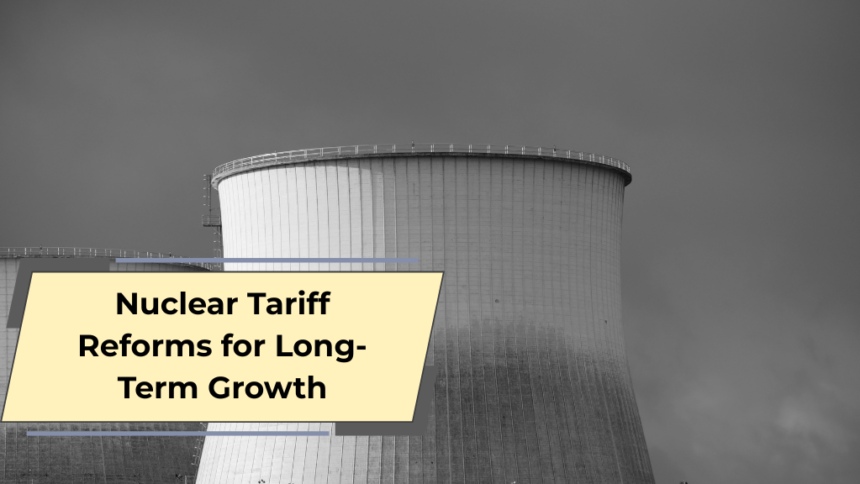
Nuclear Tariff Framework is critical for India’s goal of achieving 100 GWe of nuclear power capacity by 2047. While long-term power offtake is important, the tariff structure is equally important. A balanced framework can improve project bankability, reduce investment risks, and keep electricity affordable.
However, nuclear projects operate for several decades. Therefore, developers face uncertainties related to fuel supply, financing costs, regulatory changes, foreign exchange movements, and future market conditions. Stakeholders noted that a 35-year levelised auction tariff could force developers to include large risk premiums. As a result, electricity costs may increase over time.
Cost-Plus Tariff Model for Nuclear Projects
To address these concerns, stakeholders recommended a dedicated nuclear tariff framework based on cost-plus principles. Under this model, the tariff would include two components. The first is a Capacity Charge covering return on equity, interest, depreciation, and fixed operating costs. The second is an Energy Charge covering fuel, heavy water, variable operating costs, and waste management expenses.
At the same time, stakeholders advised against reverse auctions and levelised tariff bidding for nuclear projects. Instead, they support transparent cost recovery with clear accountability. Cost overruns would remain the responsibility of developers, while savings achieved through efficiency would benefit them.
In addition, stakeholders proposed independent audits for the first few projects to establish reliable cost benchmarks. They also recommended a formal consultation mechanism between DAE and CERC to support tariff regulation and financing decisions.
| Policy Area | Concern | Expectation / Recommendation |
|---|---|---|
| Power Offtake & Tariff Mechanism | Long-term power offtake is essential, but an equally important challenge is allocating risks fairly among developers, lenders, off-takers, and the government. Key concerns include project viability and bankability, fuel supply risks, tariff rationalisation, maintaining competition, and managing foreign exchange and price fluctuations over a 40-year project life. Stakeholders noted that a 35-year levelised auction tariff forces developers to price in significant risks related to capital costs, regulatory changes, and fuel costs. Similar challenges were seen in India’s Ultra Mega Power Projects (UMPPs), which faced stranded assets, tariff renegotiations, and litigation. | Establish dedicated Nuclear Tariff Regulations based on a cost-plus, two-part tariff model adapted from CERC principles. The tariff should include a Capacity Charge covering return on equity, interest, depreciation, and fixed O&M costs, and an Energy Charge covering fuel, heavy water, variable O&M costs, and waste management expenses as pass-through items. Reverse auctions, levelised tariff bidding, and contract-for-difference models should be avoided. Independent auditing of first-of-a-kind projects should be undertaken, with DAE retaining tariff authority through a formal DAE–CERC consultation framework. |
| Three-Part Tariff Framework | Existing tariff structures do not adequately address financing risks, construction-period costs, fuel-price uncertainty, and long-term project bankability. | Adopt a Three-Part Tariff Framework consisting of: (1) Fixed Capital Charge discovered through competitive bidding, with availability-based payments to improve tariff rationalisation, fuel-supply risk mitigation, and project bankability; (2) Interest During Construction (IDC) Charge, recovered during construction through state off-takers or a government-backed fund to avoid interest compounding and reduce future tariffs; and (3) Variable Charge, allowing full pass-through of fuel and heavy water costs to protect projects from fuel-price volatility and geopolitical risks. A government-backed nodal agency should be designated to execute long-term offtake agreements with developers. |
Nuclear Tariff Framework: Three-Part Tariff Structure
Industry participants also proposed a three-part tariff structure to distribute risks more fairly among developers, lenders, and power buyers.
The first element is a Fixed Capital Charge. It would be determined through competitive bidding and linked to plant availability. This would provide predictable revenue and strengthen project bankability.
The second element is an Interest During Construction (IDC) Charge. Stakeholders suggested recovering this cost during the construction period through state off-takers or a government-backed funding mechanism. Consequently, projects can avoid the compounding effect of interest costs and reduce future tariffs.
The third element is a Variable Charge. Under this approach, fuel and heavy water costs would be passed through directly. As a result, projects would be protected from fuel price volatility and geopolitical uncertainties.
Furthermore, stakeholders recommended appointing a government-backed nodal agency to execute long-term power offtake agreements with developers. This would improve investor confidence and provide greater revenue certainty.
Overall, stakeholders believe that a well-designed Nuclear Tariff Framework can attract investment, improve financing conditions, reduce project risks, and support India’s long-term nuclear energy expansion.
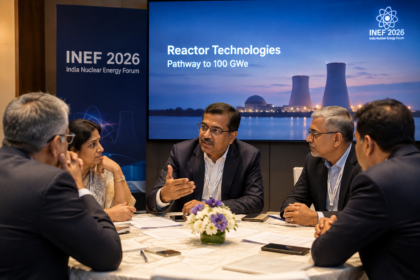
These recommendations capture the concerns, expectations, and policy priorities expressed by stakeholders during INEF 2026 at IIT Bombay.