
India’s plan to achieve 100 GWe of nuclear power capacity by 2047 will require more than technology, funding, and policy reforms. It will also require public trust. Industry stakeholders believe that public perception remains one of the biggest challenges facing nuclear energy development in India. Fear and misunderstanding about nuclear technology continue to influence public opinion and can delay or complicate nuclear power projects. Therefore, building awareness and trust has become an important national priority.
- Public Perceptions Continue to Affect Nuclear Projects
- Need for Large-Scale Awareness Campaigns to Change Public Perceptions
- Dedicated Funding Can Support Public Education
- Community Trust Must Become a Core Principle
- Local Development Can Strengthen Community Support
- Transparency Can Build Long-Term Confidence
- A National Public Information Framework to Address Public Perceptions
Public Perceptions Continue to Affect Nuclear Projects
Many people still associate nuclear energy with safety risks and accidents. As a result, apprehension about nuclear power remains widespread in some communities.
Stakeholders noted that these concerns can create resistance to new projects. Since India currently has a limited number of approved nuclear sites, delays caused by public opposition can affect the pace of nuclear expansion.
Need for Large-Scale Awareness Campaigns to Change Public Perceptions
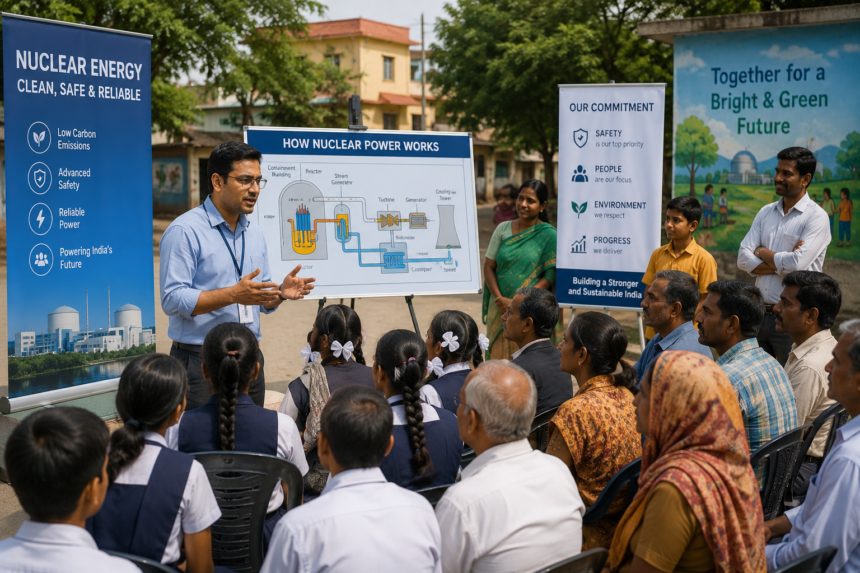
To address these concerns, stakeholders recommended launching nationwide awareness campaigns on nuclear energy. These campaigns should explain the technology, safety systems, environmental benefits, and economic value of nuclear power. Furthermore, they should reach different sections of society, including students, teachers, local communities, and opinion leaders. Schools and colleges should also become part of this effort.
Industry experts suggested using multiple communication channels. These include social media platforms, digital media, workshops, community events, and local-language content to ensure wider outreach.
Dedicated Funding Can Support Public Education
Stakeholders emphasized that awareness programmes require sustained funding.
Therefore, they proposed the creation of a dedicated fund for public education and awareness initiatives. They also suggested that the government establish matching-fund mechanisms to support investments made by private operators in public outreach activities.
Community Trust Must Become a Core Principle
Industry participants believe community trust should not depend on individual project negotiations alone.
Instead, they recommended a structured framework that defines developer responsibilities toward local communities. Such an approach can help create consistency and strengthen public confidence across future nuclear projects.
Local Development Can Strengthen Community Support
Stakeholders proposed dedicated local development programmes around nuclear project sites. These measures include local development funds, community health programmes, and employment opportunities for nearby residents. They also recommended skill-development initiatives to help local people participate in project-related jobs.
According to stakeholders, such programmes can ensure that communities directly benefit from nuclear investments while strengthening long-term social acceptance.
Transparency Can Build Long-Term Confidence
Transparency emerged as a key recommendation during discussions. Stakeholders called for annual public disclosure of environmental, safety, and operational information in simple language. They also recommended independent verification by the Atomic Energy Regulatory Board (AERB) to improve credibility and public confidence.
A National Public Information Framework to Address Public Perceptions
Experts further recommended the creation of a National Transparency and Public Information Framework. Under this approach, nuclear operators would provide clear and accessible information about plant safety, environmental performance, and operations. Information should be presented in language that ordinary citizens can easily understand. Independent verification by AERB would help ensure trust and accountability.
The framework should also establish continuous engagement with host communities and provide factual information about radiation, nuclear safety, and waste management. Stakeholders believe transparency must become a permanent part of India’s nuclear infrastructure rather than an occasional communication exercise.
| Area | Concern | Recommendation |
|---|---|---|
| Public Perception | Fear and apprehension about nuclear energy hinder projects. | Launch nationwide awareness campaigns. |
| Public Awareness | Limited understanding of nuclear technology. | Reach schools, colleges, communities, and opinion leaders. |
| Funding | Lack of resources for public education efforts. | Create dedicated awareness funds and matching grants. |
| Community Trust | Social acceptance varies from project to project. | Establish codified developer obligations. |
| Local Development | Communities seek visible benefits from projects. | Create local development, health, and employment programmes. |
| Transparency | Public access to information remains limited. | Publish annual plain-language safety and environmental reports. |
| Public Information | Lack of trusted information sources. | Establish a National Transparency and Public Information Framework. |
| Community Engagement | Need for continuous dialogue with local communities. | Create standing engagement protocols and awareness initiatives. |
India’s nuclear energy programme will ultimately depend on public confidence as much as engineering excellence. Stakeholders believe that awareness, transparency, community engagement, and local development must become integral parts of future nuclear projects.
The recommendations presented here are drawn from INEF 2026 and capture stakeholder perspectives on licensing, siting, and regulatory frameworks for India’s nuclear expansion.