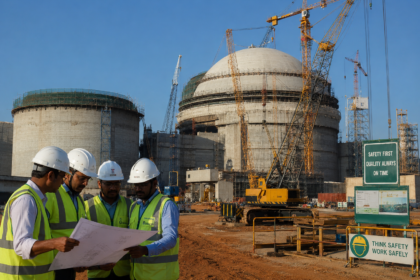


India’s goal of achieving 100 GWe of nuclear power capacity by 2047 will require more than building new reactors. It will also require continuous research and innovation. Therefore, industry stakeholders believe that stronger Nuclear R&D Collaborations are essential for the country’s nuclear future.
- Research Activity Remains Concentrated
- Private Sector Can Bring New Energy to Innovation
- Better Access to Research Facilities Is Needed
- Dedicated Funding Can Support Innovation
- Nuclear R&D Collaborations: Support for Advanced Reactor Technologies
- Thorium Research Should Receive Greater Attention
- A Public–Private Research Framework for Nuclear R&D Collaborations
- Nuclear R&D Collaborations : Tax Incentives Can Encourage Investment
During discussions at the India Nuclear Energy Forum (INEF) 2026, experts highlighted several challenges that currently limit innovation in the sector. They also proposed measures to create a stronger research ecosystem involving gove (Nuclear R&D Collaborations) stitutions, industry, startups, and academia.
Research Activity Remains Concentrated
Today, most nuclear research in India takes place within organisations under the Department of Atomic Energy (DAE).
As a result, research activity outside DAE institutions remains limited. Stakeholders believe this restricts the participation of universities, startups, and private companies. Consequently, the broader nuclear innovation ecosystem has not developed at the desired pace.
Private Sector Can Bring New Energy to Innovation
Industry participants believe private companies can play a larger role in nuclear technology development.
Private-sector participation can introduce new ideas, faster decision-making, and greater flexibility. It can also help speed up technology development and strengthen India’s domestic capabilities. Moreover, stronger industry involvement can reduce dependence on overseas technology providers over the long term.
Better Access to Research Facilities Is Needed
Stakeholders identified limited access to existing nuclear research facilities as a major challenge.
Therefore, they recommended opening DAE research infrastructure to qualified private companies, startups, and academic institutions. Easier access to testing facilities, laboratories, and specialised equipment could help accelerate innovation across the sector.
They also suggested establishing nuclear research reactors at multiple locations across the country. Such facilities could support advanced research, technology validation, workforce development, and industry collaboration.
Dedicated Funding Can Support Innovation
Innovation requires long-term investment. However, many emerging nuclear technologies face challenges in securing funding during early development stages.
To address this issue, stakeholders recommended creating a Small Business Innovation Research (SBIR)-style programme for the nuclear sector. Similar programmes have successfully supported innovation in other technology areas. Such a programme could help startups and small businesses develop new nuclear technologies and move them toward commercial deployment.
Nuclear R&D Collaborations: Support for Advanced Reactor Technologies
India is exploring several advanced reactor technologies to support future energy needs. Therefore, stakeholders recommended active funding programmes for Small Modular Reactors (SMRs), Micro Modular Reactors (MMRs), and other advanced nuclear technologies. They believe such support can help create indigenous capabilities and strengthen India’s position in emerging global nuclear markets.
Thorium Research Should Receive Greater Attention
India possesses significant thorium resources. As a result, stakeholders believe thorium technology should remain a strategic research priority.
They recommended launching dedicated research projects focused on thorium fuel development and related technologies. Greater investment in this area could support long-term energy security and contribute to India’s three-stage nuclear programme.
A Public–Private Research Framework for Nuclear R&D Collaborations
Industry experts also called for a structured Public–Private Nuclear Research Framework. Under this approach, private companies would work alongside government institutions to co-fund research programmes. In return, they would gain structured access to advanced reactor development activities. Potential areas of collaboration include Small Modular Reactors, high-temperature reactors, molten-salt reactor technologies, and thorium-based systems.
Stakeholders believe such a framework can improve knowledge sharing, reduce development timelines, and accelerate technology commercialisation. At the same time, it can help build a stronger domestic nuclear innovation ecosystem.
Nuclear R&D Collaborations : Tax Incentives Can Encourage Investment
To further strengthen research activity, stakeholders proposed tax incentives for nuclear R&D. These incentives could support investments in reactor design, advanced fuels, thorium technologies, and fuel-cycle innovation. As a result, more private companies may be encouraged to invest in long-term nuclear research programmes.
| Area | Key Concerns | Stakeholder Recommendations |
|---|---|---|
| Research Ecosystem | Nuclear R&D activity outside DAE entities remains limited. | Expand participation by industry, startups, and academic institutions. |
| Private Sector Participation | Limited involvement of private companies in nuclear research and innovation. | Create programmes that encourage private-sector R&D and technology development. |
| Access to Facilities | Private organisations face difficulty accessing DAE research facilities. | Provide structured access to DAE laboratories, testing facilities, and research infrastructure. |
| Technology Dependence | Continued dependence on overseas technology providers. | Strengthen indigenous R&D capabilities and domestic technology development. |
| Research Infrastructure | Limited availability of specialised nuclear research facilities. | Establish nuclear research reactors at multiple locations and make them accessible to industry and academia. |
| Innovation Funding | Insufficient support for early-stage nuclear innovation. | Launch a Small Business Innovation Research (SBIR)-style programme for nuclear energy. |
| Startup Development | Nuclear startups face barriers in developing new technologies. | Create dedicated funding programmes for startups and private companies. |
| Advanced Reactors | Need to accelerate development of emerging reactor technologies. | Support R&D for Small Modular Reactors (SMRs) and Micro Modular Reactors (MMRs). |
| Thorium Technology | Need for greater focus on thorium-based technologies. | Launch dedicated research projects for thorium fuel and related technologies. |
| Public–Private Collaboration | Limited mechanisms for joint research between government and industry. | Develop a Public–Private Nuclear Research Framework with co-funded R&D programmes. |
| Advanced Reactor Research | Industry lacks structured participation in next-generation reactor development. | Enable collaboration on SMRs, high-temperature reactors, molten-salt reactors, and thorium systems. |
| Investment Incentives | Limited incentives for private investment in nuclear research. | Introduce tax incentives for nuclear R&D, reactor design, fuel cycle technologies, and thorium research. |
India’s nuclear expansion programme will depend not only on construction projects but also on technological innovation. Therefore, stakeholders believe the country must build a broader and more inclusive research ecosystem. Greater access to research facilities, dedicated funding programmes, stronger public–private partnerships, and expanded thorium research can all contribute to this goal.
If implemented, these measures could help India develop indigenous technologies, strengthen industrial capabilities, and accelerate progress toward the national target of 100 GWe of nuclear power capacity by 2047.