
A clause-by-clause industry consultation on India’s new nuclear licensing framework surfaces a consistent theme: make nuclear power bankable, without diluting safety.
- 1. Make Licensing Match How Projects Actually Get Built
- 2. Fuel Security and a Real Pathway From R&D to Deployment
- 3. Liability, Insurance and the Nuclear Liability Fund
- 5. New Ground: Cybersecurity and Emergency Preparedness
- Beyond SHANTI: What Industry Wants at the Policy Level
- Three-Phase Rollout INF Wants
- A Ten-Point Policy Agenda
- Why It Matters
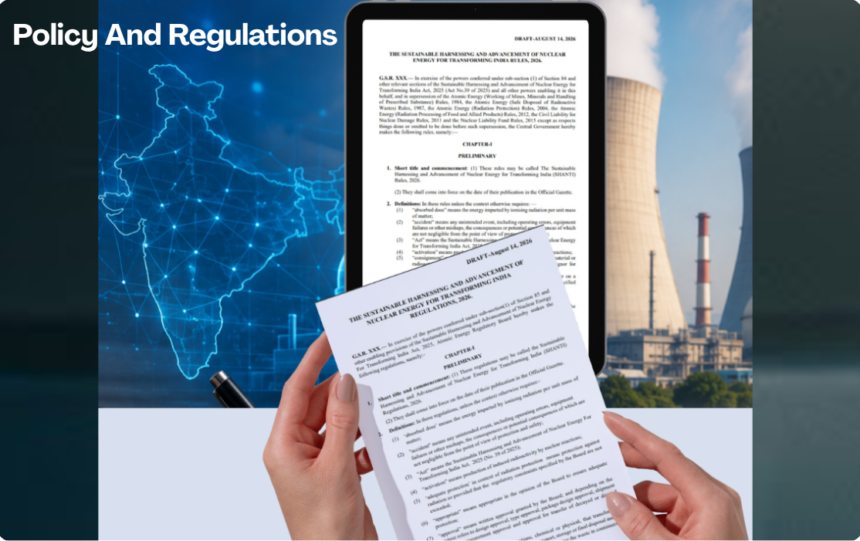
When the Department of Atomic Energy (DAE) released the Draft SHANTI Rules and Draft SHANTI Regulations 2026 the licensing backbone of India’s push toward 100 GWe of nuclear capacity by 2047. India Nuclear Forum (INF) did what industry bodies rarely do at this stage of a regulation. It went through the text clause by clause. Through a stakeholder consultation webinar and follow-up written submissions, INF gathered feedback from developers, EPC contractors, financiers and technology firms, and consolidated it into a single submission to DAE covering close to 120 specific points across the Rules, the Regulations, and wider nuclear policy.
Submission, prepared under the guidance of Dr S Shamasundar, Honorary Director of INF, is unusually granular proposing exact redrafts of individual sub-rules alongside the legal and commercial reasoning for each change. But beneath the drafting detail, a handful of themes recur again and again.
1. Make Licensing Match How Projects Actually Get Built
INF’s single largest cluster of comments concerns Rule 3, the “composite licence” that currently bundles design, construction, ownership, operation and decommissioning into one approval. Industry feedback argues this one-size-fits-all licence works against exactly the kind of staged, private-sector participation the government says it wants to encourage.
- Phased licensing: separate approvals for design, prototype/test-reactor stage, demonstration facility and full commercial deployment — so technology developers and start-ups aren’t forced through a full commercial licence just to build a test unit.
- Decoupling technology certification from site licensing: developers, EPC contractors and operators carry different risks and should be able to seek independent OEM/technology certification separate from the site-specific operator licence.
- Clearer transition rules from “in-principle approval” to a composite licence, including a proposal to grandfather previously approved site and technology elements unless something materially changes — to stop investors paying twice for the same regulatory review.
“Enables technology developers, start-ups and OEMs to progress through development stages without requiring a full commercial licence at the outset” — INF submission on Rule 3(1).
2. Fuel Security and a Real Pathway From R&D to Deployment
On Rule 10, INF asks DAE to spell out a transparent fuel-access mechanism so eligible private operators can get predictable access to uranium, yellowcake and fabricated fuel under India’s existing international agreements — arguing that without this, financiers cannot underwrite fuel-supply risk over a plant’s decades-long life.
On Rule 28, which currently exempts R&D activity from licensing altogether, the Forum wants a defined, graded pathway; from R&D, to design certification, to prototype and demonstration-reactor testing, to full regulatory approval; so that experimental and prototype work isn’t left in a legal grey zone, and so that safety requirements scale with actual risk rather than being all-or-nothing.
3. Liability, Insurance and the Nuclear Liability Fund
Rules 77 and 78 govern insurance and financial protection against nuclear damage, and Rule 108 introduces a fresh operator levy into the Nuclear Liability Fund. INF’s feedback here is pointed: it wants comprehensive insurance arrangements that go beyond the statutory minimum, and it floats an industry-wide nuclear liability insurance pool to spread risk and make coverage more affordable for new, private entrants.
On the Fund itself, INF flags that the 2015 Nuclear Liability Fund Rules capped collection at a target corpus of ₹2,000 crore and paused the levy once that ceiling was reached — protections the Forum says Rule 108 quietly removes, with no stated rationale. Its proposed fix: reinstate a rate band and lifetime cap (or replace it only with a transparent, reasoned formula), and ensure operators aren’t effectively charged twice — once through commercial insurance premiums under Rule 77, and again through an open-ended sovereign levy under Rule 108.
“An uncapped levy throughout operation is not independently stress-testable at investment approval and may collect materially more than the risk or fund requirement.”
4. Tariffs, PPAs and Bankability
Rule 106 leaves tariff determination to future notification; which INF says is precisely the kind of open-endedness that scares off lenders. Its ask is a time-bound tariff framework covering lifecycle-cost recovery, return on capital, indexation, foreign-exchange treatment, and pass-through of fuel, waste and decommissioning costs, alongside a Model Nuclear Power Purchase Agreement that DAE would notify or mandate; mirroring what standardised PPAs have done for renewable energy financing.
5. New Ground: Cybersecurity and Emergency Preparedness
Beyond amending existing clauses, INF proposes two entirely new rules. The first would require every licensee to build a formal cybersecurity management system, run independent annual cybersecurity audits, and report any incident affecting nuclear safety or security within 24 hours — arguing that newer reactor designs, including SMRs, depend far more heavily on digital instrumentation and control than the current fleet, and need a stated standard to design, procure and contract against. The second would prescribe how emergency preparedness is coordinated between operators, local authorities and central agencies.
Beyond SHANTI: What Industry Wants at the Policy Level
A separate section of the submission — nine points labelled M1 through M9 — goes beyond the Rules and Regulations into territory INF says needs action from other ministries and agencies:
- 1. Long-term power offtake mechanisms developed jointly by DAE, the Ministry of Power, CERC and the States, to give nuclear projects predictable demand.
- 2. A dedicated Nuclear Power Purchase Obligation (NPPO), created through electricity law rather than the SHANTI framework alone.
- 3. Recognition that nuclear power may not automatically qualify for renewable-energy classification,
- 4. a case for a distinct clean-firm-power eligibility category based on lifecycle emissions.
- 5. A nuclear-specific depreciation/capital-allowance regime that reflects long construction periods and long operating lives.
- 6. Greater AERB capacity and transparency; published criteria for recognised agencies, review timelines and annual regulatory performance statistics;
- 7. plus a route for AERB to draw on qualified Indian and foreign technical experts, with confidentiality and conflict-of-interest safeguards.
- 8. A three-phase implementation timeline for the Rules and Regulations themselves (see below).
- 9. An inter-ministerial coordination mechanism spanning DAE, AERB, Power, CERC, Finance/Revenue and the States. Because tariff, offtake, taxation and clean-power benefits all fall outside SHANTI’s direct scope.
Three-Phase Rollout INF Wants
INF proposes that DAE sequence implementation so the framework is usable from day one rather than notified all at once:
| Phase | What INF wants issued | Why it matters |
| Phase I — Before Notification | Publish forms, fees, guidance notes and the insurance/financial-security framework | Gives applicants a usable rulebook from day one |
| Phase II — Before Financial Close | Issue a project-specific regulatory plan, tariff pathway, and spent-fuel/decommissioning arrangements | Removes the biggest bankability blockers for lenders and investors |
| Phase III — During Execution | Use coordinated inspections, digital reporting and a single observation register | Cuts duplication and keeps construction schedules on track |
A Ten-Point Policy Agenda
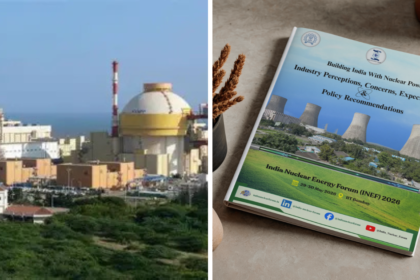
SHANTI feedback sits inside a wider set of policy recommendations INF developed through the India Nuclear Energy Forum (INEF-2026), held at IIT Bombay in May 2026 with over 350 participants from 161 organisations across nine countries. The headline proposals include:
- 1. A Nuclear Energy Development Council (NUDEC) at the policy level, and a National Nuclear Energy Mission Directorate (NUMID) as its executive arm — both with industry representation.
- 2. A single-window, three-stage licensing approach: early engagement, generic design assessment, and site-specific licensing, backed by a national nuclear portal and a National Nuclear Site Bank.
- 3. Long-term consideration of a standalone Nuclear Safety Regulatory Authority (NSRA) through separate legislation.
- 4. Bankability measures: sovereign support via IIFCL/PFC/REC-type institutions, 30-year-plus debt tenors, Viability Gap Funding for first-of-a-kind projects, rupee-bond market access,
- 5. GST on nuclear power aligned with renewables at 5%.
- 6. A phased approach to raising FDI limits in nuclear reactor technology, fuel fabrication and power plants.
- 7. Standardisation around a limited number of reactor designs (PHWR, LWR, SMR/MMR) to enable fleet-mode deployment and cost reduction.
- 8. A nuclear manufacturing mission, PLI-style incentives, vendor qualification programmes and nuclear energy parks to build out the domestic supply chain.
- 9. Coordinated workforce development with UGC, AICTE, HBNI, universities, NPCIL, BARC, IGCAR and industry, plus a nuclear-focused Small Business Innovation & Research programme.
- 10. Local-area development and public-awareness campaigns to build social acceptance around new project sites.
Why It Matters
Taken together, INF’s submission reads less like a wish list and more like a bankability checklist: predictable licensing stages, a capped and transparent liability levy, a real tariff methodology, fuel-supply certainty, and a sequenced rollout so the rules are usable before, not after, developers commit capital. None of it asks DAE to loosen safety oversight — several proposals, like the new cybersecurity rule, would add obligations. The consistent request is regulatory certainty: predictable timelines, capped costs, and a clear line of sight from application to operating licence.
India Nuclear Forum has submitted the full, clause-referenced feedback to DAE for incorporation into the final SHANTI Rules and Regulations.