
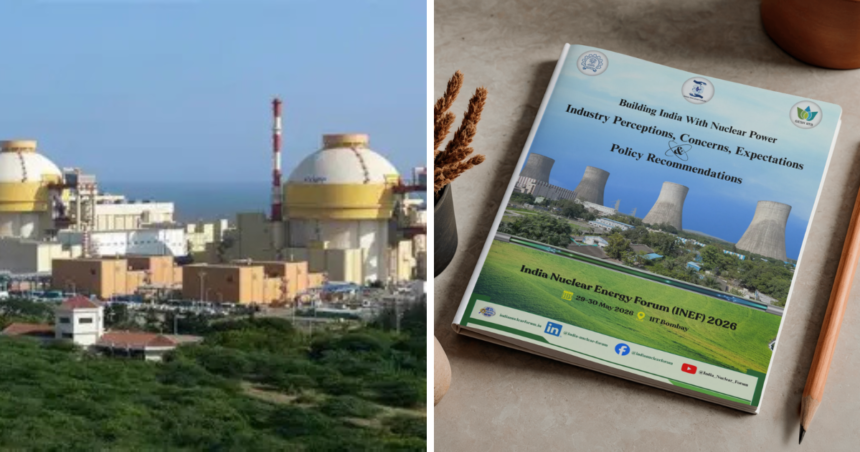
The INEF 2026 Report presents key India Nuclear Policy Recommendations developed through discussions with industry leaders, policymakers, regulators, technology developers, academia, and other stakeholders. The recommendations aim to support India’s goal of achieving 100 GWe of nuclear power capacity by 2047 by creating a business-friendly, investor-friendly, safe, and globally competitive nuclear energy ecosystem.
- Key Areas of India Nuclear Policy Recommendations
- Governance Framework
- 1. India Nuclear Mission
- 2. Licensing Rules, Regulations & Siting
- 3. Policy Interventions to Promote Nuclear Energy
- 4. Economics, Financing & Investments
- 5. Reactor Technologies Framework
- 6. Nuclear Fuel & Heavy Water Security
- 7. Nuclear Supply Chain
- 8. Human Capacity Development
- 9. Collaborative R&D
- 10. Public Perception & Mass Awareness
Key Areas of India Nuclear Policy Recommendations
Governance Framework
- Establish the Nuclear Energy Development Council (NUDEC).
- Create the National Nuclear Energy Mission Directorate (NUMID).
- Develop an inter-ministerial coordination framework.
- Prepare an integrated roadmap for 100 GWe by 2047.
- Standardize project development and financing documents.
1. India Nuclear Mission
Create a mission-driven framework with clear policies, timelines, regulatory reforms, digital clearances, licensing support, and a National Nuclear Site Bank.
2. Licensing Rules, Regulations & Siting
Simplify and modernize licensing processes, standardize reactor designs, enable fleet-mode deployment, and strengthen siting and localization frameworks.
3. Policy Interventions to Promote Nuclear Energy
Introduce green classification, infrastructure status, demand assurance mechanisms, insurance reforms, dispute resolution frameworks, and investment-friendly policies.
4. Economics, Financing & Investments
Improve project bankability through sovereign support mechanisms, long-tenor financing, payment security frameworks, viability gap funding, bond market access, and FDI reforms.
5. Reactor Technologies Framework
Develop technology-specific frameworks for PHWRs, LWRs, SMRs, and MMRs, including fuel assurance, waste management policies, and private-sector participation.
6. Nuclear Fuel & Heavy Water Security
Strengthen fuel-cycle infrastructure, ensure long-term fuel and heavy water availability, and establish policies for spent fuel and waste management.
7. Nuclear Supply Chain
Launch a Nuclear Manufacturing Mission, create PLI schemes, strengthen vendor qualification programs, support MSMEs, promote exports, and enhance localization.
8. Human Capacity Development
Expand academic programs, training centres, operator licensing systems, and industry-academia collaboration to build the workforce required for nuclear expansion.
9. Collaborative R&D
Promote public-private research partnerships, innovation programs, indigenous SMR/MMR development, and advanced nuclear technology commercialization.
10. Public Perception & Mass Awareness
Strengthen public outreach, local community engagement, transparent communication, educational initiatives, and social media campaigns to improve acceptance of nuclear energy.
For INEF 2026- India Nuclear Policy Recommendations Report click here