
The Government of India has outlined an ambitious roadmap to increase the country’s nuclear power capacity to 100 GW by 2047. The plan is part of the Nuclear Energy Mission announced in the Union Budget 2025-26.
The goal is to increase the share of reliable, low-carbon nuclear energy in India’s electricity mix. It will also support the country’s vision of Viksit Bharat and its Net Zero emissions target by 2070.
Two-Pronged Growth Strategy
The roadmap follows two parallel approaches. First, India will expand its fleet of indigenous 700 MWe Pressurised Heavy Water Reactors (PHWRs) and deploy large imported reactors at new sites.
Second, the country will develop and deploy Small Modular Reactors (SMRs). These reactors can be used at retiring thermal power plant sites, industrial facilities and remote locations.
Capacity to Reach 22 GW by 2032
India’s current nuclear power capacity stands at 8.78 GW. According to the roadmap, capacity is expected to grow to around 22 GW by 2031-32 as projects currently under construction are completed.
Beyond 2032, NPCIL plans to add another 32 GW through new PHWR and Light Water Reactor (LWR) projects. This would take NPCIL’s total nuclear power capacity to around 54 GW by 2047.
The remaining 46 GW is expected to come from projects developed by public sector enterprises, private companies and joint ventures under different business models.
Focus on Indigenous Small Modular Reactors
A major feature of the Nuclear Energy Mission is the development of Indian-designed Small Modular Reactors. The government aims to operationalise at least five indigenous SMRs by 2033. To support this effort, BARC is developing:
- BSMR-200 – a 220 MWe Bharat Small Modular Reactor
- SMR-55 – a 55 MWe Small Modular Reactor
- HTGCR – a High Temperature Gas Cooled Reactor with a capacity of up to 5 MWth
The HTGCR can also be linked to hydrogen production systems, creating opportunities beyond electricity generation.
Project Costs and Timeline
The estimated project costs are:
| Reactor | Estimated Cost |
|---|---|
| BSMR-200 (220 MWe) | ₹5,960 crore |
| Twin Unit SMR-55 | ₹7,000 crore |
| HTGCR (up to 5 MWth) | ₹320 crore |
The estimated construction period for these reactors is 60 to 72 months after financial approval.
No Immediate Need for Foreign SMR Technology
The government stated that India already has the expertise needed to develop advanced SMR technologies. Therefore, international collaborations for SMR development are not currently planned. However, India will continue to participate in International Atomic Energy Agency (IAEA) programmes and technical discussions for knowledge sharing.
A Transformational Opportunity
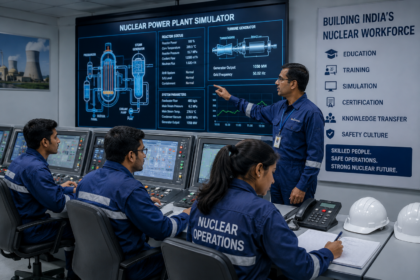
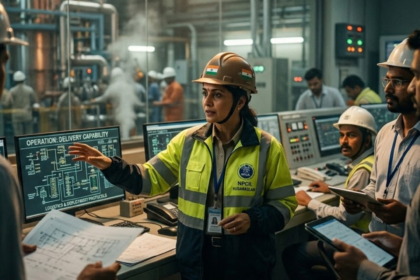
The roadmap represents the most ambitious nuclear expansion plan in India’s history. If achieved, the 100 GW target will create major opportunities in reactor construction, manufacturing, engineering services, fuel supply, technology development and workforce creation.
It also signals a growing role for public sector enterprises, private industry and advanced nuclear technologies in shaping India’s clean energy future.