
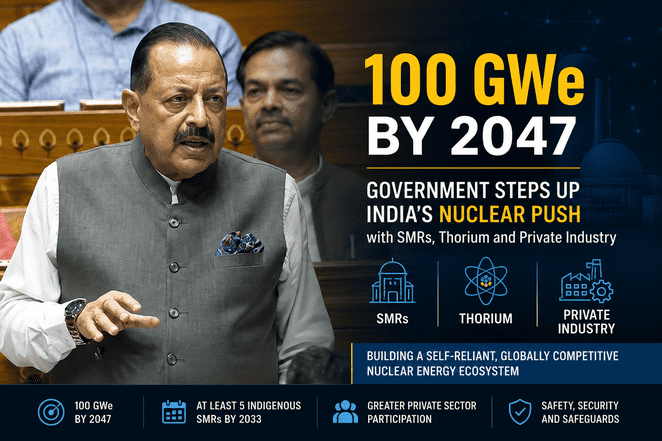
India is stepping up its nuclear energy programme with a clear focus on indigenous technology, Small Modular Reactors (SMRs), domestic manufacturing and greater private-sector participation to achieve 100 GWe by 2047.
- Two-Track Approach to Nuclear Expansion
- Private Industry Moves into the Nuclear Ecosystem
- Domestic Manufacturing Takes Centre Stage
- SMRs Could Create New Nuclear Markets
- Thorium Remains a Long-Term Strategic Priority
- Fast Breeder Technology Supports the Next Stage
- Building a Wider Nuclear Business Ecosystem
- A New Opportunity for Indian Industry
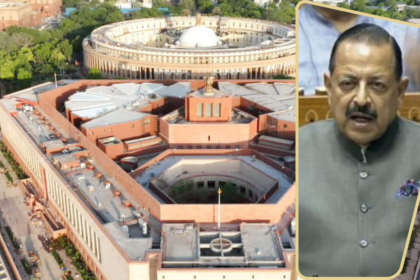
Dr. Jitendra Singh, Minister of State for Personnel, Public Grievances & Pensions and Prime Minister’s Office, outlined the Government’s nuclear roadmap in a written reply in the Lok Sabha on August 12, 2026.
The Government has set an ambitious target of 100 GWe of nuclear power capacity by 2047 (100 GWe by 2047). The Nuclear Energy Mission, announced in the Union Budget 2025-26, provides fresh momentum to this goal. For industry, the roadmap signals a potentially larger market across reactor technology, engineering, manufacturing, construction, supply chains, research and development, and nuclear services.
Two-Track Approach to Nuclear Expansion
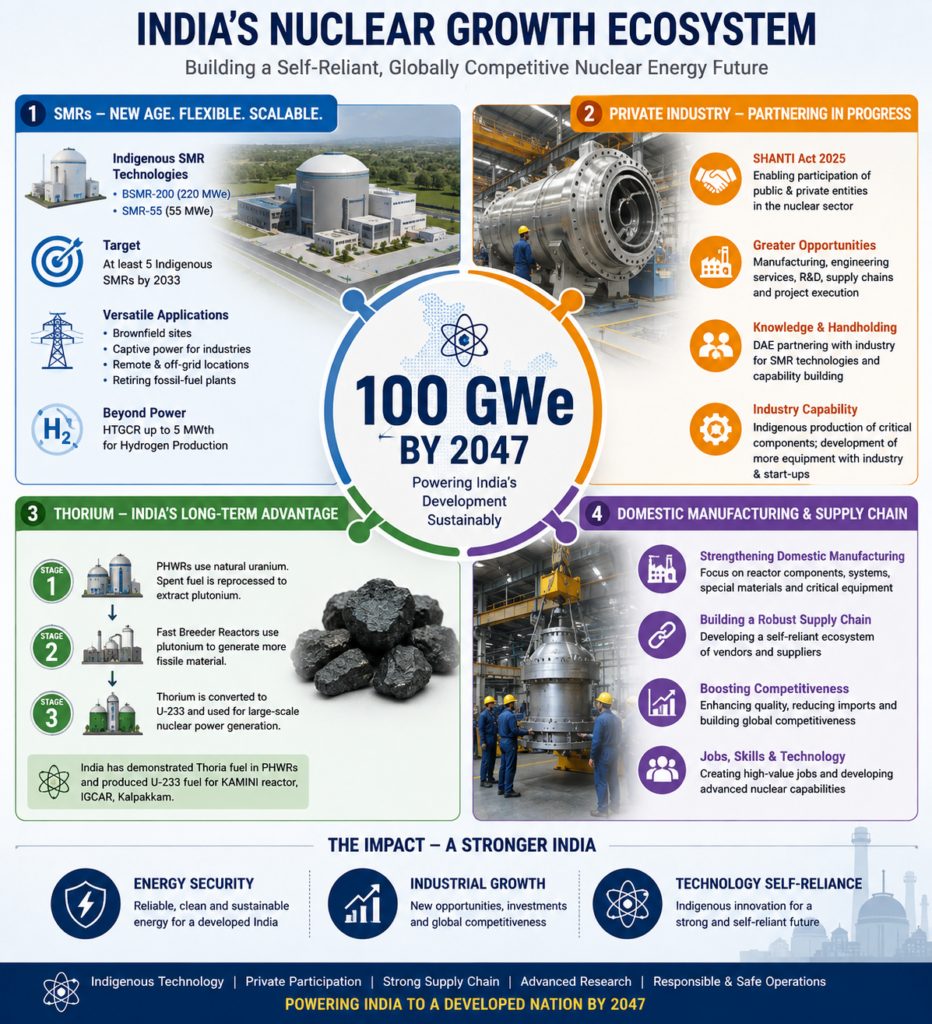
India plans to expand nuclear capacity through two parallel pathways. The first pathway focuses on large reactors. It includes indigenous 700 MWe Pressurised Heavy Water Reactors (PHWRs) and advanced reactor designs for greenfield sites.
The second pathway focuses on Small Modular Reactors. The Government sees SMRs as potential options for brownfield locations, including retiring fossil-fuel power plants. Industries could also use SMRs for captive power, while remote locations could benefit from off-grid applications. This approach could expand the nuclear market beyond conventional large power projects.
The Government has set a target to develop and operationalise at least five indigenous SMRs by 2033. The Bhabha Atomic Research Centre (BARC) is developing several indigenous reactor technologies. These include the 220 MWe Bharat Small Modular Reactor (BSMR-200) and the 55 MWe SMR-55.
BARC is also developing a High Temperature Gas Cooled Reactor of up to 5 MWth. The technology could support hydrogen production when coupled with a suitable thermochemical cycle. These developments could extend the role of nuclear energy beyond electricity generation into industrial applications and hydrogen production.
Private Industry Moves into the Nuclear Ecosystem
Greater private-sector participation represents one of the most important changes in India’s nuclear strategy. The SHANTI Act, 2025 creates a framework for wider participation by public and private entities in the nuclear sector. The reforms open opportunities for private companies in areas such as nuclear manufacturing, engineering services, research and development, and supply chains.
The Department of Atomic Energy is already working with Indian industry on emerging SMR technologies. It is providing knowledge-sharing and technical handholding to support industry participation.
At the same time, the Government is developing domestic nuclear vendors and strengthening the private-sector R&D ecosystem. Indian industry has already produced some critical nuclear components. These include low-alloy steel forgings for reactor pressure vessels and reactivity control drive mechanisms.
The Government has also started work with domestic companies and start-ups to develop other critical equipment. The direction is therefore clear. India wants to build not only more nuclear power plants, but also a stronger industrial base around them.
Domestic Manufacturing Takes Centre Stage
India’s 100 GWe ambition will require a much larger nuclear supply chain. he Government wants domestic companies to play a greater role in producing specialised equipment, components and systems for nuclear projects.
Opportunities could emerge across reactor manufacturing, engineering, construction, specialised materials, instrumentation, control systems and other nuclear-grade equipment. A stronger domestic supply chain can also reduce dependence on external sources. At the same time, it can help Indian companies develop capabilities for the global nuclear market.
For suppliers and engineering companies, the opportunity could therefore extend beyond individual reactor projects.
SMRs Could Create New Nuclear Markets
The Government’s focus on SMRs could change where and how India deploys nuclear power. Traditional large reactors generally require dedicated greenfield sites and significant infrastructure. SMRs could offer additional deployment options.
The Government is considering applications at brownfield power locations, captive industrial facilities and remote areas. Energy-intensive industries could potentially use SMRs to meet reliable power requirements. Remote locations could also explore nuclear power for applications where conventional grid infrastructure remains difficult to develop.
This model could create new opportunities for utilities, industrial companies, technology developers, engineering firms and equipment manufacturers.
However, technology alone will not determine the success of the SMR programme. Financing, licensing, site selection, manufacturing capacity, supply-chain readiness and project economics will all influence commercial deployment.
Thorium Remains a Long-Term Strategic Priority
Alongside SMRs and private-sector participation, India continues to pursue its Three-Stage Nuclear Power Programme. The programme aims to make greater use of India’s thorium resources while supporting long-term energy security. The programme follows a closed fuel cycle.
In the first stage, PHWRs use natural uranium as fuel. India then reprocesses the spent fuel to recover plutonium. In the second stage, Fast Breeder Reactors use plutonium to produce additional fissile material. The third stage aims to support large-scale thorium utilisation through uranium-233 produced from thorium.
Thorium itself is a fertile material. A reactor must first convert it into fissile uranium-233 before the material can support energy generation. India has already developed significant R&D capabilities in thorium utilisation.
Researchers have used Thorium Oxide, or thoria, pellets in the initial cores of operating PHWRs. BARC research reactors have also irradiated thoria-based fuels. Indian scientists subsequently reprocessed the irradiated thoria pins to recover uranium-233. They then fabricated the uranium-233 into fuel for the KAMINI reactor at IGCAR, Kalpakkam. This experience provides an important foundation for India’s long-term thorium strategy.
Fast Breeder Technology Supports the Next Stage
The second stage of the nuclear programme continues to receive significant attention. The Indira Gandhi Centre for Atomic Research (IGCAR) is pursuing research and advanced engineering development related to Sodium Cooled Fast Breeder Reactors.
The centre is also working on associated closed fuel-cycle facilities. Fast breeder technology remains important to India’s long-term strategy because the country needs adequate breeder capacity before it can move towards large-scale thorium utilisation.
Building a Wider Nuclear Business Ecosystem
The Government’s nuclear roadmap extends beyond electricity generation. India is strengthening capabilities across reactor design, manufacturing, construction and the nuclear fuel cycle.
The Government is also expanding indigenous nuclear medicine infrastructure. An Isotope Production Reactor (IPR) could help increase domestic production of medical isotopes. This wider approach could connect nuclear technology with several sectors, including electricity, industrial applications, hydrogen and healthcare.
A New Opportunity for Indian Industry
India’s nuclear strategy is entering a new phase. The 100 GWe target provides the long-term demand signal. The SMR programme creates a new technology pathway. The SHANTI Act opens the door to wider private participation. Domestic manufacturing can strengthen the supply base, while the three-stage programme keeps thorium at the centre of India’s long-term nuclear strategy.
For Indian businesses, the opportunity goes beyond supplying individual components. A larger nuclear programme can create demand for manufacturing, engineering, construction, technology, R&D, project services and specialised supply chains. Indian companies could also develop capabilities that allow them to participate in the emerging global nuclear market.
However, the industry must convert policy intent into commercially viable projects, competitive technologies and reliable supply chains. The Government’s roadmap therefore represents more than an expansion of nuclear generating capacity. It signals an effort to build a larger Indian nuclear industry — one that combines indigenous technology, domestic manufacturing, private-sector participation and long-term energy security.
As India moves towards 100 GWe by 2047, the nuclear sector could become an increasingly important market for technology companies, manufacturers, engineering firms, suppliers, investors and research institutions.