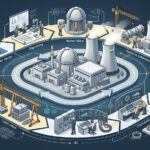

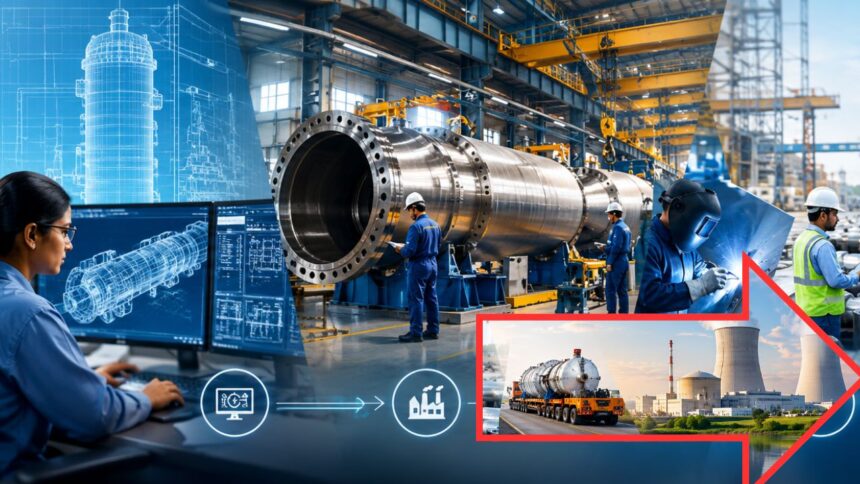
India’s nuclear expansion will not be built inside reactor sites alone. It will be built across thousands of factories, engineering offices, fabrication yards, laboratories and construction sites that form the country’s nuclear supply chain.
India is targeting 100 GWe of nuclear power capacity by 2047. Reaching that ambition will require more than reactor projects. It will require an industrial ecosystem capable of designing, manufacturing, qualifying, inspecting, constructing and maintaining nuclear facilities at a much larger scale.
India has already spent decades building that foundation. Indigenous PHWR programme has created capabilities in reactor engineering, heavy manufacturing, nuclear equipment, fuel fabrication, construction and plant operation. Large public-sector organisations and private engineering companies have become part of that ecosystem. But the next phase presents a different test.
India now has to move from a proven nuclear industrial base to a much deeper and more scalable one. That is where the supply chain becomes central to the 100 GWe story.
1. A Supply Chain Built Over Decades
Before asking what needs to change, it is important to understand what India already has. India’s nuclear industrial capability did not emerge with the current 100 GWe ambition. It has developed progressively alongside the country’s three-stage nuclear programme and the expansion of its PHWR fleet.
Result is a domestic ecosystem covering reactor design, nuclear engineering, heavy equipment manufacturing, fuel-cycle activities, construction and plant operation. NPCIL currently operates 24 reactors with an installed capacity of 8,780 MW. Its ongoing program includes indigenous 700 MWe PHWRs as well as Russian-designed LWRs at Kudankulam.
700 MWe program is particularly significant because it moves the industry towards standardisation and repeat manufacturing. That creates a very different industrial proposition from building a small number of individually configured projects. The foundation exists. The question is how far it can be extended.
2. Who Actually Builds a Nuclear Power Plant?
The answer is many companies, performing very different roles. A nuclear plant begins with reactor design and engineering. It then moves through nuclear-island equipment, turbine-island equipment, electrical and instrumentation systems, civil construction, installation, testing and commissioning.
Behind the prime contractors is another layer of suppliers providing materials, forgings, tubes, valves, pumps, cables, instrumentation, software, welding, inspection and specialised services.
Reactor design and engineering
This includes: reactor design, safety analysis, nuclear engineering, plant engineering, civil and structural design, electrical engineering, instrumentation and control, digital engineering etc. India’s PHWR program provides a strong indigenous base in this area, while international cooperation brings other reactor technologies into the country.
Nuclear island
The nuclear island includes some of the most highly controlled equipment in the plant: reactor components, steam generators, primary heat transport systems, reactor headers, pumps, heat exchangers, nuclear-grade valves, piping, fuel-handling systems, safety-related equipment etc.
Indian companies including L&T and BHEL have long supplied major equipment to the nuclear programme.
Turbine island and balance of plant
Other systems draw heavily on India’s broader engineering industry: turbines, generators, condensers, feedwater systems, pumps, cooling systems, transformers, switchgear, HVAC, water-treatment systems etc. But nuclear applications bring additional requirements for qualification, documentation and traceability.
Construction and commissioning
At the project site, the chain comes together through civil construction, equipment erection, welding, piping, electrical installation, testing and commissioning. The reactor may be the headline. The supply chain is what physically delivers it.
3. The Industry Is Opening Up
For decades, India’s nuclear electricity programme was largely government-led. That structure is changing. SHANTI Act, 2025 provides a framework for wider private-sector participation in nuclear activities, subject to licensing and regulatory requirements. This does not simply create the possibility of more reactor operators. It potentially widens the industrial ecosystem.
Private companies can have roles across: engineering, equipment manufacturing, construction, technology, digital systems, maintenance, specialised services, R&D etc. The government’s roadmap also envisages substantial capacity additions through entities beyond NPCIL, including other public-sector organisations, state governments, private companies and joint ventures.
The customer base for the nuclear supply chain could therefore become broader than it has been historically. That brings us to the next question: Does India have enough industrial depth to serve it?
4. Where India Has the Advantage
India’s strongest position is in capabilities developed through sustained domestic nuclear programmes. These include: PHWR technology, reactor engineering, heavy engineering, nuclear equipment manufacturing, steam-generator manufacturing, fuel fabrication, heavy-water production, nuclear construction, reactor operation and nuclear R&D etc.
The 700 MWe PHWR programme provides an important test of this capability. Recent manufacturing achievements, including faster production of steam-generator tubes by NFC, show how repeated orders can improve manufacturing cycles. The significance goes beyond one component.
Repeat manufacturing allows suppliers to learn, standardise processes and improve productivity while maintaining nuclear-quality requirements. That is one of the key industrial advantages of fleet-mode construction.
5. Where India Still Looks to the World
Greater localisation does not mean complete independence from global suppliers. The nuclear fuel cycle remains internationally connected. India continues to source uranium internationally for safeguarded reactors. Long-term arrangements with overseas suppliers are part of maintaining fuel security. Technology is another area where international cooperation remains relevant.
Kudankulam’s Russian-designed reactors are one example. Other large-reactor projects have also involved international technology partnerships. This creates a more nuanced picture of localisation. India’s future nuclear industry is unlikely to be completely domestic or completely international. It will increasingly combine: Indian manufacturing, Indian engineering, international technology and specialised inputs where required.
The strategic question is therefore not whether India imports. It is which capabilities India should build domestically, and where international partnerships make greater sense.
6. The Real Gap May Be Further Down the Chain
The most visible nuclear suppliers are not the entire supply chain. A reactor depends on a much larger network of Tier-2 and Tier-3 suppliers. These include companies producing: specialised machined components, valves, tubes, cables, instrumentation, welding systems, speciality materials, pumps, electrical equipment, software, testing services, NDT services, inspection services etc.
This is where MSMEs can become important. But becoming a nuclear supplier is not simply a matter of having manufacturing capacity. Companies need appropriate quality systems, documentation, traceability, inspection capability and, where applicable, nuclear-specific qualification and certification. That creates both a barrier and an opportunity.
The next generation of Indian nuclear suppliers will have to earn their place in the qualified vendor ecosystem.
7. Nuclear Is Not Conventional Power
A company that supplies equipment to a thermal power plant does not automatically become a nuclear supplier. The engineering principles may overlap. Quality culture does not. Nuclear procurement places exceptional importance on: quality assurance, traceability, qualification, documentation, inspection, testing, configuration control, long-term reliability.
The consequence is important for India’s industrial expansion. The country does not simply need more manufacturing capacity. It needs manufacturing capacity that can operate within a nuclear-quality framework. That is why vendor development may become as important as factory expansion.
8. The Workforce Behind the Hardware
There is another constraint that cannot be solved by adding factories. People. A larger nuclear programme will require engineers, designers, project managers, welders, inspectors, quality professionals, commissioning specialists, safety personnel, technicians and maintenance teams.
The challenge becomes sharper when several projects move simultaneously. A shortage of qualified personnel can delay a project just as effectively as a shortage of equipment. For India, therefore, the nuclear workforce has to grow alongside the manufacturing ecosystem. The capacity pipeline and the talent pipeline have to move together.
9. The 100 GWe Test
Now the original question comes back into focus. India is moving from a relatively limited number of nuclear projects to a much larger program. The country has: an established indigenous technology base, a growing manufacturing ecosystem, experience with large nuclear projects, a developing private-sector role, a substantial engineering industry, international technology and fuel partnerships.
But the next phase will demand more. It will require: repeat manufacturing, a wider qualified vendor base, stronger Tier-2 and Tier-3 participation, skilled manpower, inspection capacity and long-term visibility of projects.
The 100 GWe ambition therefore changes the supply-chain equation. The issue is no longer simply whether a component can be manufactured in India. It is whether it can be manufactured repeatedly, to nuclear standards, in the required quantities and within the project schedule.
Next Challenge
India has already built a nuclear supply chain. The next challenge is to industrialise it at scale. The 100 GWe ambition will put India’s manufacturers, engineering companies, MSMEs, construction firms, inspection agencies and technology providers under a new level of demand.
Some capabilities are already mature. Others will need investment, qualification and technology partnerships. The emerging nuclear industry will therefore be neither the tightly controlled ecosystem of the past nor a conventional power-sector supply chain. It will be something broader: a multi-layered Indian nuclear industry connected to global technology and supply networks, but increasingly supported by domestic manufacturing and engineering capability.
The success of the 100 GWe programme will ultimately be measured not only by reactors commissioned. It will also be measured by the industrial ecosystem capable of building the next reactor and the one after that.