
Mapping the companies, institutions and supply-chain partners behind a nuclear power plant
- 1. Reactor Design and Technology Development
- 2. Project Development and Nuclear Utility
- 3. Nuclear Island Equipment
- 4. Steam Generation and the Secondary Side
- 5. Nuclear Fuel and Fuel-Related Systems
- 6. Civil Construction and Nuclear-Grade Infrastructure
- 7. Electrical, Instrumentation and Control
- 8. Quality Assurance, Inspection and Qualification
- 9. Installation and Commissioning
- 10. Operation, Maintenance and Life-Cycle Support
- 11. The Emerging Tier-2 and Tier-3 Opportunity
- Nuclear Supply Chain Is an Ecosystem
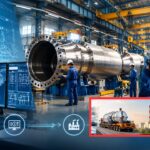
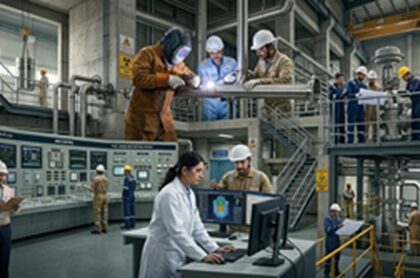
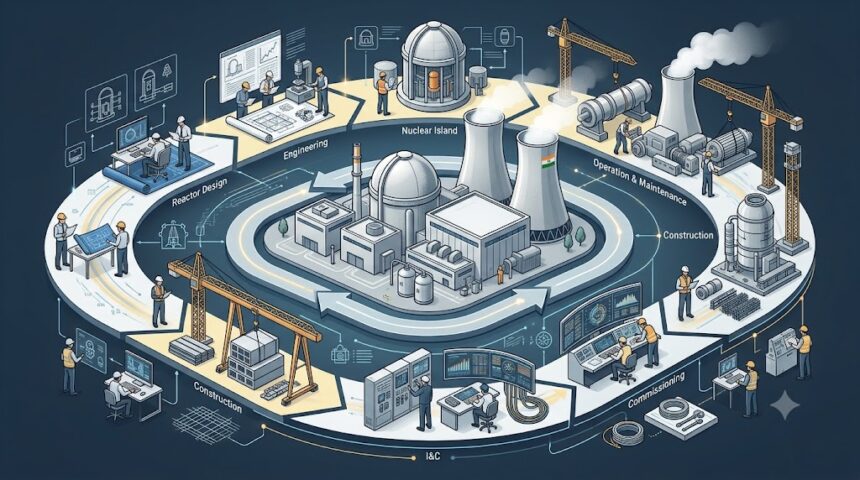
A nuclear power plant is not built by a single company. Behind every reactor is a complex industrial ecosystem involving reactor designers, nuclear research institutions, utilities, EPC contractors, heavy engineering companies, component manufacturers, instrumentation specialists, construction companies, quality agencies and thousands of Tier-2 and Tier-3 suppliers.
From the first reactor design calculation to the moment electricity is generated—and throughout decades of operation—the nuclear supply chain performs different roles at different stages. For India, this ecosystem is becoming increasingly important as the country moves towards a much larger nuclear power programme and a greater role for domestic industry. So, who supplies what?
1. Reactor Design and Technology Development
Supply chain begins long before equipment reaches a manufacturing plant. At the design stage, technology developers and nuclear research institutions establish the reactor concept, safety philosophy, systems and component requirements.
In India’s indigenous nuclear programme, the Department of Atomic Energy (DAE) and institutions such as Bhabha Atomic Research Centre (BARC) have played a central role in reactor technology development, nuclear research and engineering. For the Pressurised Heavy Water Reactor (PHWR) programme, the technology has evolved through successive generations from earlier 220 MWe units to the indigenous 540 MWe and 700 MWe designs.
At this stage, the “suppliers” are often engineering organisations and technology developers rather than conventional equipment vendors. Their work includes: Reactor and system design, Thermal-hydraulic analysis, Safety analysis, Structural analysis, Nuclear instrumentation and control concepts, Fuel and reactor physics, Materials development, Equipment specifications, Safety-classification requirements, Design documentation and qualification.
This design information ultimately becomes the technical basis for procurement and manufacturing.
2. Project Development and Nuclear Utility
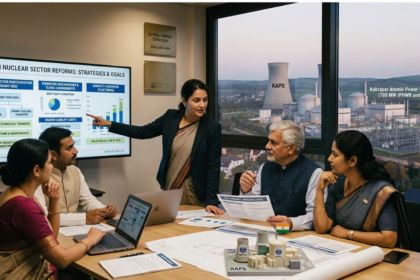
Once the reactor design and project framework are established, the nuclear utility takes centre stage. Nuclear Power Corporation of India Limited (NPCIL) is responsible for the design, construction and operation of India’s commercial nuclear power plants based on thermal reactor technologies.
For India’s fast breeder reactor program, Bharatiya Nabhikiya Vidyut Nigam Limited (BHAVINI) has a distinct role. The utility is not simply a purchaser. It translates reactor technology into a project, defines procurement requirements, manages contractors and suppliers, oversees quality and safety requirements, coordinates construction and commissioning, and eventually operates the plant. This makes the nuclear utility a critical integrator of the supply chain.
3. Nuclear Island Equipment
The nuclear island contains some of the most safety-significant equipment in the plant. For India’s PHWR programme, this includes equipment such as: Steam generators, Reactor headers, End shields, Calandria, Primary heat transport systems, Pressurised equipment, Heat exchangers, Fuel handling systems, Control and reactivity systems, Safety-related tanks and piping and Reactor building equipment.
Heavy engineering companies are therefore among the most visible industrial participants in the nuclear supply chain. Larsen & Toubro, for example, manufactures and supplies a range of nuclear island equipment, including steam generators, end shields, calandria, reactor roof slabs, control rod drive mechanisms, primary heat transport systems and other specialised equipment.
L&T has also been supplying steam generators for India’s 700 MWe PHWR fleet programme. Bharat Heavy Electricals Limited (BHEL) is another major participant. Its nuclear portfolio includes steam generators, reactor headers, end shields, heat exchangers and other reactor-side equipment. It also supplies turbine-generator equipment for the secondary side.
Companies such as Walchandnagar Industries have also supplied core nuclear equipment, including calandrias, end shields, moderator heat exchangers and other equipment for PHWR and PFBR projects.
4. Steam Generation and the Secondary Side
Heat generated in the reactor must ultimately be converted into electricity. This is where the secondary side—or turbine island—becomes critical. The major equipment includes: Steam turbines, Turbine generators, Condensers, Moisture separator reheaters, Feedwater systems, Pumps, Heat exchangers, Cooling systems, Electrical systems and Control and instrumentation.
BHEL has a particularly significant role in this segment. The company says it has supplied turbine-generator sets for multiple Indian PHWRs and has capabilities extending to complete turbine-island solutions for PHWRs and other reactor programmes.
The distinction is important: a nuclear plant’s supply chain does not end at the reactor vessel or nuclear island. A large industrial ecosystem exists on the conventional side of the plant as well.
5. Nuclear Fuel and Fuel-Related Systems
No reactor can operate without its fuel cycle. Nuclear fuel supply chain includes uranium processing, fuel fabrication, fuel elements or assemblies, zirconium-based materials, cladding, fuel handling and associated quality-control processes. In India’s indigenous programme, the Nuclear Fuel Complex (NFC) has an important manufacturing role.
For example, NFC has been manufacturing Alloy-800 steam-generator tubes for India’s 700 MWe PHWR programme, illustrating how specialised materials and components form part of the nuclear supply chain. The broader fuel ecosystem also includes specialised material producers, fabricators, inspection agencies and equipment suppliers.
6. Civil Construction and Nuclear-Grade Infrastructure
A nuclear power plant is also a massive civil engineering project. Suppliers and contractors are involved in: Nuclear-grade concrete structures, Reactor buildings, Turbine buildings, Containment structures, Cooling-water systems, Tunnels, Heavy lifting, Roads and site infrastructure, Electrical buildings, Water systems, Fire protection systems and HVAC and ventilation.
But nuclear construction has a different quality environment from conventional infrastructure. Materials, welding, embedded components, concrete, reinforcement and construction processes may all have to meet project-specific nuclear quality requirements. This creates opportunities not only for major EPC companies but also for specialised contractors and regional suppliers capable of meeting nuclear-quality requirements.
7. Electrical, Instrumentation and Control
A modern nuclear plant requires a sophisticated instrumentation and control ecosystem. This includes: Reactor protection systems, Process instrumentation, Sensors, Control systems, Electrical distribution, Switchgear, Emergency power systems, Digital control systems, Monitoring systems, Radiation monitoring and Communication systems.
The challenge is not simply supplying the equipment. Nuclear applications require demonstrated reliability, qualification, documentation, traceability and, where applicable, seismic, environmental and functional qualification. This is an area where specialised technology companies can become important Tier-1 and Tier-2 suppliers.
8. Quality Assurance, Inspection and Qualification
One of the biggest differences between nuclear and conventional industrial supply chains is the depth of quality assurance. A component cannot simply be manufactured, tested and shipped.
The supply chain may involve: Design – material qualification – procurement – manufacturing – inspection – testing – documentation – quality assurance – regulatory review – installation – commissioning.
Traceability is therefore critical. Suppliers need systems covering welding procedures, welder qualifications, material certificates, non-destructive examination, dimensional inspection, testing and documentation.
This creates a parallel ecosystem of: Inspection agencies, Testing laboratories, Certification organisations, Non-destructive testing specialists, Nuclear quality consultants, Calibration laboratories and Qualification agencies. For companies entering the nuclear supply chain, quality capability can be as important as manufacturing capability.
9. Installation and Commissioning
After equipment leaves the factory, another supply-chain phase begins: site installation. Major contractors and specialised installation companies may be responsible for: Equipment erection, Heavy lifting, Piping installation, Welding, Electrical installation, Instrumentation, System integration, Testing, Pre-commissioning and Commissioning support.
The complexity increases because systems must eventually operate together as an integrated nuclear power plant. Commissioning therefore becomes the point at which design, manufacturing, construction and equipment performance come together.
10. Operation, Maintenance and Life-Cycle Support
The supply chain does not disappear once the reactor starts generating electricity. In fact, a commercial nuclear plant can require suppliers for decades. Operational supply chain includes: Spare parts, Maintenance services, In-service inspection, Equipment refurbishment, Control-system upgrades, Instrumentation, Pumps and valves, Electrical equipment, Radiation monitoring, Fuel handling, Waste management systems, Safety systems and Plant-life extension
Companies capable of supplying qualified replacement components can therefore build long-term business relationships with nuclear utilities. L&T, for instance, highlights onsite services and life-extension activities for operating PHWR plants, including in-service inspection and coolant-channel replacement.
11. The Emerging Tier-2 and Tier-3 Opportunity
Most important development for India’s nuclear supply chain may be happening below the headline names. A nuclear project requires hundreds of categories of specialised products and services.
These can include: Metals – forgings – castings – machining – welding – heat treatment – coatings – valves – pumps – cables – instrumentation – electronics – software – NDT – inspection – logistics – installation – maintenance.
This is where MSMEs and specialised engineering companies can become part of the nuclear ecosystem. However, becoming a nuclear supplier is not simply a matter of having an engineering workshop. Companies need to understand nuclear procurement procedures, quality systems, documentation, qualification requirements and the specific standards applicable to their products.
Nuclear Supply Chain Is an Ecosystem
The answer to “who supplies what?” is therefore not one company or one organisation.
| Stage | Key Supply-Chain Participants | Typical Scope |
|---|---|---|
| Reactor technology | DAE, BARC, technology developers | Reactor design, research, safety |
| Project development | NPCIL / BHAVINI | Project ownership, integration, operation |
| Nuclear island | L&T, BHEL, specialised manufacturers | SGs, headers, end shields, vessels, piping |
| Fuel cycle | NFC and specialised suppliers | Fuel and nuclear materials |
| Turbine island | BHEL and industrial suppliers | Turbine, generator, heat exchangers |
| Civil construction | EPC and specialist contractors | Buildings, structures, infrastructure |
| I&C | Technology and instrumentation companies | Control, protection, monitoring |
| QA/QC | Inspection and testing ecosystem | Qualification, NDT, documentation |
| Installation | EPC/site contractors | Erection, piping, electrical, integration |
| Commissioning | Utility + project contractors | Testing and system commissioning |
| Operations | NPCIL/BHAVINI + suppliers | O&M, spares, inspection, upgrades |
What This Means for India’s Nuclear Industry
India’s nuclear expansion will require more than reactor construction. It will require a deeper and wider industrial base capable of delivering qualified equipment repeatedly, at scale and with consistent quality.
The next phase of the nuclear supply chain is therefore likely to be defined by three questions: Can Indian companies qualify?, Can they manufacture at scale? and Can they maintain nuclear-grade quality and documentation over the life of the product?
For the B2B industry, that is where the real opportunity lies. Nuclear supply chain is evolving from a relatively concentrated ecosystem into a broader industrial network—connecting reactor technology, heavy engineering, manufacturing, construction, digital systems, inspection, logistics and long-term plant services.
As India targets a much larger nuclear power base, understanding who supplies what and where new suppliers can enter will become increasingly important for every company looking to participate in India’s nuclear journey.