
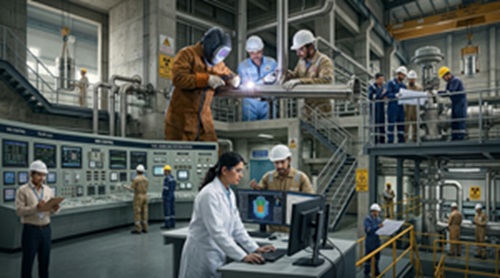
From reactor physicists and nuclear engineers to welders, technicians, project managers and supply-chain professionals, India’s nuclear expansion will require a workforce far broader than the people working inside a reactor control room.
A nuclear power plant is only the visible part of a much larger workforce ecosystem. Behind every reactor are scientists who develop technologies, engineers who design systems, technicians who maintain equipment, skilled tradespeople who build and install components, operators who run the plant, safety specialists who monitor risks and a large network of companies and professionals supporting the project.
As India looks to significantly expand its nuclear capacity, the workforce challenge is therefore not simply about producing more nuclear scientists. It is about building an entire industrial talent pipeline.
1. Scientists and Researchers: Building the Knowledge Base: At the top of the nuclear ecosystem are scientists and researchers who develop the knowledge and technologies on which the industry depends. Their work covers areas such as reactor physics, radiation science, nuclear materials, chemistry, fuel-cycle technologies and advanced reactor systems. Typical roles include – Nuclear and reactor physicists, Radiation scientists, Materials scientists, Chemists, Research engineers, Computational scientists.
2. Engineers: Turning Science into Infrastructure: Engineers form one of the largest professional groups in the nuclear industry. Nuclear engineers work on reactor design, safety analysis, fuel management, radiation protection and licensing support. But the nuclear sector also depends heavily on conventional engineering disciplines.
Mechanical engineers work on equipment and mechanical systems. Electrical engineers handle power systems and electrical equipment. Civil and structural engineers design buildings and structures. Chemical engineers contribute to process systems and chemistry. Instrumentation and control engineers work on the systems that measure, control and protect plant operations. They work in research laboratories, universities, national research centres and advanced reactor development programs. Their work may begin years before a reactor project reaches the construction stage.
Engineering workforce includes – Nuclear engineers, Mechanical engineers, Electrical engineers, Civil and structural engineers, Chemical engineers, Instrumentation & control engineers, Electronics engineers, Industrial & project engineers. These professionals can be employed by nuclear operators, engineering & EPC companies, reactor technology providers, equipment manufacturers, consultancies and regulatory organisations.
3. Operations: Running the Nuclear Plant: Once a nuclear facility begins operation, another specialised workforce takes over the daily responsibility of operating and monitoring the plant. Control-room operators & operations engineers work in shifts to monitor plant systems and maintain safe operating conditions. Operations workforce also includes specialists involved in chemistry, radiation protection, fuel handling and emergency preparedness. This is one of the areas where nuclear-specific training & qualification requirements become particularly important.
4. Technicians: Hands-on Technical Workforce: Engineers design and manage systems. Technicians help keep those systems working. Technicians support plant operations, inspection, testing and maintenance. Their work can include – mechanical maintenance, electrical maintenance, Instrumentation and control, radiation monitoring, equipment inspection, plant system testing
Diploma engineers, ITI-qualified tradespeople and other technically trained personnel can form an important part of this workforce, subject to the specific qualification and training requirements of the job. As the nuclear fleet expands, the requirement will not be limited to graduate engineers. A strong pipeline of technically trained personnel will also be essential.
5. Skilled Trades: Workforce Behind Construction: A nuclear project cannot be built by engineers alone. Welders, pipe fitters, fabricators, electricians, machinists, riggers, crane operators and non-destructive testing specialists perform much of the physical work required to construct, install, inspect and maintain industrial systems.
Their role becomes particularly important during – site preparation, construction, equipment installation, piping & fabrication, commissioning, major maintenance and refurbishment. Nuclear projects also demand stringent quality-control and documentation practices. Therefore, skilled workers may require additional training and qualification beyond their basic trade skills.
6. Manufacturing and the Supply Chain: Nuclear workforce extends far beyond the nuclear site. Reactors require a large network of equipment manufacturers, component suppliers, fabricators, quality laboratories, logistics providers and engineering companies.
This creates employment opportunities for– production engineers, manufacturing specialists, quality assurance professionals, metallurgists, procurement specialists, supply-chain managers, quality inspectors, component and equipment specialists Expansion of nuclear power can therefore create demand in the wider industrial economy, including companies that may not traditionally have considered themselves part of the nuclear sector.
7. Safety, Security and Regulation: Nuclear energy operates within a highly regulated environment. Safety & regulatory functions require specialised professionals who assess plant designs, inspect facilities, review operating procedures & oversee compliance with applicable requirements. Wider ecosystem also includes professionals working in radiation protection, emergency preparedness, nuclear security and safeguards-related activities. These functions are essential throughout the lifecycle of a nuclear facility -from design & construction to operation and eventual decommissioning.
8. Fuel Cycle, Waste and Decommissioning: Nuclear industry does not begin with a reactor and end with electricity generation. Wider ecosystem includes activities associated with the nuclear fuel cycle, radioactive waste management, transportation, environmental monitoring and, ultimately, decommissioning. These activities require their own specialists, including engineers, scientists, radiation professionals, environmental specialists, technicians and project-management teams. As India’s nuclear program expands, these capabilities will remain an important part of long-term workforce planning.
9. The Business Workforce Behind Nuclear Energy: There is another layer that is often overlooked. Large nuclear projects also require professionals in – project management, finance, procurement, legal services, human resources, contract management, communications, public affairs, training and knowledge management. Growth of the nuclear sector therefore creates opportunities not only for people with nuclear degrees, but also for professionals whose expertise can be applied to a highly regulated and technically demanding industry.
Nuclear Industry Employment Value Chain
| Stage | Workforce |
| Research & Development | Scientists, researchers, research engineers |
| Design & Engineering | Nuclear, mechanical, electrical, civil, chemical and I&C engineers |
| Manufacturing | Production engineers, quality specialists, fabricators, component manufacturers |
| Construction | Civil engineers, EPC professionals, welders, pipe fitters, electricians and other trades |
| Commissioning | Engineers, technicians, operators and safety specialists |
| Operations | Operators, engineers, technicians, chemistry and radiation professionals |
| Maintenance | Maintenance engineers, technicians and specialised contractors |
| Fuel Cycle | Fuel, mining, processing and related technical specialists |
| Waste Management | Waste-management, radiation and environmental specialists |
| Decommissioning | Engineers, radiation professionals, technicians and project teams |
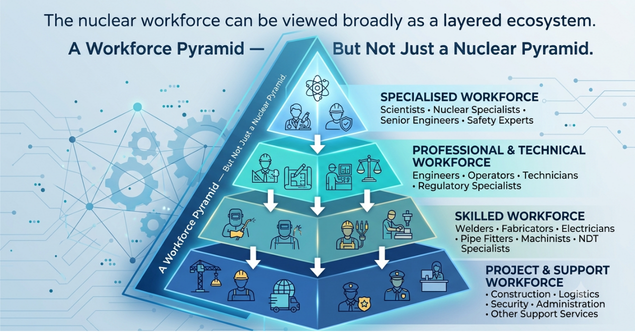
This should be understood as an illustrative representation of the breadth of skills involved, rather than a fixed employment ratio. The composition of the workforce varies by project stage, organisation and type of nuclear facility.
Bigger Workforce Challenge
India’s nuclear expansion will require more than additional reactors. It will require the people capable of designing, manufacturing, building, operating, maintaining, regulating and eventually decommissioning those facilities. That means workforce development has to happen across the entire ecosystem. Universities and research institutions will continue to produce scientists and engineers. Training institutions will need to develop technicians and specialised operators. Industry will need skilled tradespeople and manufacturing specialists. Companies entering the nuclear supply chain will need personnel familiar with nuclear quality, safety and regulatory requirements.