
Developed by BRIT in 2024, ROTEX-I uses an Iridium-192 radioactive source to inspect welds and metal components. The technology illustrates how India’s nuclear research capabilities extend beyond uranium mining and power generation to industrial applications.
- What is ROTEX-I?
- How does industrial gamma radiography work?
- Why does ROTEX-I use Iridium-192?
- Key technical specifications
- Where is gamma radiography used?
- How does ROTEX-I support India’s indigenous technology capabilities?
- What is its relevance to India’s nuclear supply chain?
- Radiation safety and regulatory requirements
- ROTEX-I in the wider story of India’s nuclear programme
India’s nuclear programme involves much more than producing electricity. It begins with the exploration and mining of uranium and extends to nuclear fuel manufacturing, reactor development, radiation technologies and industrial applications.
Uranium Corporation of India Limited (UCIL) marked 60 years of its uranium mining and processing journey in 2026. Its Diamond Jubilee celebrations at Jaduguda highlighted the role of indigenous capabilities in supporting India’s nuclear program. The wider Department of Atomic Energy (DAE) ecosystem also demonstrates how nuclear science contributes to applications beyond the nuclear power sector.
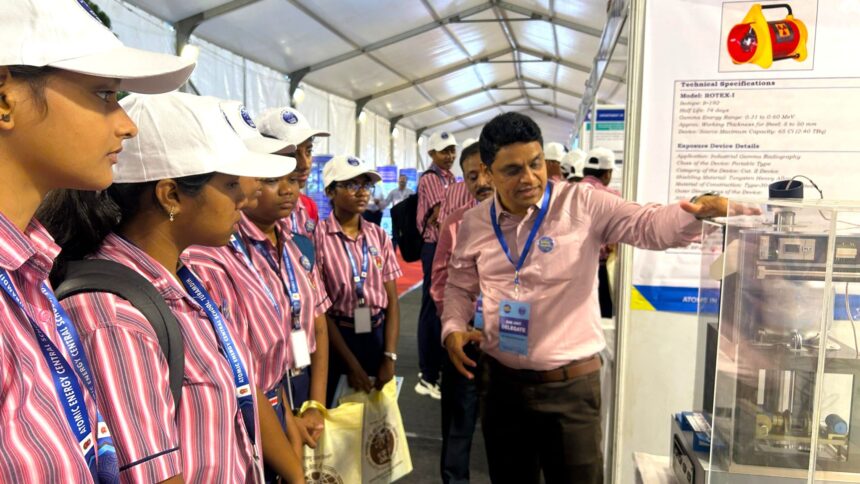
One example is ROTEX-I, an indigenous industrial gamma radiography exposure device developed by the Board of Radiation and Isotope Technology (BRIT), a unit of DAE. Introduced in October 2024, the device was designed to support non-destructive testing (NDT) using an Iridium-192 radioactive source.
ROTEX-I is not a uranium mining or nuclear fuel technology. Instead, it demonstrates how expertise in radioisotopes, radiation shielding and precision engineering can support industrial inspection.
What is ROTEX-I?
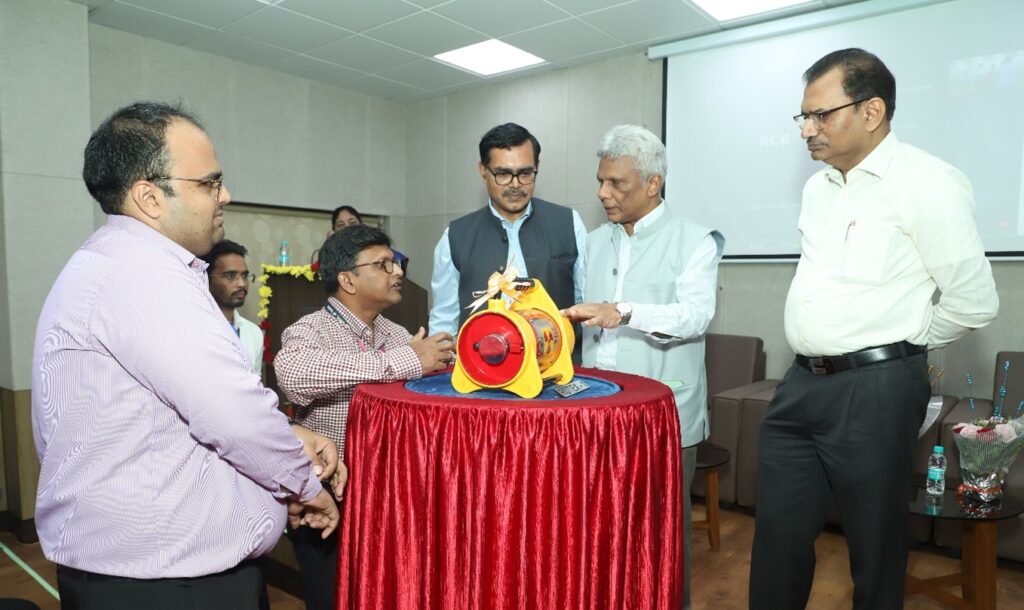
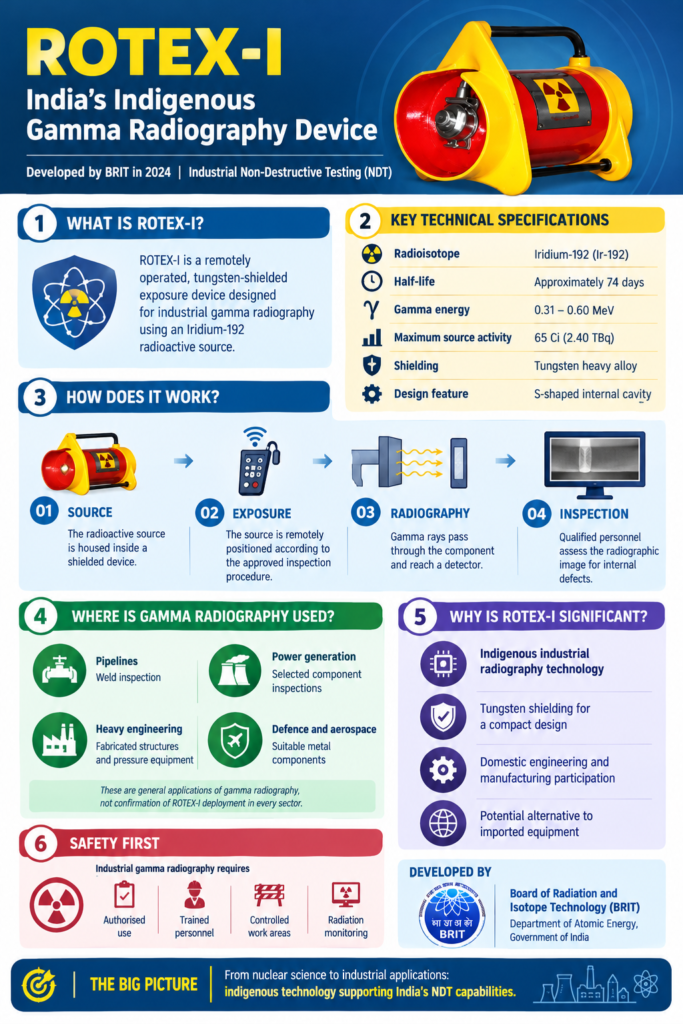
ROTEX-I stands for Remotely Operated Tungsten-Shielded Exposure Device. It is a portable device designed to house and remotely operate an Iridium-192 (Ir-192) source for industrial gamma radiography.
Gamma radiography is a non-destructive testing method. It uses gamma radiation to examine the internal condition of a material or component without damaging it. The resulting radiographic image can help inspectors identify internal discontinuities in welds, castings and other metal components.
The technique is important in industries where component quality and structural integrity matter. Defects in a welded joint, for example, may not be visible from the outside. Radiography can help reveal such defects so that qualified inspectors can assess them against the relevant acceptance criteria.
ROTEX-I provides the shielding and source-handling mechanism needed for this inspection method. It does not detect or classify defects independently. That requires a suitable radiographic technique, an appropriate detector or film, and qualified personnel to interpret the results.
How does industrial gamma radiography work?
Gamma radiography uses radiation emitted by a radioactive source to produce an image of a component’s internal features. The process involves three basic elements: the source, the component being inspected and a detector.
1. The source is housed inside the exposure device. The Ir-192 source is held within the device’s shielding when it is not being used for an exposure.
2. The source is positioned for inspection. Trained personnel use the remote operating mechanism to position the source according to the approved inspection procedure. The component and detector are arranged in the required geometry.
3. Gamma radiation passes through the material. The amount of radiation reaching the detector depends on the material’s thickness, density and internal features. Discontinuities can create differences in the resulting image.
4. The image is assessed. Qualified personnel examine the radiograph to identify relevant indications and determine whether the component meets the applicable inspection requirements.
This method is commonly used to inspect welded joints in pipelines, pressure vessels and fabricated equipment. Its suitability depends on the material, component geometry, defect criteria and applicable inspection code.
Why does ROTEX-I use Iridium-192?
Iridium-192 is a radioisotope widely used in industrial gamma radiography. It emits gamma radiation with energies commonly reported in the approximate range of 0.31 to 0.60 MeV.
These characteristics make it suitable for inspecting many steel components, particularly welds and sections of moderate thickness. Ir-192 has a half-life of approximately 74 days. This means its activity falls to half its initial value in about 74 days. As the source decays, exposure times may need to increase to achieve the required radiographic image quality.
Source therefore requires planned management and replacement under the applicable arrangements. Its useful inspection range also depends on source activity, material thickness, exposure time and the required image quality.
According to DAE’s October 2024 announcement, ROTEX-I was designed to accommodate an Ir-192 source with a maximum activity of 65 curies (Ci), equivalent to approximately 2.40 terabecquerels (TBq).
Key technical specifications
The following specifications are reported in the ROTEX-I technical material and DAE announcement.
| Parameter | Specification |
|---|---|
| Device | ROTEX-I |
| Full description | Remotely Operated Tungsten-Shielded Exposure Device |
| Developer | BRIT, Department of Atomic Energy |
| Development milestone | Introduced in October 2024 |
| Radioisotope | Iridium-192 |
| Half-life | Approximately 74 days |
| Gamma energy range | Approximately 0.31–0.60 MeV |
| Maximum source capacity | 65 Ci (approximately 2.40 TBq) |
| Shielding material | Tungsten heavy alloy |
| Internal cavity | S-shaped design |
| Primary application | Industrial gamma radiography and NDT |
Source: DAE’s launch announcement and the technical paper on ROTEX-I.
A gamma radiography device must provide effective shielding when the radioactive source is not in the exposure position. Its design must also support controlled source movement and safe operation. ROTEX-I uses tungsten heavy alloy as its shielding material. Tungsten has a high density, which allows it to attenuate gamma radiation within a relatively compact volume.
This property is important for portable equipment. Designers must balance shielding effectiveness, weight, dimensions and ease of transport. DAE reported at the device’s launch that the tungsten-shielded design reduced its weight by 27% compared with the radiography cameras used as the reference for the development.
The device also incorporates an S-shaped internal cavity. This design facilitates movement of the radioactive source while helping minimise radiation streaming, in which radiation escapes through a less-shielded path. These features address two important engineering requirements: compact equipment and effective radiation shielding.
However, the use of tungsten does not eliminate radiation risk. Safe operation also depends on the device’s approved configuration, source integrity, remote operating mechanism, radiation monitoring and operating procedures.
Where is gamma radiography used?
Industrial gamma radiography supports quality assurance in several sectors.
- Pipelines and process industries: Inspecting welds in pipelines, pressure vessels and process equipment.
- Power generation: Examining selected welded components during fabrication and construction, where the inspection procedure permits radiography.
- Heavy engineering: Assessing weld quality in fabricated structures and industrial equipment.
- Defence and aerospace: Inspecting suitable components where gamma radiography meets the technical and regulatory requirements.
These are general applications of industrial gamma radiography. They should not be interpreted as confirmation that ROTEX-I has been deployed in every sector. For the nuclear industry, NDT is particularly relevant to the fabrication and inspection of components that must meet specified quality and safety requirements. Radiography is one of several inspection methods used, depending on the component and applicable code.
How does ROTEX-I support India’s indigenous technology capabilities?
One of ROTEX-I’s main features is its domestic development and manufacturing base. At its October 2024 launch, DAE stated that the Ir-192 isotope required for the device was produced by the research reactor Dhruva, while Indian industry manufactured the device’s components. BRIT also acknowledged the contribution of Indian micro, small and medium enterprises (MSMEs) to the development process.
This provides an example of collaboration between a government technology organisation and domestic manufacturers. The development involved more than the radioactive source alone. It required shielding design, mechanical engineering, source movement arrangements, fabrication and safety evaluation.
For India’s industrial supply chain, this illustrates how specialised capabilities developed within the nuclear ecosystem can support other sectors. An indigenous device may also provide an alternative to imported equipment. DAE stated at the launch that ROTEX-I was expected to be available at nearly half the price of imported devices. This was a launch-era expectation, not confirmation of its current market price or actual cost savings.
Its long-term contribution will depend on commercial availability, field performance, maintenance support, lifecycle costs and user acceptance.
What is its relevance to India’s nuclear supply chain?
India’s nuclear supply chain includes mining and processing, nuclear fuel manufacturing, reactor systems, specialised materials, fabrication, engineering and inspection services. These activities depend on quality assurance at different stages. NDT helps assess the integrity of components without destroying them, making it an important part of industrial manufacturing and construction.
ROTEX-I belongs to the industrial inspection equipment segment rather than the reactor or nuclear fuel segments. Its relevance lies in the development of indigenous technology that can support inspection activities across eligible industrial applications. Wider supply-chain significance can be understood in three areas.
Domestic engineering: The device demonstrates Indian capability in designing and manufacturing specialised radiation-based equipment.
Industry participation: Domestic manufacturers and MSMEs contributed to the development process, showing how industrial partners can support technology development.
Potential import substitution: A domestic alternative could reduce dependence on imported equipment if it proves competitive in performance, cost and service support.
These outcomes need to be assessed through actual market adoption and operating experience. Indigenous development is an important first step, but commercial success depends on sustained performance and customer confidence.
Radiation safety and regulatory requirements
Industrial gamma radiography involves ionising radiation and requires strict safety controls. Remote operation helps personnel control the exposure process from a distance. However, it does not remove the need for radiation protection measures.
Atomic Energy Regulatory Board (AERB) oversees applicable safety requirements. These can cover equipment design, radioactive-source handling, transport, personnel qualifications, radiation monitoring and operational controls.
AERB’s 2023 annual report records that it issued Type B(U) design approval for BRIT’s ROTEX-I following a satisfactory safety review. This relates to the device’s transport-package design and should not be treated as blanket authorisation for every use or operating condition.
Industrial users must comply with the applicable approvals and operating requirements. They must also ensure that radiography is carried out by appropriately qualified personnel using approved procedures and controlled work areas.
ROTEX-I in the wider story of India’s nuclear programme
UCIL’s 60-year journey highlights the importance of indigenous capabilities in uranium mining and processing. ROTEX-I illustrates a different part of India’s nuclear technology ecosystem: the application of radioisotopes and radiation engineering to industrial inspection.
The two activities serve different purposes, but both sit within the wider DAE ecosystem. For readers exploring India’s nuclear industry, this distinction matters. The sector extends beyond uranium resources, fuel fabrication and nuclear power plants. It also includes research institutions, radioisotope applications, specialised equipment manufacturers and industrial service providers.
ROTEX-I demonstrates how this ecosystem can translate research and engineering capabilities into a practical industrial product. The next measure of its significance will be its performance in service, its adoption by qualified NDT users and its ability to provide reliable, cost-effective support for industrial inspection.
ROTEX-I is therefore an example of how India’s nuclear technology capabilities can extend beyond the reactor and into the industrial systems that help maintain quality, integrity and reliability.
Sources