
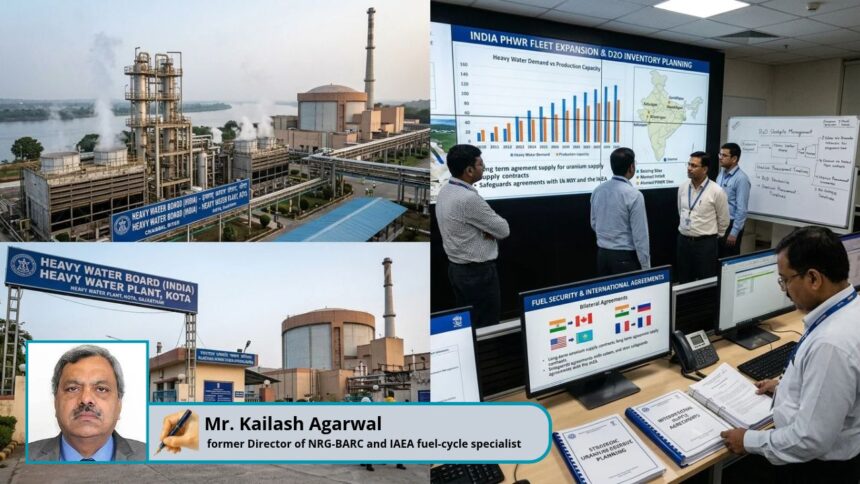
India has substantial heavy-water production capacity, but the expansion of its PHWR fleet will make inventory planning, uranium security and long-term international supply agreements increasingly important for India’s Nuclear Supply Chain.
A nuclear reactor cannot operate without a secure supply chain. For India, this means ensuring access not only to reactor components and specialised materials, but also to the strategic resources required throughout the lifetime of a nuclear plant. Heavy water and uranium occupy a particularly important position in this equation.
- Heavy water: production versus inventory
- Capacity can be used strategically
- Storage becomes increasingly important
- Uranium remains the critical vulnerability
- Uranium cannot simply be bought on the open market
- Diversification is the key
- PWR and SMR transition
- What India can learn from China
- From importing capability to exporting capability
- A five-part supply-chain strategy
- Strategic supply chain behind 100 GWe
India has developed substantial domestic heavy-water production capacity over decades. But as more PHWRs are added to the fleet, the challenge will increasingly involve balancing production, storage and initial reactor inventory requirements. At the same time, uranium remains India’s most important strategic import dependency. India’s nuclear expansion will hinge on domestic capability, international cooperation and assured long-term supplies.
Heavy water: production versus inventory
India has several heavy-water plants, providing substantial installed production capacity. However, installed capacity should not be confused with annual consumption. During normal reactor operation, the recurring requirement for heavy water is primarily on account of replacing losses. This is considerably different from the requirement when a new PHWR is commissioned.
A new reactor requires a substantial initial inventory of heavy water. This creates an important planning consideration for India’s nuclear expansion. The question is therefore not simply whether annual heavy-water production is sufficient. India must also ensure that adequate inventory is available when new reactors enter service.
Capacity can be used strategically
The largest plants has a production capacity of around 200 tones per year. Heavy-water plants also have applications beyond reactor operations. Oxygen-18, produced using heavy water as feed material, has applications in the medical sector. This provides another dimension to the heavy-water production ecosystem. For India’s nuclear programme, however, the strategic priority remains ensuring that production and inventory planning remain aligned with the expanding PHWR fleet.
Storage becomes increasingly important
As India’s PHWR programme expands, newer capacities may be required to be added in addition to the aging management of the existing plants. Heavy-water storage remains will become an important element of supply-chain planning. Existing production has created accumulated stocks that can contribute to the initial inventory requirements of new reactors.
This means India’s past investment in heavy-water production provides an advantage as the reactor fleet expands. However, meeting future demand will require a significant expansion of production capacity. Several new heavy-water plants will need to be established, alongside capacity enhancement at existing facilities, to support the growing requirements of PHWRs, including those planned in the private sector. Timely capacity addition, efficient production planning and adequate inventory management will be essential to ensure a reliable supply of heavy water as India scales up its nuclear power programme.
Uranium remains the critical vulnerability
Heavy water is an area where India has developed substantial domestic capability. Uranium presents a different challenge. India has uranium resources, but some domestic deposits are not of sufficiently high grade to economically meet the requirements of an expanding nuclear programme.
Imported uranium will therefore continue to play an important role. This makes uranium fundamentally different from many of the components used in India’s PHWR programme, where domestic manufacturing capability is already extensive. Uranium availability is directly linked to the ability to operate nuclear reactors. Consequently, uranium supply is not merely a procurement issue. It is a strategic supply-chain and geopolitical issue.
Uranium cannot simply be bought on the open market
International uranium trade operates within specific rules and regulatory frameworks. Imports require appropriate bilateral arrangements with supplier countries. India’s international agreements have therefore played an important role in enabling access to uranium supplies. Long-term arrangements provide greater visibility and reduce the risk associated with short-term market uncertainty. For an expanding nuclear programme, this becomes increasingly important.
Diversification is the key
One way of reducing supply risk is to establish long-term arrangements with multiple supplier countries. India has already entered into long-term uranium supply arrangements, including contracts extending over periods of around ten years. Such agreements can provide greater security and predictability. The strategic objective should be to avoid excessive dependence on any single external source.
A diversified international supply base, combined with continued development of domestic uranium resources wherever technically and economically feasible, can strengthen the resilience of the nuclear programme.
PWR and SMR transition
India’s supply-chain challenge will also evolve as the country expands beyond PHWR technology. PWRs and SMRs introduce additional requirements for specialised technologies and major components. Large reactor pressure vessels and other specialised systems require significant development effort.
Design is only the beginning. Technology must be tested, qualified, refined and eventually manufactured at the required scale. This means India will need to combine indigenous technology development with international collaboration.
Trying to achieve complete technological self-sufficiency immediately could slow the pace of expansion. At the same time, excessive dependence on imported technology could create new strategic vulnerabilities. The balance between the two will be critical.
What India can learn from China
There is also a broader lesson from the evolution of China’s nuclear industry. China initially entered into technology and business arrangements with the United States and other nuclear-energy countries while developing its domestic capabilities. Over time, it built its own industrial and technological base. The result was a gradual transition from technology recipient to technology and equipment supplier.
For India, this offers an important strategic perspective. International cooperation does not necessarily have to create permanent dependence. If partnerships are used to build domestic knowledge, manufacturing capability, qualification experience and industrial capacity, they can become stepping stones towards greater technological independence.
From importing capability to exporting capability
This could become one of the defining objectives of India’s nuclear supply-chain strategy. The immediate requirement is to support the country’s expanding nuclear programme. But the longer-term opportunity is much larger.
India can build capabilities in materials, components, engineering, manufacturing, quality assurance and nuclear technologies that serve both the domestic and international markets. The 100 GWe programme can therefore become more than a capacity-building exercise. It can become the foundation for a globally competitive Indian nuclear industry.
A five-part supply-chain strategy
The emerging picture points towards five interconnected priorities:
1. Domestic manufacturing – Expand India’s ability to produce critical materials, components and systems.
2. Capacity expansion – Ensure manufacturing and processing capacity grows alongside reactor deployment.
3. Technology development – Build capabilities for PWRs, SMRs and specialised components and materials.
4. International cooperation – Use global partnerships where technologies or resources are not yet available domestically.
5. Long-term supply agreements – Secure critical resources such as uranium through diversified, predictable international arrangements.
Together, these measures can create a more resilient nuclear supply chain.
Strategic supply chain behind 100 GWe
India’s nuclear expansion will ultimately depend on more than the number of reactors under construction. It will depend on whether the country can secure the materials, fuel, technologies, components and industrial capacity required to build and operate them.
Heavy-water production gives India an important domestic advantage for its PHWR programme. Uranium remains a strategic vulnerability requiring international supply arrangements. PWRs and SMRs introduce new technology and manufacturing challenges.
And the expanding role of private industry means that the nuclear supply chain will increasingly become a broader industrial ecosystem. The long-term objective should therefore be clear: build a domestic supply chain strong enough to support 100 GWe, while developing the capability to supply the global nuclear industry.
For India, nuclear energy security will ultimately depend on both what the country can make itself and how intelligently it manages what it still needs from the world.
About the Author: Mr Kailash Agarwal, former Director of NRG-BARC and an IAEA fuel-cycle specialist, brings decades of experience in nuclear fuel-cycle technologies, spent-fuel management and reprocessing.
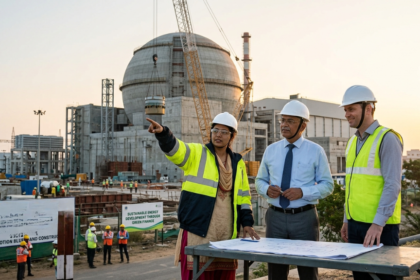
Hero Image of the Article – Gemini Generated Indicative Image used for Illustration.