
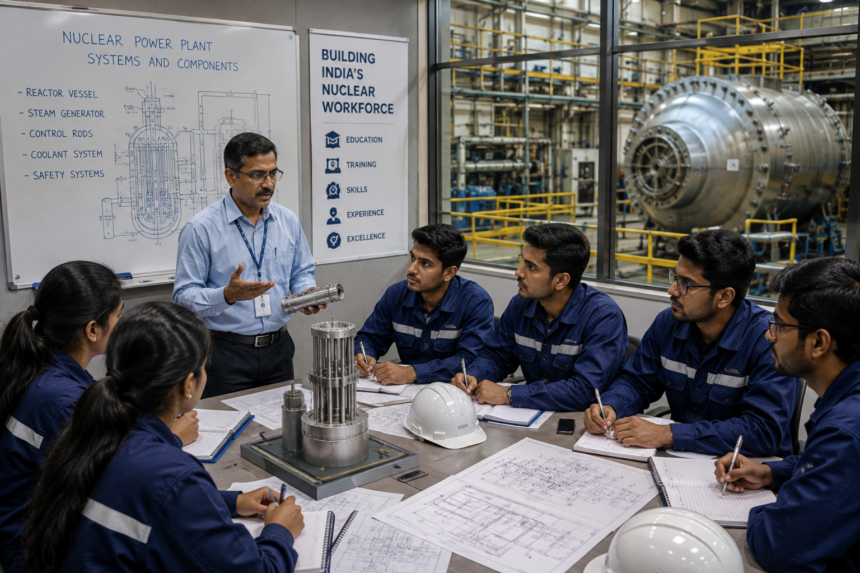
India plans to build 100 GWe of nuclear power capacity by 2047. This will require new reactors, new investments, and new technologies. However, it will also require thousands of skilled people that means nuclear workforce. Without enough trained professionals, India’s nuclear expansion could face delays. Therefore, workforce development must become a national priority.
- Nuclear Workforce: Closing the Skills Gap
- Expanding Nuclear Education
- Strengthening Practical Training
- Nuclear Workforce: Developing Skilled Workers
- Increasing Industry Exposure
- Preparing for Construction and Operations
- Supporting Multiple Reactor Technologies
- Nuclear Workforce: Encouraging International Cooperation
During the India Nuclear Energy Forum (INEF) 2026, industry leaders highlighted the need to build a larger and more skilled nuclear workforce. They identified human capacity development as a key requirement for achieving Mission 100 GWe.
Nuclear Workforce: Closing the Skills Gap
India has built strong nuclear capabilities over many decades. However, the sector faces a growing shortage of experienced professionals.
At the same time, only a limited number of academic programmes focus on nuclear engineering. In addition, there are not enough training programmes for skilled workers such as welders, technicians, and plant operators. Therefore, stakeholders recommended treating workforce development as a critical part of nuclear infrastructure planning.
Expanding Nuclear Education
Experts believe that more students should have access to nuclear education. To achieve this, stakeholders recommended bringing together organisations such as UGC, AICTE, HBNI, BARC, IGCAR, NTPC, and private industry. Together, these organisations can help create a long-term workforce development strategy.
They also called for new undergraduate, postgraduate, and doctoral programmes in nuclear energy. In addition, integrated Master’s programmes in reactor physics and reactor engineering were recommended. These programmes can help create the next generation of nuclear professionals.
Strengthening Practical Training
Classroom learning alone is not enough. Nuclear professionals also need hands-on experience. Therefore, stakeholders recommended creating more training centres, simulation facilities, and operator training programmes. They also called for specialised postgraduate training courses.
Such facilities can prepare engineers and operators for work in modern nuclear power plants.
Nuclear Workforce: Developing Skilled Workers
The nuclear sector depends on more than engineers. It also needs welders, inspectors, electricians, fabrication specialists, and many other skilled workers.
Therefore, industry experts recommended launching national nuclear skill development and certification programmes for creating nuclear workforce. They also suggested involving skill development agencies in creating specialised training courses for the sector.
Increasing Industry Exposure
Practical experience is one of the biggest challenges for workforce development. Today, most operating nuclear facilities are managed by Department of Atomic Energy organisations. As a result, opportunities for field training are limited.
To address this issue, stakeholders recommended allowing private-sector employees to train at NPCIL projects that are under construction or already in operation. This would help workers gain valuable experience before joining future projects.
Preparing for Construction and Operations
Different stages of a nuclear project require different skills. For this reason, stakeholders recommended separate training programmes for project construction and plant operations.
They suggested creating programmes similar to the one-year training courses offered by the National Power Training Institute for thermal power professionals. Such programmes can help create a steady pipeline of trained personnel for future nuclear projects.
Supporting Multiple Reactor Technologies
India is expected to deploy both domestic and international reactor technologies in the coming years. Therefore, experts recommended developing training and licensing systems that can support different reactor designs.
They also suggested reviewing training systems already used by international reactor vendors. Where appropriate, these systems could be recognised by Indian regulators. This would reduce duplication and speed up workforce preparation for new projects.
Nuclear Workforce: Encouraging International Cooperation
Stakeholders also highlighted the importance of global partnerships. Collaboration with foreign universities, research organisations, reactor vendors, and training institutes can help India learn from international experience. As a result, the country can build stronger training programmes and develop a more capable workforce.
| Theme | Industry Concern | Recommended Action |
|---|---|---|
| Workforce Availability | Limited experienced manpower in the nuclear sector | Recognise workforce development as a critical infrastructure requirement |
| Academic Programs | Limited nuclear engineering courses in universities | Develop UG, PG, Integrated Masters, and PhD programmes in nuclear energy |
| Institutional Coordination | Fragmented education and training efforts | Create a national task force involving UGC, AICTE, HBNI, BARC, IGCAR, NTPC, and industry |
| Reactor Engineering Skills | Shortage of specialised reactor experts | Launch integrated programmes in reactor physics and reactor engineering |
| Operator Training | Need for qualified plant operators | Develop operator licensing programmes, simulation centres, and specialised training facilities |
| Skilled Trades | Shortage of trained welders and specialist technicians | Launch national nuclear skill development and certification programmes |
| Industry Exposure | Limited access to operational nuclear facilities | Deploy private-sector personnel to NPCIL projects for hands-on training |
| Construction Workforce | Lack of project execution skills | Create dedicated training modules for construction and commissioning phases |
| Operations & Maintenance | Future workforce demand for plant operations | Develop specialised O&M training programmes |
| International Collaboration | Need for global best practices | Encourage international partnerships in workforce development |
| Foreign Reactor Technologies | Multiple reactor technologies expected in future | Develop training and licensing frameworks covering Indian and foreign reactor technologies |
| Regulatory Recognition | Different international licensing systems | Evaluate and recognise foreign OEM training and licensing frameworks where appropriate |
| Practical Training Access | Limited access to nuclear facilities outside DAE | Expand field training opportunities through DAE facilities |
India’s nuclear future depends on people as much as technology. Thousands of engineers, operators, technicians, inspectors, and skilled workers will be needed to support Mission 100 GWe.
Stakeholders at INEF 2026 concluded that workforce development must start now. Through better education, stronger training programmes, practical industry experience, and international cooperation, India can build the skilled workforce needed for its next phase of nuclear growth.