

India’s nuclear self-reliance is not confined to reactor design or operation. It extends deep into the materials and manufacturing chain that keeps its reactors running. From zirconium-based fuel components to uranium oxide fuel pellets and major reactor systems, India has developed a substantial domestic industrial capability around its Pressurised Heavy Water Reactor (PHWR) programme. But the scale of the next phase will be very different.
India’s ambition of reaching 100 GWe of nuclear capacity will require not only more reactors, but also a much larger and more capable supply chain – none that can expand production, qualify specialised materials and develop technologies required for newer reactor designs.
Dr Dinesh Srivastava, former Chairman & Chief Executive of NFC and Distinguished Scientist, has played a significant role in advancing India’s indigenous nuclear materials and manufacturing capabilities.
A largely domestic PHWR ecosystem
India currently operates a fleet dominated by PHWRs, apart from the Russian-designed PWRs at Kudankulam. For the PHWR programme, virtually all major material requirements are produced domestically. These include nuclear fuel as well as zirconium-based fuel and reactor components.
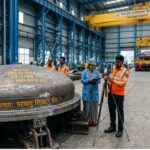
Indian engineering and manufacturing companies are also supplying major components such as calandria and steam generators. The evolution of this ecosystem is significant. Components that were once imported are now being manufactured in India, reflecting the development of domestic technology, manufacturing expertise and quality systems.
India, therefore, enters the next phase of nuclear expansion with an important advantage: an established domestic industrial base.
Zirconium chain
One of the clearest examples is the zirconium value chain. Journey begins with zircon sand and progresses through several stages to produce zirconium sponge, zirconium alloys, tubes and other components used in fuel assemblies. The Nuclear Fuel Complex has played a central role in developing this capability.
A typical PHWR fuel bundle contains uranium oxide fuel pellets, zirconium alloy tubes, spacers, end caps and other components. Each individual component requires stringent quality control and inspection, while the overall scale of the reactor programme translates into very large production requirements. This is where the depth of the domestic supply chain becomes important.
India is not simply manufacturing a finished fuel assembly. It has developed capabilities across multiple stages of the material and component chain.
NFC at the centre of the fuel-component ecosystem
NFC’s Hyderabad facilities manufacture fuel sponge and a range of fuel- and reactor-related components. The organisation has also developed the capability to manufacture UO₂ fuel pellets, converting uranium oxide powder into fuel pellets through a large-scale chemical and manufacturing process.
Additional production capacity is being developed to support the requirements of the upcoming PHWR programme. Significance goes beyond production volumes.
Nuclear components must meet extremely stringent quality and inspection requirements. The ability to repeatedly manufacture such components to nuclear-grade standards is itself a strategic industrial capability. India’s PHWR programme has therefore created not only manufacturing capacity but also experience in nuclear-grade quality assurance, inspection and qualification.
Zirconium is not expected to be the bottleneck
As India expands its PHWR programme, zirconium is not expected to become a major constraint. Existing facilities can be expanded to produce the quantities required for upcoming reactors. That is an important distinction in the 100 GWe discussion.
The challenge is not necessarily the availability of every material today. It is whether India’s production and processing capacity can be expanded fast enough to match the reactor construction programme. For zirconium, the capability exists. The requirement is to scale it.
PWR and SMR challenge
The supply-chain picture becomes more complicated when India moves beyond its established PHWR ecosystem. PWRs and SMRs require technologies and specialised materials that are not necessarily covered by India’s existing manufacturing base. Large reactor pressure vessels are one example.
India has already developed smaller pressure vessels for compact reactors, while technology for larger power-reactor pressure vessels is being developed domestically. But technology development alone is not sufficient.
Design capability must be followed by manufacturing, testing, qualification and eventually production at the scale required by a growing nuclear programme. This is likely to become one of the defining supply-chain challenges of India’s next nuclear phase.
Specialised materials remain a gap
While zirconium is not expected to constrain PHWR expansion, some specialised materials remain areas of dependence. Certain niobium-containing materials and alloys used in specific applications require extremely stringent purity and quality levels. Some of these materials are currently imported. This illustrates an important characteristic of the nuclear supply chain.
A material may be available commercially, but that does not automatically mean it is suitable for nuclear applications. Purity, metallurgy, consistency, qualification and long-term performance are critical.
Therefore, building a resilient nuclear supply chain requires more than increasing production capacity. It requires developing materials to the required nuclear-grade specifications and demonstrating their performance.
Private industry will have to scale
Expansion towards 100 GWe will also place greater demands on India’s private-sector manufacturing base. Companies already supplying steam generators and other reactor systems will need to expand their production capabilities.
Growth of nuclear power and the growth of the supply chain must therefore happen simultaneously. If reactor capacity expands faster than component manufacturing, the supply chain itself can become a bottleneck.
The converse is also important. Early investment in manufacturing capacity, technology and qualification can create an industrial base capable of supporting sustained reactor deployment.
From self-reliance to global competitiveness
India’s experience with PHWRs demonstrates what can be achieved through long-term domestic capability development. The next step is to apply that experience to the technologies and materials required for PWRs and SMRs. The objective should not be limited to replacing imports.
India needs to develop technologies, manufacturing capabilities and specialised expertise that can eventually make Indian companies competitive suppliers to the global nuclear industry.
The country’s nuclear supply chain is therefore entering a new phase. The question is no longer simply whether India can manufacture the materials required for its reactors. It is whether the domestic ecosystem can scale, diversify and innovate fast enough to support 100 GWe – and ultimately become a global nuclear supply base.
About the author: Dr Dinesh Srivastava, former Chairman and Chief Executive of the Nuclear Fuel Complex (NFC) and a Distinguished Scientist, has played a significant role in advancing India’s indigenous nuclear materials and manufacturing capabilities.
Image Credit – NFC