
Nuclear Infrastructure Finance is emerging as a critical requirement for India’s goal of achieving 100 GWe of nuclear power capacity by 2047. The planned expansion will require investments worth several lakh crore rupees. Therefore, industry stakeholders believe that conventional financing channels alone cannot support the scale of capital required.
Moreover, nuclear projects have unique financing characteristics. They require large upfront investments, long construction periods, and operating lives that can extend beyond six decades. Consequently, stakeholders are calling for a specialised financing framework that matches the long-term nature of nuclear infrastructure.
Dedicated Finance Window Can Support Nuclear Expansion
Industry experts argue that India’s nuclear programme needs a dedicated financing platform. A single nuclear power project can require tens of thousands of crores in investment. As a result, one project can consume a significant portion of a lender’s exposure limit. Furthermore, the combined financing requirement of future projects may exceed the capacity of individual financial institutions.
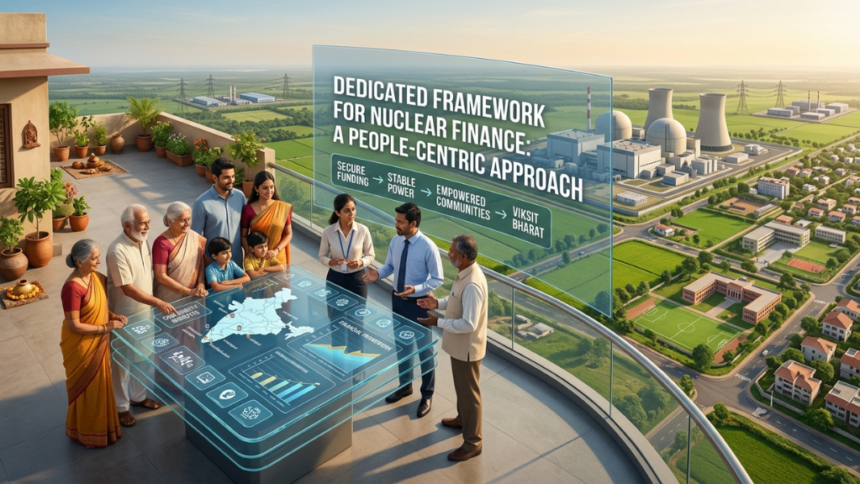
To address this challenge, stakeholders have proposed a dedicated Nuclear Infrastructure Finance window through institutions such as IIFCL, PFC, and REC. The proposed facility could provide:
- Long-term loans of up to 25 years
- Construction-period repayment moratoriums
- Competitive financing linked to benchmark lending rates
- Support for projects with approved designs and secured off-take arrangements
Such a mechanism can help mobilise large volumes of capital while maintaining project-level financial discipline. Industry stakeholders note that similar approaches have supported nuclear deployment in several countries by reducing financing barriers and improving lender confidence.
Payment Security and Bond Markets Can Unlock Capital for Nuclear Infrastructure Finance
Access to capital is only one part of the challenge. Investors and lenders also require confidence in long-term revenue recovery. Many power purchase agreements rely on distribution utilities as the primary off-takers. However, the financial health of some utilities remains a concern. Consequently, lenders often seek stronger payment protection mechanisms. To improve credit quality, stakeholders recommend a multi-layered payment security structure.
This framework could include:
- Letters of credit from power purchasers
- Escrow-backed payment security mechanisms
- Government-backed support for prolonged defaults
- Termination payment provisions that protect lenders and investors
At the same time, stakeholders emphasise the need to expand financing sources beyond the banking sector. India’s nuclear expansion programme will require access to deep pools of long-term capital. Therefore, experts recommend allowing nuclear projects to access existing infrastructure bond and infrastructure debt frameworks. This approach can attract participation from: Insurance companies, Pension funds, Provident funds, Long-term institutional investors. Furthermore, it can help develop a market for 25- to 35-year rupee-denominated financing instruments that align with the life cycle of nuclear assets.
Dedicated Financing Mechanisms for Nuclear Power Projects
| Recommendation Area | Concern | Expectation |
|---|---|---|
| Dedicated Nuclear Project Finance Window | Nuclear power projects require very large investments. A single project can consume a significant portion of a lender’s exposure limit. Moreover, the planned nuclear pipeline will require debt financing beyond the capacity of any single financial institution. | Create a dedicated financing window through IIFCL, PFC, and REC with an indicative corpus of ₹1 lakh crore over five years. Provide loan tenors of up to 25 years, including a construction-period moratorium. Offer financing at MCLR-linked rates with the possibility of lower pricing through sovereign support. Restrict eligibility to projects with approved siting and design, signed PPAs, technology supply agreements, and at least 30% committed equity. |
| Sovereign-Backed Payment Security | Distribution utilities often face financial challenges. As a result, lenders may not consider them reliable counterparties for long-term nuclear power purchase agreements. | Establish a four-layer payment security mechanism comprising an off-taker letter of credit, an escrow-backed payment security fund, a Government of India backstop for prolonged defaults, and a termination payment framework that protects both lenders and investors. This structure can improve lender confidence and lower financing risk. |
| Long-Tenor Rupee Bond Market Access | Bank lending alone cannot meet the financing requirements of India’s planned nuclear expansion. The sector requires access to deeper and longer-term capital markets. | Ensure that bonds issued for private nuclear projects qualify under existing infrastructure bond and infrastructure debt frameworks. This will enable participation from insurance companies, pension funds, provident funds, and other long-term institutional investors without creating a separate regulatory category. |
| Expected Outcome | Limited access to long-term capital and payment security mechanisms can increase financing costs and constrain project development. | Dedicated financing channels, stronger payment security, and access to long-tenor bond markets can mobilise large-scale capital, improve project bankability, reduce financing costs, and support India’s goal of achieving 100 GWe of nuclear power capacity by 2047. |
Industry experts argue that technology alone will not deliver Mission 100 GWe. Equally important is the availability of patient, low-cost capital. Therefore, India must build a financing framework that matches the long life cycle of nuclear assets. A robust Nuclear Infrastructure Finance ecosystem can attract investors, support project development, and strengthen energy security.
Developed through discussions at INEF 2026, these recommendations reflect the Indian nuclear community’s views on regulatory reforms needed to accelerate Mission 100 GWe.