
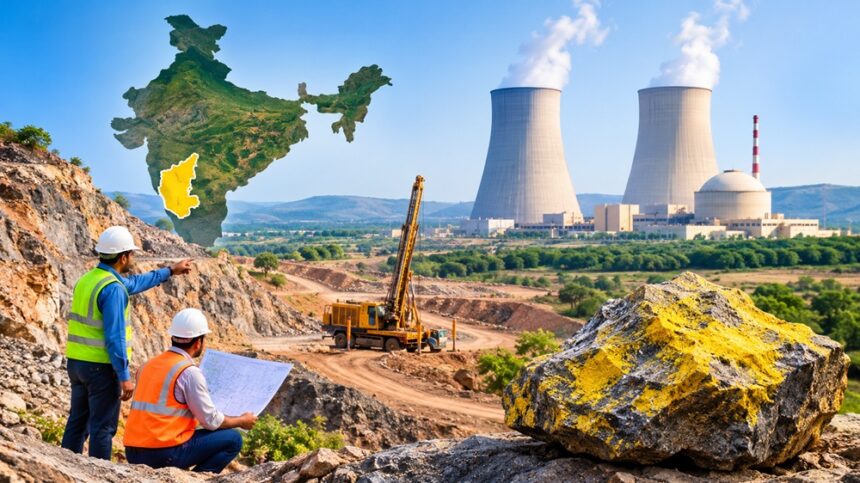
Kanchankayi and Hulkal deposits in Yadgir district highlight the potential of the Bhima Basin, but further exploration, resource evaluation and mining development will determine their contribution to India’s uranium supply.
India is stepping up efforts to strengthen its domestic uranium resources. New discoveries in Karnataka are adding to this potential. The Kanchankayi and Hulkal deposits in Yadgir district are particularly significant. They could support India’s growing nuclear power programme. In a parliamentary reply on December 4, 2025, the Department of Atomic Energy (DAE) confirmed uranium resource discoveries at both locations. The Atomic Minerals Directorate for Exploration and Research (AMD) carried out the exploration.
These discoveries are part of a wider national programme. Between April 2015 and September 2025, AMD added 2,17,560 tonnes of in-situ uranium oxide resources across India. However, the government has not disclosed separate resource estimates for Kanchankayi and Hulkal. Further exploration and feasibility studies will determine their commercial potential. They could eventually strengthen India’s domestic uranium supply and long-term nuclear fuel security.
Uranium Supply : Exploring the Bhima Basin
The deposits are located in the Bhima Basin, a geological region with considerable uranium exploration potential. The nearby Gogi deposit provides an important reference point for understanding the region’s uranium mineralisation. Research published in the Journal of the Geological Society of India describes Kanchankayi as a concealed, fracture-controlled uranium deposit. Mineralisation occurs mainly in fractured limestone of the Shahabad Formation and partly in the underlying basement granite. Exploration has also extended towards Hulkal and other sectors along the Kurlagere–Gogi–Gundanahalli fault zone. The objective is to establish the continuity and extent of uranium mineralisation beneath the surface. A Karnataka government document listing mineral exploration activities identifies AMD’s exploratory core drilling at Hulkal, along with additional drilling and geological investigations in neighbouring sectors of Yadgir district.
Uranium Supply: Exploration Expands Beyond Yadgir
Karnataka’s uranium exploration program extends beyond Kanchankayi and Hulkal. Atomic Minerals Directorate for Exploration and Research (AMD) is also investigating potential uranium-bearing areas in Kalaburagi and Belagavi districts. In Kalaburagi, detailed geophysical surveys are underway in the Anbi–Achola and Farhatabad–Martur sectors. These surveys aim to identify underground structures favourable for uranium mineralisation. Meanwhile, in Belagavi district, AMD is conducting radiometric surveys and geological mapping around Deshnur, Hanumanhatti and Khangaon. The exploration is targeting possible unconformity-type uranium mineralisation.
Furthermore, the Department of Atomic Energy has identified parts of Vijayapura, Bagalkot and Gadag districts for uranium exploration at different stages. These activities indicate a wider exploration effort across Karnataka. However, further geological investigations and drilling will be necessary to establish the presence and extent of commercially viable uranium resources.
From Discovery to Commercial Mining
The next challenge is to establish whether these deposits can support economically viable mining operations. Geological resource estimates alone are not sufficient. Detailed drilling, ore-grade assessment, mineralogical studies, metallurgical testing and mine feasibility evaluations will be essential. A technical paper published in 2023 by former AMD official R. Dhana Raju reported a resource of 7,261 tonnes of U₃O₈ for the Gogi–Kanchankayi deposit system. It also identified Hulkal as a satellite uranium deposit. This historical estimate should not be interpreted as a separate current resource figure for either location. Mining development will also require environmental baseline studies, groundwater assessments, waste-management plans, infrastructure development and statutory clearances.
Importantly, the December 2025 parliamentary reply outlined the regulatory process for proposed uranium mining projects, including mining-plan approval, environmental impact assessment, environmental clearance and mining lease procedures. Confirmation of the present approval status of the Karnataka projects remains necessary.
Strategic Importance for India’s Nuclear Expansion
India’s ambition to achieve 100 GW of nuclear power capacity by 2047 will require a reliable and diversified nuclear fuel supply. Domestic uranium exploration is therefore strategically important. Successful development of Karnataka’s resources could strengthen indigenous uranium production, reduce exposure to international supply disruptions and support long-term fuel security. The opportunity also extends beyond Kanchankayi and Hulkal. Continued exploration across the Bhima and Kaladgi basins could identify additional uranium-bearing geological formations.
However, the strategic value of these discoveries will ultimately depend on the quantity of economically recoverable uranium, production costs, environmental sustainability and the time required to bring mines into operation. The key question for India is no longer simply where uranium exists, but how effectively geological discoveries can be converted into commercially viable resources and a dependable domestic nuclear fuel supply.
Umesh Kumar Shimladka
Source
- https://www.pib.gov.in/PressReleseDetailm.aspx?PRID=2198946&lang=2®=48
- https://kla.kar.nic.in/council/Replies/unstarred/16122025/usq1025%2816122025%29.pdf
- https://pubs.geoscienceworld.org/geosocindia/jour-geosocindia/article-abstract/96/3/232/633093/Iso-dip-Contouring-An-Innovative-Approach-to
- https://www.researchgate.net/publication/371082355_GOGI-KANCHANAKAYI_U-DEPOSIT_AND_U-BEARING_PHOSPHATIC_ROCKS_NEAR_UKINAL_YADGIR_DISTRICT_KARNATAKA_INDIA
- https://cms.oecd-nea.org/upload/docs/application/pdf/2025-04/7683_uranium_2024_-_resources_production_and_demand_2025-04-22_14-29-2_928.pdf