
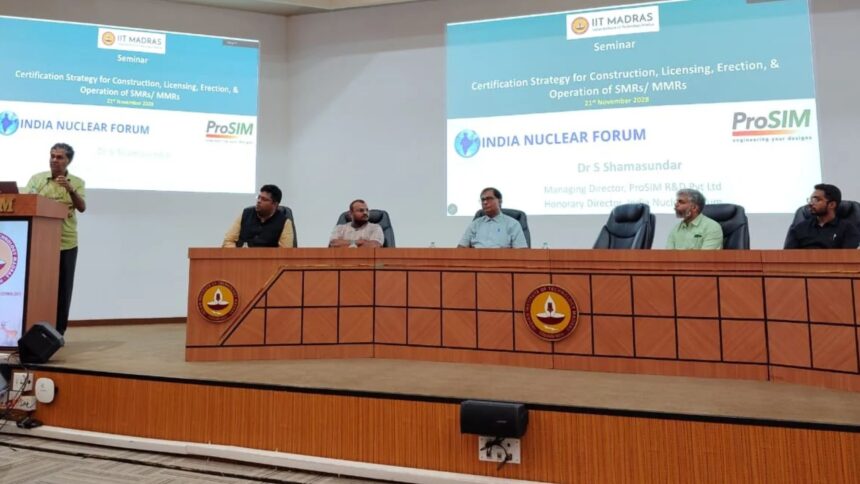
Dr. S. Shamasundar of India Nuclear Forum (an initiative of India Energy Network) explains how engineering simulation, seismic analysis (FEM Analysis ) and regulatory assessment help establish the safety and reliability of nuclear systems.
Chennai, 22 November 2026: India’s nuclear energy expansion will require strong engineering and simulation capabilities. These capabilities are essential to ensure the safety and reliability of nuclear equipment and systems. Finite Element Method (FEM) Analysis helps engineers assess structural strength, stress and seismic resistance. It helps demonstrate whether equipment can safely perform its intended function before installation in a nuclear facility.
Dr. S. Shamasundar, Managing Director of ProSIM R&D Pvt. Ltd. and Honorary Director of India Nuclear Forum (INF), highlighted these requirements during his presentation on FEM/FDM analysis. His presentation covered structural stress assessment and temperature profiles. He spoke during Session 4, Detailed Analysis & Simulation Capabilities, at a seminar on developing a certification strategy for Small Modular Reactors (SMRs) and Micro Modular Reactors (MMRs).
Nuclear Safety Requires Detailed Analysis
Dr. Shamasundar explained that nuclear engineering follows strict safety requirements. These are based on the International Atomic Energy Agency (IAEA) guidelines and the principle of Defence in Depth. Nuclear safety must be demonstrated at every stage. This includes design, construction, operation and accident management. He also explained that nuclear facilities have stricter equipment qualification requirements than conventional power plants and industrial facilities. Seismic safety is one of the key requirements.
FEM Analysis for Seismic Qualification
Seismic analysis is an important part of nuclear equipment qualification. Dr. Shamasundar explained how engineers use site-specific earthquake data to develop Floor Response Spectra (FRS). These spectra show how different floors of a nuclear building respond to earthquake movements. Engineers use this information to assess whether equipment, piping and other systems can withstand seismic forces. The assessment depends on the site location, geological conditions, building structure and equipment position. He also pointed out that some systems cannot be qualified through computer analysis alone. They require physical testing on shake tables to demonstrate their ability to withstand seismic conditions.
From Engineering Design to Regulatory Approval
Dr. Shamasundar outlined the steps involved in nuclear equipment qualification. The process starts with General Arrangement (GA) drawings. This is followed by detailed engineering and 3D CAD modelling. Engineers then carry out FEM analysis, pipe stress analysis and seismic qualification. The analysis reports are submitted for review through the project approval process. This involves equipment vendors, EPC contractors and NPCIL, followed by the relevant regulatory review and clearance by AERB. He emphasised that the required analysis and approvals must be completed before equipment is cleared for installation at a nuclear facility.
Engineering Simulation: Practical Applications
Dr. Shamasundar shared examples from ProSIM’s engineering work for nuclear facilities, including projects associated with the Indira Gandhi Centre for Atomic Research (IGCAR). One example involved a pressure vessel containing liquid. During the regulatory review, additional analysis was requested for different liquid levels, including 50% and 25% capacity. The analysis also examined the sloshing effect of the liquid and its impact on the vessel structure. He also presented ProSIM’s analysis work associated with the ITER tokamak project in France. The tokamak is an extremely large and complex structure. Physical testing of the complete system is not practical. Computational analysis was therefore used to study its structural behaviour and damage mechanisms under applicable RCC-MR codes.
Dr. Shamasundar said ProSIM has completed around 1,500–1,600 projects involving engineering analysis and qualification. These include work on compressors, chillers, pumps, valves, pressure vessels and piping systems. The corresponding reports have been submitted for review.
FEM Analysis: Building India’s SMR/MMR Engineering Capabilities
The presentation highlighted the need to strengthen India’s domestic engineering and simulation capabilities. As the country moves towards developing SMRs and MMRs, these capabilities will become increasingly important. Equipment manufacturers, MSMEs and startups will need access to specialised engineering expertise. Collaboration with IITs, academic institutions and government laboratories can help companies develop designs, conduct simulations and validate equipment. Such support will also help MSMEs understand nuclear industry requirements and prepare for the qualification and regulatory approval process. Developing these capabilities will be important for building a strong domestic engineering and manufacturing base for India’s growing nuclear energy sector.
The session also featured presentations by Research Scholar Maruthi Prasanna on “Need for CFD Analysis for Energy Removal by Coolant from Fuel” and Research Scholar Varun Nayak on “Analysis for Steady State & Transients for Coolant Flow.” Both topics highlighted the importance of computational analysis in understanding coolant behaviour and thermal-hydraulic performance in nuclear systems. Pradeep Thangappan, representing the start-up perspective, discussed the “Need for Hand-holding of Start-ups by GoI Labs/Academic Institutions for Initial Designs, Experimental Validations & Regulatory Approvals,” emphasising the importance of institutional support, access to testing facilities and technical guidance to help start-ups progress in nuclear technology development. The session was chaired and moderated by Dr. Kallol Roy.