
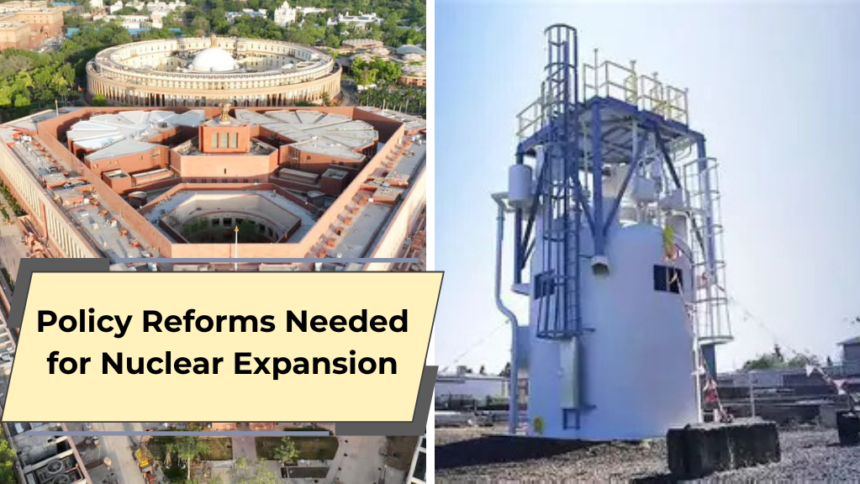
Nuclear Policy Interventions are essential for India’s goal of achieving 100 GWe of nuclear power capacity by 2047. However, investors and developers still face financing, demand, and payment-related challenges. Therefore, stakeholders at INEF 2026 called for targeted policy reforms to support long-term growth.
Green Finance and Demand Assurance
Many nuclear projects face difficulty accessing green finance. As a result, funding costs remain high. Stakeholders recommended classifying nuclear energy as clean green energy. This would help projects access green bonds, blended finance, climate funds, and carbon credit mechanisms.
At the same time, developers need confidence that future power demand will exist. Therefore, stakeholders proposed a Nuclear Purchase Obligation (NPO) for DISCOMs, similar to the Renewable Purchase Obligation (RPO). A phased increase in NPO targets would create stable demand and encourage new investments.
| Policy Area | Concern | Expectation / Recommendation |
|---|---|---|
| Green Classification | Nuclear energy projects face limited access to green and blended finance, green bonds, sustainability-linked financing, and carbon credit mechanisms due to the absence of formal green classification. | Classify nuclear energy as clean green energy within India’s sustainable finance and climate policy framework to enable access to green finance, climate funds, and lower-cost capital. |
| Market Offtake & Demand Assurance | Lack of long-term demand visibility for nuclear power projects. Absence of mandatory procurement obligations for nuclear power creates uncertainty for investors and developers. | Introduce a Nuclear Purchase Obligation (NPO) for DISCOMs, similar to Renewable Purchase Obligation (RPO), with progressively increasing targets to provide demand certainty and support long-term nuclear capacity addition. |
| Power Offtake & Payment Security | Payment security concerns arising from the varying financial health of DISCOMs. Counterparty risk for developers and challenges in executing multiple long-term PPAs. | Establish a Government-designated Intermediary Procurer (similar to SECI) to execute centralized PPAs, manage power allocation, provide a robust payment security framework, and ensure timely payments to nuclear power developers. |
Nuclear Policy Interventions: Power Offtake and Payment Security
Power developers also face payment risks because the financial health of DISCOMs varies across states. Consequently, long-term revenue certainty remains a concern.
To address this issue, stakeholders recommended creating a Government-designated Intermediary Procurer, similar to SECI. Such an entity could sign centralized power purchase agreements, allocate power, and provide payment security. As a result, developers would receive timely payments and face lower counterparty risk.
These policy interventions can strengthen investor confidence, improve project bankability, and support India’s long-term nuclear energy ambitions.
Based on discussions at INEF 2026 held at IIT Bombay, these recommendations capture industry perspectives on licensing, siting, and regulatory reforms needed to achieve Mission 100 GWe by 2047.