
India’s nuclear industry has welcomed the Draft SHANTI Rules and Draft SHANTI Regulations. Stakeholders see the framework as a major step toward private sector participation in nuclear energy. However, they have asked for more time and greater clarity before the rules are finalized.
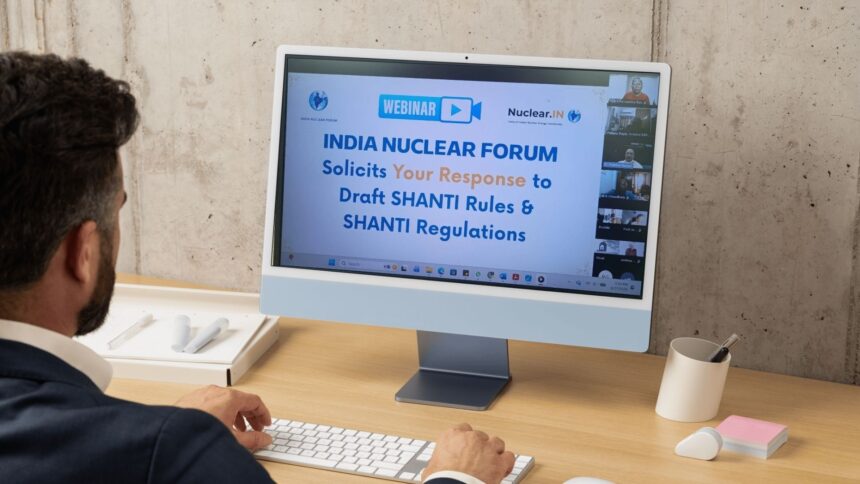
These views emerged during a stakeholder consultation webinar organized by India Nuclear Forum (INF) on 26 August 2026. The discussion brought together industry leaders, startups, investors, insurers, academics and technology developers.
Draft SHANTI Rules: Industry Seeks More Time and Clearer Regulations
One of the strongest recommendations was to extend the public consultation period. Participants said the draft SHANTI Rules and Regulations framework is complex and requires detailed review. Many suggested extending the consultation by at least two weeks. Some recommended a one-month extension.
Industry representatives also called for a clearer licensing framework. They proposed separate pathways for technology approval and project licensing. A standalone design certification process would allow approved reactor designs to be used across multiple projects.
Stakeholders highlighted the need for dedicated regulations for fusion energy. They said fusion technologies should not be regulated under the same framework as conventional fission reactors. They also sought specific provisions for fusion-fission hybrid systems.
Participants asked for greater clarity on siting requirements for Small Modular Reactors (SMRs) and Micro Modular Reactors (MMRs). They recommended risk-based exclusion zones instead of fixed distance requirements. The consultation also emphasized the need for clear implementation guidelines. Stakeholders requested defined approval timelines, detailed guidance documents and regular engagement with industry.
Financing, Innovation and Workforce in Focus
Financing emerged as a major concern. Investors want greater certainty on tariffs, project revenues, fuel availability and licensing timelines. Stakeholders recommended standardized power purchase agreements, dedicated financing mechanisms and long-term policy guidance.
Participants also urged the government to include nuclear energy in India’s green finance framework. They said this would improve access to green bonds, ESG funds and sustainable finance instruments. Startups welcomed the opening of the sector but sought simpler regulatory pathways. They also requested access to national laboratories, testing facilities and regulatory sandboxes to support innovation.
Workforce development was identified as a critical challenge. Stakeholders called for a national nuclear workforce strategy, stronger industry-academia collaboration and expanded training infrastructure. Participants further sought clarity on insurance, liability and fuel supply arrangements. They recommended clear frameworks for risk allocation, insurance coverage and private sector participation in fuel-cycle activities.
Consultation demonstrated strong industry support for the SHANTI framework. Stakeholders believe the reforms can unlock investment, innovation and private participation. They emphasized that clear regulations and predictable implementation will be essential to achieve India’s target of 100 GWe of nuclear power capacity.