
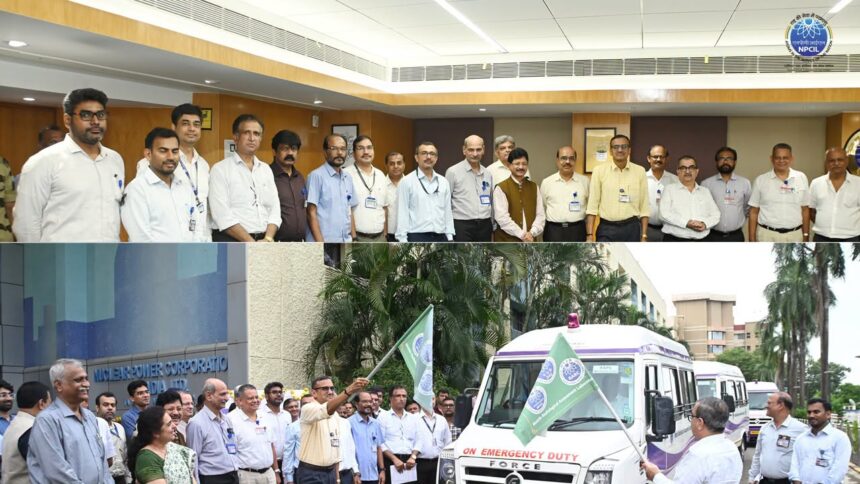
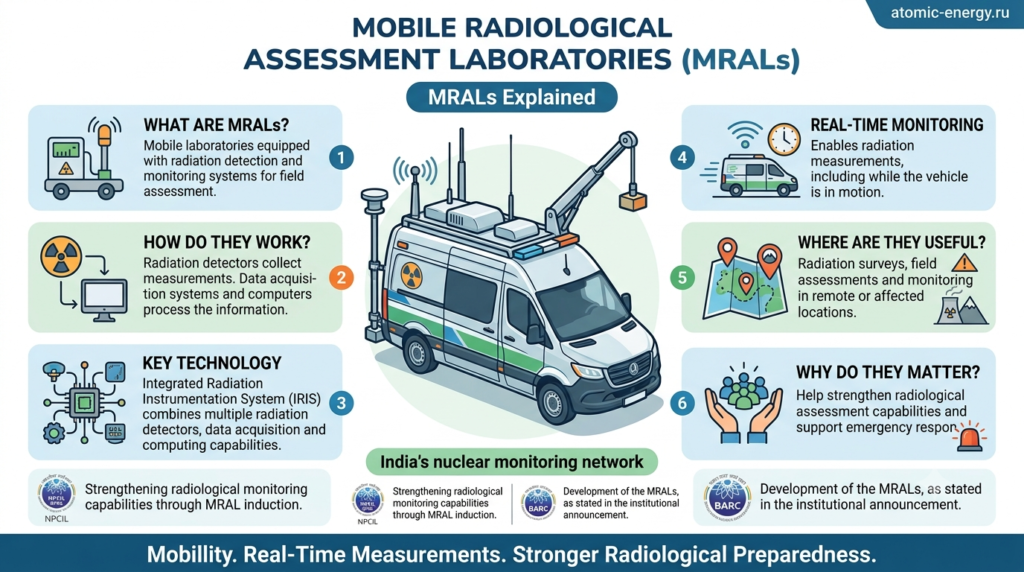
Mobile Radiological Assessment Laboratories (MRALs) are specialised vehicles equipped with radiation detection and monitoring systems. They enable trained teams to measure radiation levels and assess radiological conditions at different locations.
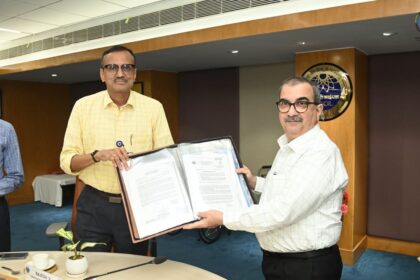
Unlike fixed monitoring stations, mobile laboratories can travel to specific areas and collect radiation measurements on site. This mobility is particularly useful when radiation levels need to be assessed over a wide area or at locations that are difficult to access. In India, the Nuclear Power Corporation of India Limited (NPCIL) has strengthened its radiological monitoring capabilities through the induction of MRALs developed by RSSD, BRAC, BARC.
How do MRALs work?
1. Detect radiation: Radiation detectors measure radiation levels in the surrounding environment. Different detectors can be used to identify and measure different types of radiation.
2. Collect and process data: The instruments send measurements to data acquisition systems and computing equipment. These systems help organise and process the collected information.
3. Monitor while moving: Mobile monitoring allows measurements to be taken along a route. This helps teams assess radiation levels across different locations without relying only on stationary monitoring points.
4. Support radiological assessment: The collected measurements can help trained specialists understand local radiological conditions and support decisions on further surveys or response measures.
What makes NPCIL’s MRALs significant?
MRALs feature an Integrated Radiation Instrumentation System (IRIS). It brings together multiple radiation detectors, data acquisition systems and computing capabilities. This integrated arrangement enables real-time radiation measurements, including while the vehicle is in motion.
MRALs are intended to augment Radiation Emergency Response Centers across India, particularly in remote locations. They can strengthen the capacity to conduct field assessments when timely information about radiation levels is required.
MRALs vs fixed radiation monitoring stations
| Feature | Mobile laboratories | Fixed monitoring stations |
|---|---|---|
| Location | Can travel between locations | Installed at designated locations |
| Coverage | Can survey different areas along a route | Monitor their specific locations |
| Measurements | Can collect measurements while moving, depending on system configuration | Provide measurements at fixed points |
| Main role | Mobile surveys and field assessment | Continuous or periodic monitoring at established points |
Both approaches can complement each other. Mobile laboratories provide geographical flexibility, while fixed stations can provide ongoing information about conditions at specific locations.
When can MRALs be useful?
Radiological emergency response: They can help specialists assess radiation levels in affected areas and gather information for response planning.
Remote-area assessment: Their mobility can help extend monitoring capabilities to locations where fixed facilities may be limited or less accessible.
Radiation surveys: Mobile measurements can help map variations in radiation levels along survey routes, subject to the instruments and survey methods used.
Strengthening monitoring networks: They can supplement existing monitoring resources and provide additional field assessment capabilities.
What MRALs cannot do on their own
MRALs are monitoring and assessment platforms. Their readings do not, by themselves, determine the full risk to people or the environment. Interpretation depends on factors such as radiation type, measured levels, exposure duration, location and environmental conditions. Emergency decisions also require trained personnel, established procedures and coordination with the relevant authorities. Mobile monitoring complements, rather than replaces, fixed monitoring networks and other radiation protection systems.
Why this development matters for India’s nuclear sector
As India’s nuclear programme expands, radiological preparedness requires more than monitoring equipment installed at nuclear facilities. It also requires the ability to assess conditions beyond fixed monitoring locations when the need arises.
NPCIL’s induction of MRALs adds a mobile component to this capability. By combining radiation detection, data acquisition and computing in a vehicle-based platform, the laboratories can support field assessments and strengthen the country’s radiological emergency response infrastructure. MRALs bring radiation monitoring to the location where assessment is needed. Their value lies in mobility, real-time measurement and their ability to complement India’s wider radiological monitoring network.
Sources: Bhabha Atomic Research Centre (BARC), Mobile Radiological Assessment Laboratory; Department of Atomic Energy (DAE), Resource Group of CMG-DAE; DAE Annual Report 2017–18. Technical descriptions are based on official BARC and DAE publications. Details of the latest NPCIL induction should be verified against the original institutional announcement.
Related Reads | NPCIL Inducts Mobile Radiological Assessment Laboratories