
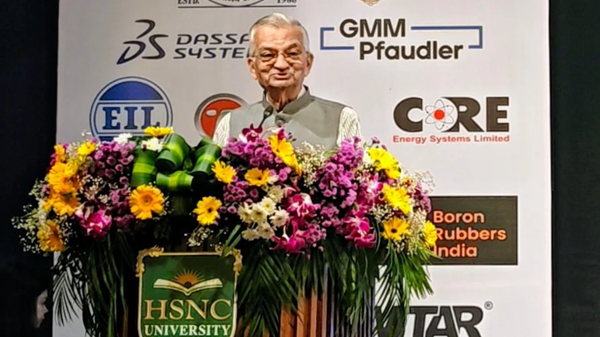
Mumbai, October 29, 2026: The SHANTI Act could open new opportunities for private investment, industry participation and technology development in India’s nuclear energy sector. This was highlighted by Dr. Anil Kakodkar, former Chairman of the Atomic Energy Commission of India.
Speaking at the inaugural session of INSAC-2026 in Mumbai, Dr. Kakodkar highlighted the importance of the Act in supporting India’s ambitious 100 GWe nuclear energy mission. He stressed that achieving this target would require more than government funding and institutional support. India must also bring more stakeholders into the nuclear ecosystem. “The SHANTI Act has come in very timely,” Kakodkar said. He emphasised the need to mobilise additional financial resources and expand participation in the sector.
SHANTI Act: Private Capital to Support Nuclear Expansion
Dr. Kakodkar noted that India’s nuclear expansion would require substantial investment. Government funding and existing institutional resources alone may not be enough to achieve the 100 GWe target. Therefore, private investment and wider industry participation will be important. The SHANTI Act could create opportunities for more organisations to contribute to the nuclear program.
NPCIL will continue to play a central role in implementing the programme. However, public sector undertakings (PSUs) and private companies could also take on larger roles. As a result, the nuclear industry must prepare for a wider ecosystem of investors, technology providers and industrial partners.
SHANTI Act: Opportunities Beyond Conventional Nuclear Power
Dr. Kakodkar also pointed out that the opportunities under the SHANTI Act go beyond conventional nuclear power plants. He highlighted the scope for research and development across large reactors, small modular reactors and micro reactors. These areas could create new opportunities for technology development and innovation. He also referred to activities related to fusion reactors. Although commercial fusion power remains a technological challenge, this field offers scope for further research and development. These provisions could attract research institutions, technology developers and new companies to the nuclear sector.
SHANTI Act: Startups and Nuclear Technology Development
Dr. Kakodkar highlighted the growing interest among entrepreneurs and startups in India’s nuclear sector. He observed that several startups have already entered this emerging space. With opportunities in research, development and different reactor technologies, more companies could become part of the nuclear ecosystem. Thus, participation need not remain limited to traditional nuclear power organisations.
However, he stressed that legislation alone cannot deliver these opportunities. The nuclear community must take the initiative to turn them into practical outcomes. This will require active participation from government organisations and private industry.
SHANTI Act: Building a Wider Nuclear Industry Ecosystem
Dr. Kakodkar’s INSAC 2026 address underlined the need for wider industry participation in achieving India’s 100 GWe nuclear energy target. NPCIL will remain central to the programme. At the same time, PSUs, private companies, startups and research institutions will have important roles to play. Therefore, India must strengthen coordination across the nuclear ecosystem. This will help convert policy opportunities into investment, innovation and industrial growth.
Concluding his remarks, Dr. Kakodkar called on both government organisations and private industry to take responsibility for India’s nuclear energy ambitions. His message at INSAC-2026 was clear: India’s nuclear expansion will need more investment, greater innovation and wider industry participation.
INSAC-2026: Advancing India’s Nuclear Energy Vision Towards 2047
India stands at a defining juncture in its development journey, guided by the national vision of Viksit Bharat @2047. As the country moves towards the centenary of its independence, nuclear energy is expected to play a pivotal role in building a resilient, sustainable and energy-secure future. The Government of India’s announcement of a national mission targeting 100 GWe of nuclear power capacity by 2047 marks a significant policy initiative. The opening of the nuclear sector to private participation, supported by the SHANTI Act, further strengthens opportunities for investment, innovation and industrial development. At the same time, India’s focus on advanced nuclear technologies, including fast breeder reactors, Small Modular Reactors (SMRs), high-temperature gas-cooled reactors and molten salt breeder reactors, along with the utilisation of its vast thorium resources, reflects its long-term commitment to energy security and sustainability. Against this backdrop, the Indian Nuclear Society Annual Conference 2026 (INSAC-2026) aims to serve as a premier global platform for bringing together policymakers, scientists, researchers and industry leaders to discuss these developments, exchange knowledge and develop actionable pathways for advancing nuclear science and technology for national and global benefit.