
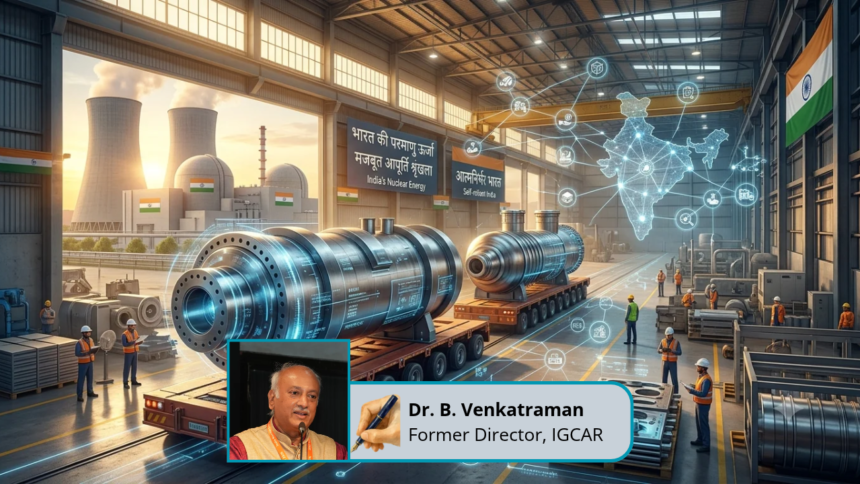
Long lead times, a limited pool of qualified manufacturers, strict material requirements, regulatory clearances and geopolitical risk will shape how quickly India can build new nuclear capacity.
India’s nuclear power expansion will depend on more than reactor designs, project approvals and construction schedules. It will also depend on whether the right materials, equipment and qualified components are available when projects need them.
This makes the nuclear supply chain a strategic priority. A delay in a single critical component can push back installation and every activity that follows. A shortage of qualified suppliers can narrow procurement options. And a long manufacturing cycle can move delivery well beyond the date the project team expected.
Scale of the Task
India’s installed nuclear capacity stands at 8,780 MW. The Government aims to raise this to 22,380 MW by 2031–32 and to 100 GWe by 2047. The nearer target depends on completing ten indigenous 700 MWe Pressurised Heavy Water Reactors (PHWRs), approved in 2017 for construction in fleet mode, alongside further VVER units at Kudankulam. Building at this pace places heavy, simultaneous demands on a small group of fabricators, including Larsen & Toubro (L&T), BHEL and Godrej & Boyce. Their throughput must grow with the programme, or component backlogs will follow.
Long Lead Times, Limited Capacity
Nuclear power plants require specialised equipment, including reactor pressure vessels, steam generators, heat exchangers, large forgings, nuclear-grade valves and pumps, and instrumentation and control systems. These demand advanced manufacturing capabilities, strict quality controls and extensive inspection, and production capacity cannot always expand as quickly as project demand.
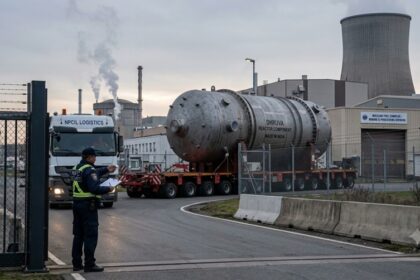
Large forgings show why. The biggest reactor pressure vessel forgings start as steel ingots of 500–600 tonnes, worked on presses of 14,000 tonnes or more, a capability few companies worldwide possess. In 2007, Japan Steel Works could make about four vessel sets a year at its Muroran plant; tripling that to twelve took an investment of about ¥80 billion and was completed only in 2011. In India, L&T’s heavy-forgings facility at Hazira, Gujarat, set up in 2010 as a joint venture with NPCIL and designed for 600-tonne ingots, became wholly owned by L&T in 2025. Such capacity takes years to build and qualify; it cannot be switched on when orders arrive.
Fleet mode reflects this reality. NPCIL has placed bulk orders well ahead of need: BHEL’s 2021 order for 12 steam generators, for example, serves units targeted for completion by 2031. The International Atomic Energy Agency (IAEA), in its Nuclear Supply Chain Toolkit, highlights longer lead times, which the COVID-19 pandemic extended further, along with supplier compliance with nuclear requirements and the management of sub-suppliers. These challenges make procurement planning a project-level concern, not just a purchasing function.
Materials Cannot Simply Be Substituted
The reactor pressure vessel (RPV) houses the reactor core and contains the coolant at pressures over 150 times atmospheric and temperatures around 300 °C. It is a key barrier against the release of radioactivity, and because it cannot practically be replaced, its condition largely decides how long a plant can operate.
Most modern pressurised water reactor vessels are forged from SA-508 Grade 3 Class 1, a manganese-nickel-molybdenum low-alloy steel with a minimum yield strength of 345 MPa. The VVER-1000 units at Kudankulam use the Russian chromium-nickel-molybdenum-vanadium steel 15Kh2NMFA.
A stronger steel exists within the same specification: SA-508 Grade 4N, with a minimum yield strength of 585 MPa. Yet it is not used for operating reactor vessels, because strength is not the governing property. The wall facing the core must retain adequate fracture toughness after 40–60 years of neutron irradiation, which hardens the steel and raises the temperature at which it changes from ductile to brittle behaviour.
The RPV illustrates a wider rule: availability alone is not enough. Materials must meet the applicable specifications and come with the required quality records and traceability. Buyers cannot simply replace an unavailable item with a readily available alternative, because any change may require technical review, verification and approval, and safety-significant changes may need regulatory acceptance. Each step adds time.
Geopolitics and Imported Supply
Where fuel, materials or components come from abroad, supply is exposed to events far outside a project’s control. India knows this from experience. Following the US Nuclear Non-Proliferation Act of 1978, the United States ended nuclear cooperation with India in 1980, including the supply of fuel and spare parts for the Tarapur reactors it had built. Decades of restricted access to international nuclear trade, until the Nuclear Suppliers Group exemption of 2008, also pushed India to build domestic capability in heavy water, fuel and zirconium alloys, capability that today underpins the PHWR programme.
Imported reactors carry similar exposure today. A 2017 audit attributed the more than seven-year delay in the commercial operation of Kudankulam Units 1 and 2 partly to delayed supply of equipment and working documents by the overseas partner. In 2022, the Government told Parliament that the conflict in Ukraine was likely to affect the schedule of later units, citing logistics and ocean freight problems for components from Russia and Ukraine. Sanctions, export controls, shipping disruptions and payment channels can all lengthen lead times, and for a qualified, design-specific component there may be no ready alternative source.
For imported designs, resilience therefore means ordering long-lead imports early, holding strategic spares, qualifying alternative sources where the design permits and progressively localising components, so that a disruption abroad does not halt construction at home.
Qualification and Regulatory Clearance
Not every industrial manufacturer can supply nuclear-grade components. Vendors must understand the applicable codes, quality assurance systems, documentation requirements and inspection processes, and must demonstrate consistent control over their manufacturing processes.
Industrial capability is only the first step. Vendor pre-qualification, stage-wise inspection, quality assurance audits and the requirements of the Atomic Energy Regulatory Board (AERB) that every project must satisfy determine the actual pace of delivery. These demands limit the number of qualified suppliers for certain products, and dependence on a small vendor base becomes a real risk when several projects need the same equipment at the same time.
MSMEs and the Cost of Qualification
India’s nuclear growth creates opportunities for domestic manufacturers, including micro, small and medium enterprises (MSMEs). The opportunity lies in identifying suitable product categories, investing in quality systems and developing capabilities that meet nuclear-sector expectations.
Qualification, however, is costly. It needs investment in testing and non-destructive examination equipment, quality systems and trained personnel, with long payback periods and irregular orders. To justify that investment, MSMEs need long-term order visibility, assured offtake and targeted vendor-development support. Expanding this pool of qualified suppliers is central to reducing dependence on a few vendors for critical items.
Planning, Standardisation and Resilience
Developers, engineering teams and suppliers must coordinate well in advance. That means identifying critical items, forecasting demand for major components, reserving supplier capacity, placing orders early and tracking manufacturing progress, while allowing time for qualification, testing and documentation.
Repeat reactor designs help. Standardisation lets manufacturers reuse proven processes, develop dedicated tooling and build experience across successive orders, improving productivity and delivery predictability, provided it remains consistent with approved designs and applicable safety requirements.
Resilience also depends on upstream inputs. India already produces many critical materials domestically; the Nuclear Fuel Complex, for example, manufactures zirconium alloy tubing for PHWRs. Some inputs, however, still come from abroad. Supplier diversification, stronger logistics planning, transparent production schedules and early identification of bottlenecks can reduce exposure to any single supplier or disruption.
From Manufacturing Capability to Delivery Readiness
India’s nuclear expansion will need more than additional factories. It will need a coordinated industrial ecosystem in which project developers, manufacturers, quality professionals, regulators and policymakers plan capacity together, backed by sustained investment, skilled personnel and testing facilities.
The central question is no longer simply whether Indian industry can manufacture a component. It is whether it can qualify, produce, inspect and deliver that component reliably, within the project’s schedule and without compromising nuclear safety or quality. Building this capability today will help India meet future project demand, avoid preventable delays and strengthen the resilience of its nuclear power programme.