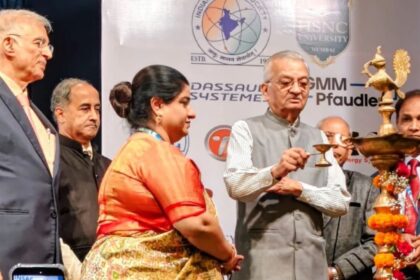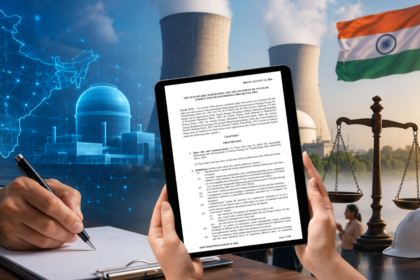

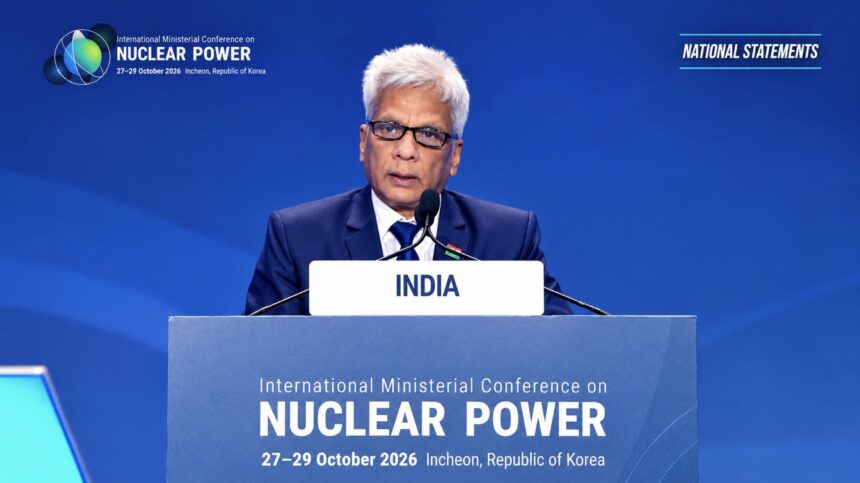
Dr. Ajit Kumar Mohanty’s National Statement highlights India’s three-stage nuclear programme, fast breeder reactor technology (Nuclear Technology) and indigenous Small Modular Reactor development.
India has highlighted its nuclear technology priorities at the International Atomic Energy Agency’s (IAEA) International Ministerial Conference on Nuclear Power in Incheon, Republic of Korea. Dr. Ajit Kumar Mohanty, Chairman of the Atomic Energy Commission and Secretary of the Department of Atomic Energy (DAE), delivered India’s National Statement on 27 October 2026. His statement highlighted India’s three-stage nuclear power programme, the Prototype Fast Breeder Reactor (PFBR) milestone and ongoing efforts to develop indigenous Small Modular Reactor (SMR) technologies.
Fast Breeder Technology (Nuclear Technology) and the Three-Stage Programme
Dr. Mohanty outlined India’s three-stage nuclear power program, which provides the long-term framework for developing the country’s nuclear resources. He also highlighted the achievement of criticality by the 500 MWe Prototype Fast Breeder Reactor (Nuclear Technology). The milestone represents progress in India’s development of fast breeder reactor technology. Fast breeder technology has strategic importance within India’s long-term nuclear programme. Its development is linked to the country’s plans for the phased utilisation of domestic nuclear resources.
Indigenous SMRs Remain on India’s Agenda
India is also advancing indigenous Small Modular Reactor technologies (Nuclear Technology) for diverse energy applications, according to the DAE statement. SMRs are attracting attention for their potential applications across different electricity and industrial energy requirements. Their eventual deployment will depend on technology development, regulatory approvals, project economics and implementation readiness.
For India’s nuclear industry, this technology pathway could create opportunities in engineering, component manufacturing, specialised materials and other areas of the domestic supply chain. However, the DAE announcement does not specify new SMR project approvals, deployment dates or commercial commitments.
Policy and Energy Security
Dr. Mohanty also highlighted the SHANTI Act 2025 as a significant step in transforming India’s nuclear sector. The statement placed nuclear energy within the wider context of a changing global energy landscape. It described nuclear power as a reliable, low-carbon and environmentally sustainable energy source. India’s Nuclear Energy Mission, with its target of 100 GW of nuclear power capacity by 2047, also featured in the address. The target reflects the country’s long-term ambitions for clean energy and energy security and also having indigenous nuclear technology
India Emphasises International Cooperation
India reaffirmed its commitment to working with the IAEA and international partners. The statement emphasised the importance of aligning energy access, technological progress and global commitments. It also placed India’s domestic nuclear development within the broader international discussion on the future of nuclear power.
For the Indian nuclear industry, the key areas to watch are the development of indigenous reactor technologies (Nuclear Technology), progress in advanced nuclear systems and the practical implementation of policy reforms. The statement reinforces these priorities. However, it does not announce a new reactor project, investment commitment or policy decision. As the global nuclear sector reassesses its role in future energy systems, India’s technology development and industrial capabilities will remain important areas to follow.
Source – DAE