
Jean-Pierre Revol shares observations from his August 2026 visit to China’s thorium molten salt reactor (China’s Thorium Reactor) and accelerator-driven system facilities.
- China’s Thorium Reactor : Inside China’s Experimental Thorium Molten Salt Reactor
- Corrosion, Materials and Fuel Processing
- China’s Thorium Reactor : China’s Next Experimental Reactor
- China’s Accelerator-Driven System (ADS) Programme
- China’s Thorium Reactor : Technical Challenges for Molten Salt Reactors and ADS
- Revol’s Assessment of China’s Research Direction
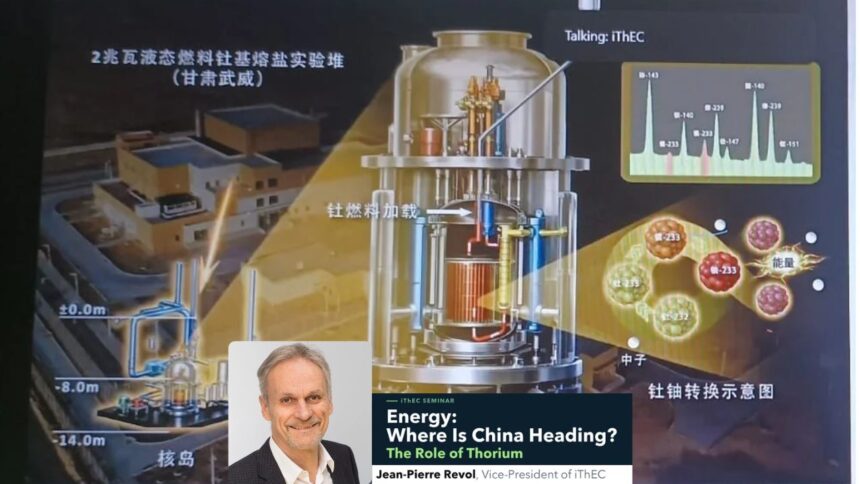
China is advancing research into thorium-based molten salt reactors (China’s Thorium Reactor ) and accelerator-driven systems (ADS) as part of its exploration of future nuclear energy technologies. These developments were discussed by physicist Jean-Pierre Revol during an International Thorium Energy Committee (iThEC) webinar held on 11 November 2026. Revol, a former CERN researcher and founding member of the iThEC – International Thorium Energy Committee, shared observations from his visit to China in August 2026. His presentation covered the experimental Thorium Molten Salt Reactor (TMSR) facility at Wuwei in Gansu Province, China’s ADS research facility in Huizhou, and the technical challenges associated with both technologies.
China’s Thorium Reactor : Inside China’s Experimental Thorium Molten Salt Reactor
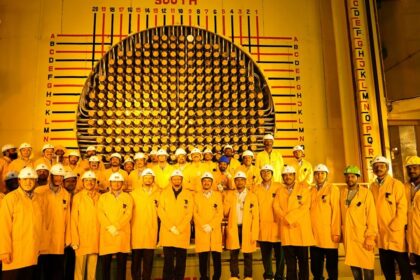
During his visit, Revol travelled to the TMSR research facility at Wuwei, where he was received by the reactor operations team, including Professor Sun Bo. According to Revol’s presentation, the experimental reactor has a thermal power of 2 MW and uses uranium fluoride fuel salt. He reported an operating temperature of approximately 650°C. The facility also has a secondary salt circuit without uranium.
Revol explained the reactor’s fuel-loading arrangements and the systems used to introduce uranium and thorium salts. The facility is designed to support experiments on the production of uranium-233 from thorium-232. At the time of his visit, the reactor contained thorium for experimental studies. Revol described the facility as an experimental platform for investigating thorium utilisation and optimising uranium-233 production.
He also discussed the reactor’s operating arrangements, control room, control rods, emergency shutdown systems and fuel-handling infrastructure. The facility requires a dedicated operating team and specialised systems for handling radioactive materials. One of the features he described was the mechanism for extracting liquid fuel during reactor operation. Fuel samples are withdrawn, cooled and allowed to crystallise before further handling.
Corrosion, Materials and Fuel Processing
Revol identified corrosion as one of the major technical challenges for molten salt reactor development. The reactor provides an experimental platform for studying the behaviour of materials under high-temperature molten salt conditions. He explained that the 2 MW experimental system provides an opportunity to begin such studies, although its neutron flux is limited.
Another important area is the temperature margin between normal operation and salt crystallisation. Revol discussed the reactor’s operating temperature and the time available for the system to cool following a loss of electrical power. He also described ongoing work on the reactor’s fusible plug. According to his presentation, the plug was not yet considered operational because its performance still needed to be demonstrated. Online fuel processing is another major development requirement. The technology involves extracting and treating liquid fuel while managing radioactive materials and maintaining the required operating conditions. Revol also referred to hot-cell facilities used to handle highly radioactive fuel samples and other materials under controlled conditions.
China’s Thorium Reactor : China’s Next Experimental Reactor
During his visit, Revol observed an area identified for a proposed follow-on reactor, referred to as LF2. According to his presentation, the proposed reactor would have approximately four times the power of the existing experimental system. However, Revol stated that its status was still under discussion and that, to his knowledge, it had not yet received approval. The Wuwei site also houses other research activities, including work related to high-temperature hydrogen production and thermal energy storage using molten salts.
China’s Accelerator-Driven System (ADS) Programme
Revol also visited China’s experimental ADS facility in Huizhou, Guangdong Province. The facility is associated with the China Accelerator Driven System programme. An accelerator-driven system uses a high-energy particle accelerator to generate a proton beam. When the beam strikes a spallation target, it produces neutrons that can drive a subcritical reactor core.
During the webinar, Revol described the facility’s accelerator infrastructure, spallation target system and proposed subcritical core arrangements. He also explained the project’s research objectives. These include improving uranium utilisation, transmuting nuclear waste, particularly minor actinides, conducting proton and neutron irradiation experiments, collecting nuclear data and developing other research applications.
Revol described the Chinese programme as a multi-phase development effort. He explained that the accelerator was ready and being commissioned, while the containment structure and design of the subcritical core were also ready. However, construction of the core system was still subject to safety discussions and approval. Revol emphasised that construction could not proceed until the relevant safety aspects had been understood and addressed.
China’s Thorium Reactor : Technical Challenges for Molten Salt Reactors and ADS
Revol identified different engineering challenges for the two technologies. For molten salt reactors, key challenges include:
- Corrosion of structural materials under high-temperature salt conditions.
- Online fuel processing and treatment.
- Control of reactivity during fuel circulation.
- Management of temperature changes and salt crystallisation.
- Demonstration of the performance of safety-related systems, including the fusible plug.
- Remote handling and maintenance of radioactive fuel and components.
For ADS, the major challenges include accelerator reliability, coupling a high-power proton beam with a subcritical core, and managing interruptions in accelerator operation. He also discussed the importance of materials performance and the challenges associated with maintaining systems exposed to demanding operating conditions.
Revol’s Assessment of China’s Research Direction
In his concluding remarks, Revol highlighted China’s emphasis on fundamental research and its systematic exploration of different energy technologies. He described China’s approach as pragmatic, with simultaneous development of several energy sources, including solar, wind, hydro and nuclear power.
Revol argued that thorium could become increasingly important in the future for two reasons: the need to improve the utilisation of nuclear fuel resources and the potential role of advanced systems in nuclear waste transmutation. He also stressed the importance of preparing for future energy requirements through sustained research and international collaboration.